 France
“Pépé le Moko review – mysterious and passionately despairing French noir with a luminous Jean Gabin.”
The Guardian
The Guardian
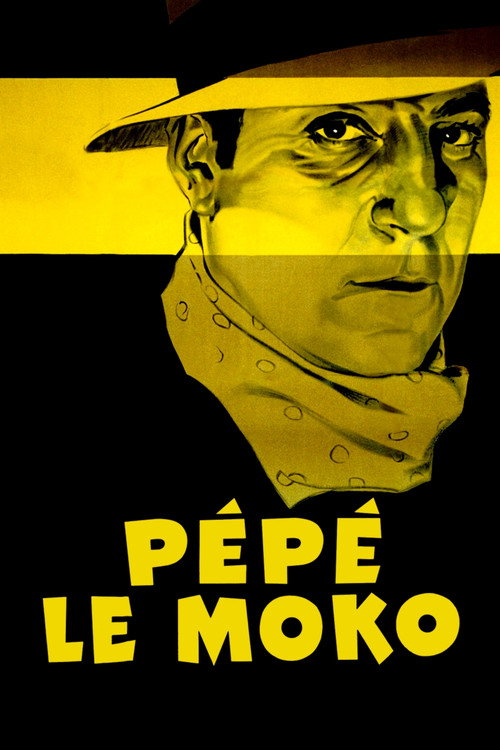
Julien Duvivier's 1937 crime drama, Pépé le Moko, plunges viewers into the labyrinthine alleys of Algiers' Casbah, a territory where French police fear to tread. The film centers on its titular character, a notorious gangster played with magnetic intensity by Jean Gabin. Pépé, a man on the run and a constant headache for law enforcement, finds himself trapped in the very district he controls. His carefully constructed life of crime, however, is thrown into disarray when he encounters Gaby, a captivating Parisian woman played by Mireille Balin, who has become lost in his world.
This atmospheric picture, shot in stark black and white, captures the gritty reality of its setting and the romantic fatalism that defines its characters. Duvivier, working from a story that would later inspire the Hollywood remake Algiers, crafts a story of love, betrayal, and inescapable destiny. The film was a significant production for Paris Film Production, earning $155,895 at the box office. Its critical standing is evident in its solid rating, reflecting a film that resonated deeply with audiences and critics alike for its potent blend of crime thriller and tragic romance.
Stream
Criterion Channel
Rent
Apple TV
Amazon Prime Video
Google Play
YouTube
Vudu
Availability and pricing can change. Confirm on the provider's site before purchasing.
Set within the dense, maze-like Casbah of Algiers, a district considered off-limits to the French police, Pépé le Moko introduces us to its charismatic and infamous namesake. Pépé le Moko, portrayed by Jean Gabin, is a master criminal hiding out in this sanctuary after a string of audacious robberies in Paris. Though constantly evading capture, he reigns supreme within the Casbah, commanding the unwavering loyalty of his gang and the respect of the local population. His life is a delicate balance of power and confinement; he is protected by the very walls that imprison him, unable to step outside without facing immediate arrest.
Pépé's existence in the Casbah is marked by a paradoxical blend of authority and isolation. He is surrounded by his devoted crew, including his lover Inès, his right-hand man Pierrot, and other associates like L'Arbi and Jimmy. However, his every move is observed by Inspector Slimane, an astute Algerian police inspector who possesses an intimate understanding of the Casbah's unique social fabric and is determined to apprehend Pépé. Slimane employs a strategy of calculated patience and psychological insight, recognizing that Pépé's own pride and growing sense of ennui could prove to be his downfall.
The narrative takes a critical turn with the arrival of Gaby, an elegant Parisian woman accompanied by her affluent fiancé, Max. Gaby, feeling a profound sense of boredom and disillusionment with her superficial high-society life, finds herself unexpectedly captivated by the exotic, dangerous allure of the Casbah. Her encounter with Pépé is charged with immediate chemistry, sparking a passionate romance. Gaby represents a portal to the outside world, a glimpse of the freedom and sophistication that Pépé has long been denied. For Pépé, she becomes a symbol of escape, a potential path away from his self-imposed prison.
However, Pépé's deepening infatuation with Gaby proves to be a significant vulnerability. His gang members, particularly Pierrot, begin to notice his preoccupation and the subtle erosion of his authority within the Casbah. Concurrently, Inspector Slimane keenly observes that Pépé's obsession with Gaby is his most exploitable weakness. Slimane begins to carefully orchestrate events, subtly exacerbating Pépé's entanglement with Gaby while simultaneously intensifying the pressure on him. The escalating romantic tension between Pépé and Gaby, set against the backdrop of the Casbah's volatile atmosphere and the persistent threat of police intervention, cultivates an overwhelming sense of impending doom. Pépé finds himself increasingly torn between his obligations to his gang, his profound desire for Gaby, and the gnawing certainty that his fate is irrevocably tied to the confines of the Casbah.
Official Trailer [Subtitled]
Critical Consensus
A seminal work of French poetic realism, Pépé le Moko masterfully blends crime drama with tragic romance. Jean Gabin delivers an unforgettable performance as a gangster trapped by his legend and the allure of a Parisian woman, creating a darkly romantic and fatalistic crime narrative.
“Pépé le Moko review – mysterious and passionately despairing French noir with a luminous Jean Gabin.”
The Guardian
The Guardian
“One of the masterpieces of the poetic realist movement that flourished in French cinema of the 1930s.”
TCM Staff
TCM
“A terrific proto-noir film about a gangster hero trapped in the impenetrable Casbah of Algiers, a criminal enclave where the police dare not tread.”
Reddit user
Jean Gabin
Pépé le Moko
Mireille Balin
Gaby, the Parisian
Gabriel Gabrio
Carlos
Lucas Gridoux
Inspector Slimane
Gilbert Gil
Pierrot
Line Noro
Inès, Pépé's mistress
Saturnin Fabre
The Great Father
Fernand Charpin
Régis
Marcel Dalio
L'Arbi
Charles Granval
Maxime
Gaston Modot
Jimmy
René Bergeron
Meunier
Director
Julien Duvivier
Writers
Henri Jeanson, Jacques Constant, Henri La Barthe, Julien Duvivier
Composers
Vincent Scotto, Mohamed Iguerbouchène
Cinematographers
Marc Fossard, Jules Kruger
Producers
Raymond Hakim, Robert Hakim
Join the community
fans discussing