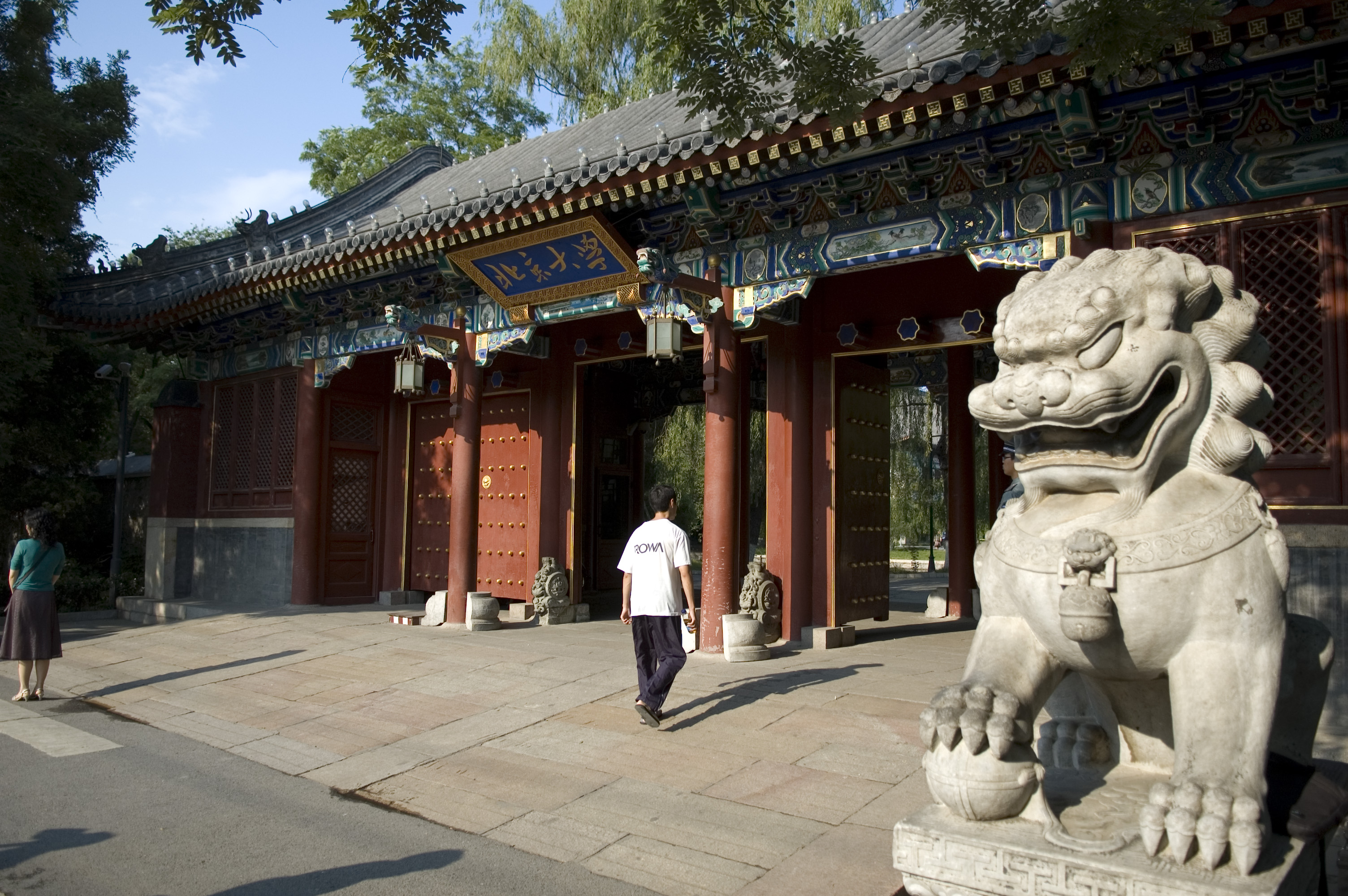
Peking University
 Taiwan
"A leading Chinese research university with a 125-year legacy of intellectual and political influence"
About
Peking University, commonly known as PKU or Beida, sits in Haidian District, Beijing, surrounded by more than a dozen other major universities. It operates as a public research institution under China's Ministry of Education and holds membership in the C9 League, Project 211, Project 985, and the Double First-Class Construction. These affiliations place it at the center of the country's academic elite.
The university's roots go back to July 3, 1898, when the Guangxu Emperor issued a royal charter creating the Imperial University of Peking during the Hundred Days' Reform. That makes it the second-oldest university in China, behind only Tianjin University. After the Qing dynasty fell in 1912, the new Republic of China government renamed it Peking University. Its current campus, originally the site of Yenching University, became home to the institution in the 1950s.
PKU is a comprehensive university with strengths across the humanities, sciences, engineering, and social sciences. It consistently lands near the top of global rankings: #13 in the QS World University Rankings 2027 and #19 in US News Best Global Universities. The university also draws international attention through its English-language website and an active recruitment effort for overseas students, with a dedicated portal at studyatpku.com.
Mission
Peking University aims to cultivate talent with a global perspective and a deep sense of social responsibility. It seeks to advance knowledge through cutting-edge research across disciplines, while preserving and promoting China's cultural heritage. The university is committed to serving national development and contributing to global academic exchange.
History
Peking University began as the Imperial University of Peking, created by royal charter in 1898 as part of the Hundred Days' Reform, an attempt by the Qing court to modernize after military defeats. The reform was short-lived, but the university survived, becoming a center for new learning. In 1912, after the Qing fell, it took the name Peking University.
During the May Fourth Movement in 1919, PKU students led protests against the Treaty of Versailles, which handed German concessions in Shandong to Japan. That movement ignited a wave of nationalism and cultural change, and the university became a hub for progressive thinkers like Chen Duxiu and Li Dazhao, who later helped found the Chinese Communist Party.
In the 1950s, PKU moved to its current campus in Haidian, the former site of Yenching University, a Christian university that merged into PKU. The relocation allowed for expansion. Over the following decades, the university grew in size and reputation, especially after China's economic reforms began in 1978.
Recent milestones include the 2023 completion of a new School of Mathematical Sciences building, designed by FEI Architects after eight years of work. In 2026, mathematician Hong Wang won the Fields Medal, a first for a PKU-affiliated researcher, sparking national pride and debate about math education in China.
Subdivisions
School of Mathematical Sciences
One of PKU's most prestigious departments, known for producing top mathematicians, including 2026 Fields Medalist Hong Wang.
School of Physics
A leading physics department in China, with research in condensed matter, quantum optics, and particle physics.
College of Chemistry and Molecular Engineering
A hub for chemical research, with strengths in organic synthesis, materials chemistry, and chemical biology.
School of Life Sciences
Focuses on molecular biology, genetics, and ecology, with strong ties to China's biotechnology sector.
College of Urban and Environmental Sciences
Researches urban planning, environmental policy, and sustainable development, often collaborating with government agencies.
School of Earth and Space Sciences
Studies geology, geophysics, and planetary science, contributing to China's space program and resource exploration.
School of Psychological and Cognitive Sciences
A newer school dedicated to neuroscience, cognitive psychology, and behavioral research.
School of Electronics Engineering and Computer Science
Offers programs in computer science, artificial intelligence, and electrical engineering, with a strong industry tie-in.
College of Engineering
Covers mechanical, energy, and aerospace engineering, emphasizing innovation and applied research.
School of Software & Microelectronics
Specializes in software development, chip design, and microelectronics, supporting China's tech industry.
Department of Chinese Language and Literature
A historic department central to modern Chinese literary studies and language education.
Department of History
Offers rich programs in Chinese and world history, with a focus on historical methodology.
School of Archaeology and Museology
Known for fieldwork in Chinese archaeology and heritage preservation.
Department of Philosophy and Religious Studies
Explores both Chinese and Western philosophical traditions, including Confucianism and Buddhism.
School of Foreign Languages
Teaches over 20 languages, from English and French to less common ones like Swahili, preparing diplomats and translators.
Notable People
Hong Wang
Mathematician · 2026 Fields Medal
One of four recipients of the 2026 Fields Medal, the highest honor in mathematics, for work on partial differential equations.
Gong Qihuang
Chairman · Present
Physicist and current chairman of Peking University's governing body, overseeing the university's strategic direction.
Empress Dowager Cixi
Founder (associated) · 1898
Historical figure associated with the university's founding during the Hundred Days' Reform, though the charter came from the Guangxu Emperor.
Chen Duxiu
Dean of Humanities (historical) · 1917-1919
Co-founder of the Chinese Communist Party and a leading intellectual during the May Fourth Movement.
Li Yan
Historian of Chinese mathematics · 1920s-1960s
Pioneered the study of traditional Chinese mathematics at PKU, authoring influential works on the subject.
Milestones
1898
Founded as the Imperial University of Peking by royal charter from the Guangxu Emperor during the Hundred Days' Reform.
1912
Renamed Peking University after the fall of the Qing dynasty.
1919
Students lead the May Fourth Movement, establishing PKU as a center of political and cultural activism.
1952
Moved to the former Yenching University campus in Haidian District, merging with Yenching's arts and sciences faculties.
2023
New School of Mathematical Sciences building completed, designed by FEI Architects.
2026
Mathematician Hong Wang wins the Fields Medal, the first for a PKU-affiliated researcher.
Departments
Sources
Organization Info
- Founded
- +1898-07-03
- Headquarters
- Haidian District, Beijing, People's Republic of China
- Country
- People's Republic of China
- Chairman
- Gong Qihuang
- Parent
- Ministry of Education of China
- Type
- University
- Employees
- 4206
- Founder
- Empress Dowager Cixi
- QS Ranking 2027
- #13
- US News Ranking
- #19
Financials
- Employees
- 4206
Official Website
pku.edu.cn
Join the community
fans discussing