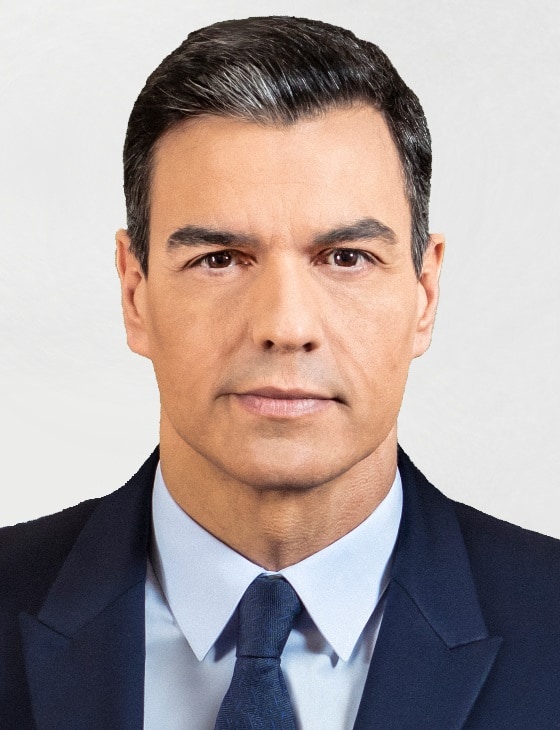
Pedro Sánchez
 Spain
Spainpolitician•economist•university teacher
Birthday
February 29, 1972
Birth Sign
Sagittarius
Birthplace
Madrid, Spain
Age
54 years old
About
Pedro Sánchez is a Spanish politician and economist who has served as Prime Minister of Spain since 2018 and leads the Spanish Socialist Workers' Party (PSOE). His rise to power was one of the more dramatic stories in recent European politics. After losing the party leadership amid internal revolt, he staged a remarkable comeback by appealing directly to the membership, reclaimed control of the party, and then seized the premiership through a no-confidence vote against his conservative predecessor, all without having won a general election at the time.
Sánchez has since governed largely at the head of fragile coalition and minority arrangements, displaying notable resilience and tactical skill in holding together support from a patchwork of left-wing and regional parties. His tenure has been marked by progressive social legislation, navigation of the COVID-19 pandemic, and contentious negotiations over the status of Catalonia, including controversial amnesty measures that drew fierce opposition. Admirers credit him with a survivor's instinct and a steady pro-European stance; critics accuse him of opportunism and of relying on uncomfortable political bargains to stay in power.
A polarizing figure in Spain's divided politics, he has repeatedly defied predictions of his downfall. As of 2026, Sánchez remains a central and combative presence in Spanish public life and a prominent voice within the European social-democratic movement.
Early Life & Background
Sánchez grew up in a stable, middle-to-upper-class household in Madrid. His father was a senior public administrator who later owned an industrial packaging company; his mother worked as a civil servant before becoming a lawyer. As a kid, Sánchez dreamed of becoming a professional basketball player, a pursuit he kept up until his early 20s.
He studied business and economics at Complutense University of Madrid, then completed postgraduate work at the Free University of Brussels and the Ortega y Gasset University Institute. In 1993, he joined the PSOE. Between 1998 and 1999, he advised the European Parliament and served as chief of staff to the United Nations high representative for Bosnia and Herzegovina during the Kosovo conflict. He then taught economics at university level while staying active in Madrid politics.
His first elected office came in 2004 as a Madrid city councilor. He entered the Spanish Parliament in 2009, lost his seat in 2011, and returned to academia to finish a Ph.D. in economics and business at Camilo José Cela University in 2012.
Career Growth
Sánchez returned to Parliament in 2013 and became PSOE secretary-general the following year. But his first stint as party leader ended in 2016 after a bitter internal rebellion. Rather than fade away, he campaigned directly to the party membership and won back the leadership in 2017.
In June 2018, Sánchez pulled off what no one expected: he tabled a no-confidence motion against conservative Prime Minister Mariano Rajoy, won it, and became Spain's head of government without having contested, let alone won, a general election. He was the first Spanish prime minister to take office that way.
Once in power, he formed a minority government and later a coalition with the left-wing Unidas Podemos. His administration raised the minimum wage, expanded gender-equality measures, and steered the country through the COVID-19 pandemic. He also faced the Catalan independence crisis head-on, granting pardons to jailed separatist leaders and later pushing through a controversial amnesty law in exchange for parliamentary support. In March 2023, he survived a no-confidence vote of his own. Through 2026, Sánchez continues to govern, navigating coalition strains and regional tensions.
Career Timeline
Public Image & Style
Sánchez presents a clean-cut, professional image typical of a modern European social-democratic leader. His communications blend official government addresses, parliamentary speeches, and active social media presence on Instagram, X, and Facebook.
Media portrayals split sharply along Spain's political divide. Supporters see a resilient survivor who kept the left in power against long odds; detractors paint him as an opportunist willing to strike uncomfortable deals with Catalan separatists and far-left parties to hold onto office. His approval ratings have fluctuated but never collapsed, and he has repeatedly outlasted predictions of his political death.
No formal fandom name exists, but his base within the PSOE membership remains loyal, energized by his direct relationship with party grassroots.
Fame & Fandom
Pedro Sánchez commands a political base rather than a traditional fandom, lacking an organized fan community with formal names or rituals typical of entertainment icons. His influence is measured through legislative outcomes and diplomatic engagements rather than chart metrics or fan-funded projects. Despite this structural difference in his public following, the iFANN Global Fame Rankings place him among the most recognized figures on the planet. He stands as the 1st most famous person in Spain, a position he holds steady from the previous cycle. This domestic prominence extends across the continent, where he ranks as the 10th most famous person in Europe. On a global scale, he is the 275th most famous person in the world, maintaining that standing since the last assessment. Within his specific sector, he is the 43rd most famous person in Politics, while also holding the 13th spot for the most famous person from Spain. These placements reflect a broad reach tracked across media coverage, search activity, and consumption signals worldwide. The rankings confirm that while his support is channeled through the Spanish Socialist Workers' Party and official government channels, his individual name recognition rivals that of many cultural celebrities.
Interesting Facts and Legends
Born on February 29, Pedro Sánchez celebrates his actual birthday only once every four years, observing it on either February 28 or March 1 during non-leap years. His early ambition was not politics but professional basketball, a career he pursued seriously until his early twenties before switching paths. He shares this rare leap day birthday with serial killer Richard Ramirez, a coincidence the Prime Minister has never publicly addressed. His mother, Magdalena Pérez-Castejón, graduated from the same institution as her son: Complutense University of Madrid. Sánchez holds the distinction of being the first Spanish prime minister in modern history to assume office without having won a general election. In the realm of political mythology, the Ceuta Migration Crisis of August 2026 stands as a defining legend. During this event, Sánchez refused to close borders despite an unprecedented diplomatic rift involving a letter signed by 22 EU leaders criticizing his humanitarian stance. This moment cemented his reputation as a progressive outlier willing to face international isolation for his principles. Another notable chapter in his lore emerged in June 2026 when a corruption probe led to his wife being legally forbidden from leaving the country, shattering the image of invincibility surrounding his tenure. Additionally, financial reports from August 2026 described a maneuver where the King of Spain effectively outmaneuvered the Prime Minister, adding a layer of constitutional drama to his public narrative.
Family & Personal Life
Sánchez's father, Pedro Sánchez Fernández, was a senior public administrator at the National Institute of Performing Arts and Music under the Ministry of Culture before becoming the owner of an industrial packaging company. His mother, Magdalena Pérez-Castejón, worked as a civil servant in social security before qualifying as a lawyer. He grew up in Madrid with a comfortable middle-to-upper-class upbringing.
He married María Begoña Gómez Fernández in 2006. She is a Spanish businesswoman and academic. The couple has two daughters. In June 2026, a Spanish judge ordered Begoña Gómez to face a corruption trial and surrender her passport, a development that drew intense media scrutiny and became a political flashpoint.
Notable Connections
Sánchez's political career is closely tied to Mariano Rajoy, whom he unseated in 2018. He works regularly with King Felipe VI, the head of state, and has collaborated with European leaders Emmanuel Macron and Ursula von der Leyen. His wife, Begoña Gómez, has been a central figure in recent legal and political controversies.
Relationships & Dating History
Sánchez married María Begoña Gómez Fernández in 2006. She is a Spanish businesswoman and academic, and the couple has two daughters together. Their marriage has been under the spotlight since June 2026, when a Spanish judge ordered Begoña Gómez to face a corruption trial and surrender her passport. The proceedings have become a major political issue, with Sánchez defending his wife's presumption of innocence. As of 2026, the marriage remains ongoing.
- MarriedBegoña Gómez2006 - presentCurrentMarried in 2006; two daughters together; she faces a corruption trial as of 2026.
Awards & Accolades
Known For
Prime Minister of Spain
2018 · Head of Government
Secretary-General of PSOE
2014 · Party Leader
Keywords
Sources
Quick Facts
- Profession
- politician, economist, university teacher
- Born
- +1972-02-29
- Birthplace
- Madrid
- Gender
- Male
- Spouse
- Begoña Gómez
- Birth Sign
- Sagittarius
Personal Details
- Full Name
- Pedro Sánchez Pérez-Castejón
- Spouse
- Begoña Gómez
- Children
- 2 daughters
- Education
- Complutense University of Madrid (business and economics), Free University of Brussels (postgraduate), Ortega y Gasset University Institute (postgraduate), IESE Business School, Camilo José Cela University (Ph.D. in economics and business, 2012)
Frequently Asked Questions
How old is Pedro Sánchez?
Is Pedro Sánchez married?
What is Pedro Sánchez's net worth?
How did Pedro Sánchez become Prime Minister?
Does Pedro Sánchez have children?
Social Media
Join the community
fans discussing