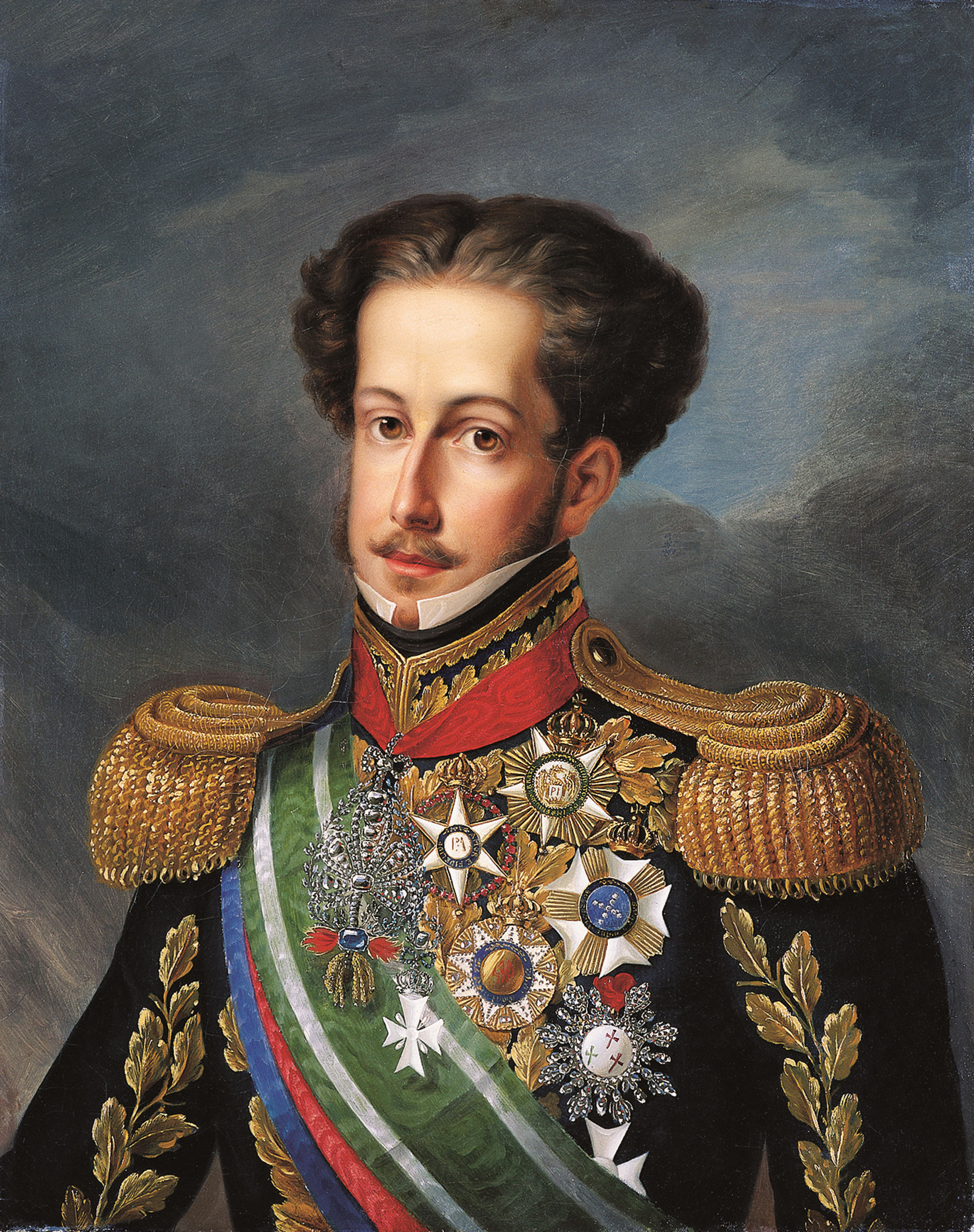
Pedro I of Brazil
 Brazil
Birthday
+1798-10-12
Birth Sign
Libra
Birthplace
Palace of Queluz
Age
Died at 35
About
Born in Lisbon on October 12, 1798, Pedro I was a pivotal figure in the history of both Brazil and Portugal. As the fourth child of King Dom John VI and Queen Carlota Joaquina, he was a member of the House of Braganza. His early life took a dramatic turn in 1807 when Napoleon's invasion forced his family to flee to Brazil, then the Portuguese empire's largest colony. This move would profoundly shape his destiny. Pedro's political career truly ignited in 1821 when his father returned to Portugal, leaving him as regent of Brazil. He faced considerable unrest, from revolutionary factions to insubordinate Portuguese troops, but managed to quell these challenges. When the Portuguese government threatened to curtail Brazil's autonomy, Pedro made a decisive choice. On September 7, 1822, he declared Brazil's independence, an act that earned him the title "the Liberator" in Brazil. He was acclaimed Emperor on October 12, 1822, and by March 1824 had secured Brazil's sovereignty, defeating loyalist armies and suppressing the Confederation of the Equator uprising in the northeast. His reign, however, was marked by significant challenges. A secessionist movement in Cisplatina led to the costly Cisplatine War against the United Provinces of the Río de la Plata, ultimately resulting in Brazil's loss of the territory. In 1826, he briefly held the Portuguese throne as Pedro IV before abdicating in favor of his daughter, Maria II. Political struggles within Brazil, particularly over the balance of power between the monarch and legislature, coupled with personal scandals, strained his rule. On April 7, 1831, Pedro I abdicated the Brazilian throne in favor of his young son, Pedro II, and sailed back to Europe to fight for liberal causes. In Portugal, he led an army in 1832, becoming embroiled in a conflict between liberals and absolutists. He emerged victorious in this struggle just months before his death from tuberculosis on September 24, 1834. Pedro I's life was a whirlwind of political upheaval and royal duty, leaving a lasting impact on the political landscapes of both Brazil and Portugal.
Fame & Fandom
Pedro I of Brazil does not command a modern fanbase in the way contemporary celebrities do. There are no organized social media campaigns, birthday billboards, or dedicated forums where fans debate his merits. As an 18th and 19th-century monarch, he cannot interact with admirers, nor does a specific group rally behind him as a pop culture icon. Interest in his life remains the domain of historians, students, and the general public during national commemorations rather than a fervent fandom. Yet his presence persists through the tangible relics of his reign and the unique mythos surrounding his final journey. The most striking chapter of this legacy unfolded in August 2022 when his embalmed heart returned to Rio de Janeiro for the bicentennial of Brazil's independence. After nearly two centuries resting in Lisbon, the organ traveled across the Atlantic as a state guest, drawing crowds eager to witness the physical fragment of the nation's founder. This event transformed historical fact into a living narrative of reconciliation and homecoming. Today, Pedro I stands as a figure of immense historical weight whose fame is measured by his foundational role rather than viral trends. According to the iFANN Global Fame Rankings, he is currently the 45th most famous person in Brazil, up from the previous cycle. He also holds the position of the 61st most famous person from Brazil, holding steady from the previous cycle. In the realm of creative achievement, he ranks as the 75th most famous person in Art & Design, holding steady from the previous cycle.
Interesting Facts and Legends
Dom Pedro I was not only a ruler but also a prolific composer and poet who penned works while navigating the turbulent politics of the early 19th century. His musical contributions often reflected the romantic spirit of his era, blending personal emotion with nationalistic themes. A legendary aspect of his story involves the declaration of Brazil's independence on September 7, 1822, where he famously proclaimed "Independence or Death" near the Ipiranga River. This moment remains etched in Brazilian consciousness as the birth of the nation. More recently, a verified and widely retold event reshaped his modern legend: the return of his embalmed heart to Brazil in August 2022. Separated from his body at death in 1834, the heart had resided in Portugal for almost 200 years before being loaned back for the bicentennial celebrations. Brazilians flocked to the National Museum in Rio to view the relic, treating its arrival as a symbolic homecoming for the first emperor. While his body rests in São Paulo, the heart's journey created a unique cultural moment where the nation collectively engaged with a tangible piece of its founding history.
Death & Aftermath
Died
+1834-09-24 (aged 35)
Death Place
Lisbon, Portugal
Cause of Death
Pulmonary tuberculosis
Pedro I of Brazil died on September 24, 1834, in Lisbon, Portugal. For months, his health had crumbled under the weight of pulmonary tuberculosis, a chronic disease that forced him into bed by August. He spent his final days confined to the palace, attended only by royal physicians who monitored his decline through clinical observation. His last public appearance remained the abdication of the Brazilian throne in April 1831, after which he retreated from the political stage until illness claimed him. The news triggered profound mourning across both nations he once ruled. In Brazil, where he was revered as the Liberator, and in Portugal, where he had briefly served as King Dom Pedro IV, officials issued tributes acknowledging his dual legacy.
State funerals followed shortly after his death, with religious services honoring his status as a former sovereign. The burial took place at the Monastery of São Vicente de Fora, interred within the Royal Pantheon of the House of Braganza. A private yet state-organized affair, the ceremony included members of the royal family, high-ranking clergy, and government officials. Posthumous recognition has endured for centuries through statues, street names, and educational institutions dedicated to his memory in both countries. Historical scholarship continues to cite him as a pivotal figure in South American and European history. His estate passed to the Portuguese royal succession, distributed according to the laws of the Braganza dynasty.
Awards & Accolades
Keywords
Quick Facts
- Profession
- politician, composer, poet
- Born
- +1798-10-12
- Birthplace
- Palace of Queluz
- Died
- +1834-09-24
- Death Place
- Palace of Queluz
- Gender
- Male
- Spouse
- Maria Leopoldina of Austria, Empress Amélie of Brazil
- Birth Sign
- Libra
Personal Details
- Spouse
- Maria Leopoldina of Austria, Empress Amélie of Brazil
Join the community
fans discussing