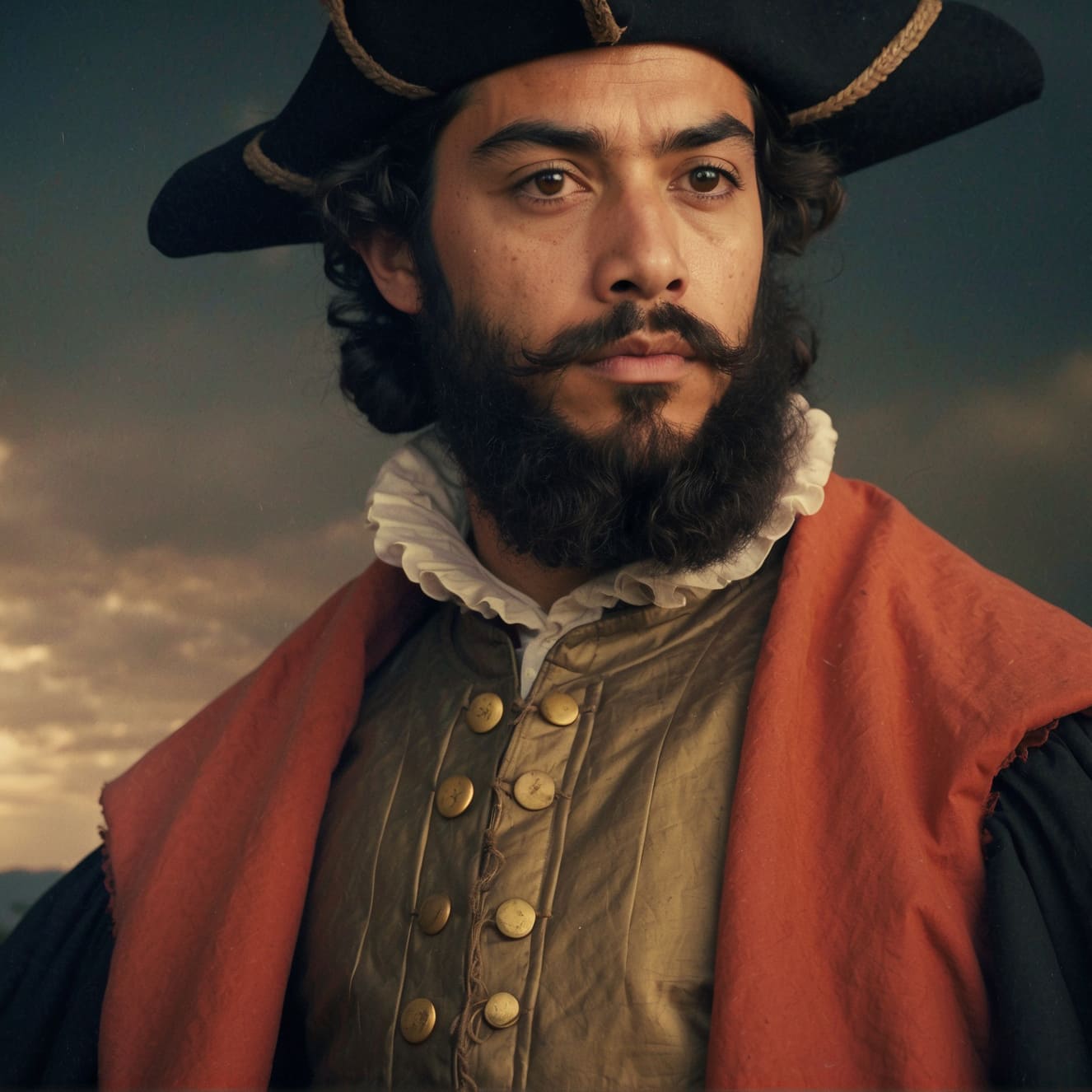
Pedro Álvares Cabral
 Portugal
explorer•seafarer•military commander
Also known as: Pedro Álvares de Gouveia
Birthday
c. 1467
Birth Sign
Aquarius
Birthplace
Belmonte, Portugal
Age
Died at 53
About
Pedro Álvares Cabral stands as a monumental figure in the Age of Discovery, historically credited as the European discoverer of Brazil. Born into a minor noble family in Belmonte around 1467, he served as a squire in the royal court before rising to prominence as a captain in the Portuguese navy. His career trajectory shifted dramatically in 1500 when King Manuel I appointed him to lead a massive fleet of thirteen ships toward India. This mission aimed to bypass the Arab, Turkish, and Italian monopolies on the spice trade by establishing direct commercial ties with Indian city-states.
His journey altered history when his fleet drifted far west into the Atlantic Ocean. In April 1500, the ships made landfall on a coast that Cabral initially mistook for a large island. The territory fell within the Portuguese sphere defined by the Treaty of Tordesillas, so he formally claimed it for the crown. After exploring the shoreline and realizing this vast new landmass was likely a continent, he sent a ship back to Lisbon to inform King Manuel I. That land became known as Brazil, marking the first substantial European exploration of South America's northeast coast.
The expedition then turned eastward, but a violent storm in the southern Atlantic sank several vessels before the survivors reached Mozambique and eventually Calicut in India. Diplomatic tensions flared quickly upon arrival, leading to heavy casualties and destroyed facilities. Cabral responded with force, burning the opposing Arab fleet and bombarding the city of Calicut in retaliation. He then sailed to Cochin, where he secured friendly relations with the local ruler and loaded his remaining ships with spices. Despite losing men and ships, the voyage returned to Portugal with extraordinary profits that bolstered the kingdom's finances and laid the groundwork for a global empire stretching from the Americas to Asia. Cabral later lost favor with the king following a quarrel and retired to private life, leaving his legacy to fade for over three centuries until historians began reevaluating his role in the Age of Discovery.
Early Life & Background
Pedro Álvares Cabral was born Pedro Álvares de Gouveia in Belmonte, Portugal, around 1467. He entered the world into a minor noble family that held modest standing within the Portuguese aristocracy. His early education and upbringing were typical for a son of the nobility, focusing on martial training, courtly etiquette, and the administration of estates. Little is documented about his childhood years or specific formative experiences prior to his entry into royal service, as genealogical records from this period rarely capture such intimate details for non-royal figures. However, historical analysis suggests his father may have been Beltrão de Gouveia, a knight who held lands near Belmonte, providing the foundation for his future status.
He began his public career serving as a squire in the royal court, a common stepping stone for young noblemen seeking advancement. This role provided him with access to the highest levels of Portuguese society and allowed him to develop the diplomatic and organizational skills necessary for high-ranking military commands. By the late 15th century, he had earned a reputation as a capable officer and gained the trust of the monarchy. His appointment to lead the 1500 expedition was not the result of a sudden rise to fame but rather the culmination of steady service and demonstrated competence within the royal hierarchy. Some accounts suggest he may have participated in earlier naval skirmishes against Moorish forces, though these details remain obscure in primary sources.
The pivotal moment arrived in 1500 when King Manuel I selected him to command a massive fleet of thirteen ships. The mission was designed to follow the sea route to India established by Vasco da Gama three years earlier. Cabral prepared extensively for this undertaking, overseeing the outfitting of the ships and the recruitment of over 1,000 men and supplies needed for trade with India. This appointment marked the beginning of his most significant historical contribution, setting the stage for an expedition that would inadvertently change the map of the world and establish Portugal's claim to a vast new territory.
Career Growth
Cabral's career is defined almost exclusively by his 1500 expedition, which departed Lisbon on March 9, 1500. The fleet carried over 1,000 men and supplies intended for trade with India. On April 22, 1500, the fleet made landfall on the coast of present-day Bahia, Brazil. Cabral initially mistook the landmass for an island, naming it Ilha de Vera Cruz (Island of the True Cross), before realizing it was part of a continent. He formally claimed the territory for the Portuguese crown, citing the Treaty of Tordesillas.
After sending a ship back to Lisbon to report the discovery, the main fleet continued eastward toward India. The journey was marred by a violent storm in the southern Atlantic that sank four ships and killed many crew members. Upon reaching Calicut, India, diplomatic tensions escalated into violence when local merchants incited an attack on the Portuguese trading post, resulting in significant casualties. Cabral retaliated by bombarding the city and burning an Arab fleet. He subsequently secured a treaty with the ruler of Cochin, loaded his remaining ships with valuable spices (pepper, cinnamon, and ginger), and returned to Portugal in September 1501.
Despite the heavy losses, the voyage yielded immense profits that solidified Portugal's position in the spice trade. Following this success, Cabral fell out of favor with King Manuel I due to political quarrels and retired from public service. He spent his final years in private life until his death around 1520 in Santarém. His return to Portugal marked the end of his active career, yet the economic impact of his voyage ensured his name remained embedded in the nation's history.
Career Timeline
Public Image & Style
Cabral is portrayed as a disciplined military commander and a skilled navigator who operated within the rigid structures of the Portuguese court. His public persona was that of a loyal servant of the crown, tasked with expanding the kingdom's influence and securing profitable trade routes. Historical accounts depict him as a man of action who was willing to use force to protect Portuguese interests, as seen in his retaliation against the attacks in Calicut. His image has evolved over time from a heroic figure of discovery to a more complex symbol of colonial expansion and its consequences.
Fame & Fandom
iFANN has not yet collected fame data for this person. As a historical figure from the late 15th century, Pedro Álvares Cabral does not have a modern pop-culture fandom or ranking in the iFANN Global Fame Rankings. Instead, he is the subject of academic study, historical commemoration, and national pride.
In the context of Brazil, he is revered as a national hero. Millions of Brazilians participate in annual ceremonies on April 22nd, involving school parades, historical reenactments, and official government speeches to mark the anniversary of his landing. The name "Pedro Álvares Cabral" has occasionally been referenced by players or managers in football (soccer) as a metaphor for discovering something new or achieving a breakthrough, such as when manager Jorge Jesus likened himself to Cabral in 2025 ahead of a potential return to Brazil. His image appears on coins, stamps, and in educational materials across Lusophone countries, ensuring his continued presence in the public consciousness.
Interesting Facts and Legends
Pedro Álvares Cabral is widely recognized as the first human in recorded history to set foot on four continents during his 1500 voyage: Europe (Portugal), Africa (via the Cape of Good Hope route), Asia (India), and South America (Brazil). This distinction is often cited in historical trivia as a unique feat of navigation. The prevailing folklore suggests that the discovery of Brazil was accidental, caused by the fleet drifting westward due to currents or navigation errors while heading for India. While some modern historians debate whether the westward drift was intentional to secure claims against Spain, the narrative of the accidental discovery remains the dominant cultural story.
He was born Pedro Álvares de Gouveia but adopted the surname Cabral later in life, possibly through marriage or inheritance. Of the 13 ships in his fleet, only two returned to Portugal with the spices; the others were lost to storms or abandoned. The first written account of the indigenous people of Brazil comes from Pero Vaz de Caminha, the secretary of Cabral's expedition, who described the Tupinambá people in vivid detail. His claim to Brazil shifted the balance of power in the New World, preventing Spanish dominance over the eastern tip of South America.
Family & Personal Life
Pedro Álvares Cabral was married to Isabel de Castro, a member of the Portuguese nobility. Their union was a strategic marriage typical of the era, aimed at consolidating social standing and wealth rather than romantic affection. They had children, though specific details regarding their number or names are not extensively recorded in primary sources available today. There were no dating histories in the modern sense; his relationship with Isabel de Castro was formalized to strengthen his position within the nobility. He died around 1520, leaving behind a legacy defined by his exploration rather than a complex romantic biography.
Notable Connections
Relationships & Dating History
Pedro Álvares Cabral was married to Isabel de Castro, a member of the Portuguese nobility. Their union was a strategic marriage typical of the era, aimed at consolidating social standing and wealth. They had children, though specific details regarding their number or names are not extensively recorded in primary sources available today. There were no dating histories in the modern sense; his relationship with Isabel de Castro was formalized to strengthen his position within the nobility. He died around 1520, leaving behind a legacy defined by his exploration rather than a complex romantic biography.
- MarriedIsabel de Castrounknown - c. 1520Strategic marriage to consolidate social standing; they had children.
Death & Aftermath
Died
c. 1520 (aged 53)
Death Place
Santarém, Portugal
Cause of Death
Unknown
Pedro Álvares Cabral died circa 1520 in Santarém, Portugal. The exact date and cause of death are not definitively recorded in contemporary medical or coroner reports, as such documentation was not standard practice for non-monarchs of that era. Historical consensus places his death within a few years of his return from India. Following his death, his reputation faded for centuries; he was largely forgotten in the public consciousness until the 19th century, when historians began reevaluating the Age of Discovery. Today, he is celebrated as a national hero in both Portugal and Brazil. In Brazil, April 22nd is officially observed as "Dia do Descobrimento do Brasil" (Discovery Day of Brazil), commemorating his landing.
Following his death, Cabral's reputation faded significantly for centuries. While he was initially celebrated as a hero for claiming Brazil, later generations viewed his voyage through the lens of colonial expansion and the tragic impacts on indigenous populations. For a long period, he was largely forgotten in the broader European consciousness until the 19th century when Romantic historians began reevaluating the Age of Discovery. His legacy underwent a major transformation during this revival, shifting from a figure of imperial ambition to a foundational national icon.
Today, Cabral is celebrated as a national hero in both Portugal and Brazil. In Brazil, April 22nd is officially observed as Dia do Descobrimento do Brasil (Discovery Day of Brazil), commemorating the landing of his fleet. Millions of Brazilians participate in annual ceremonies involving school parades, historical reenactments, and official government speeches to honor the event. His image appears on coins, stamps, and educational materials across Lusophone countries. Political discourse occasionally references him, such as when former Brazilian President Jair Bolsonaro proposed placing Cabral's face on Brazilian banknotes in 2020 to highlight his enduring symbolic value. A medal was also issued in 1900 to commemorate the fourth centenary of the discovery, cementing his place in the cultural memory of the Americas.
Recent developments continue to keep his legacy alive. On April 22, 2026, Brazil and Portugal continued to observe the anniversary of the discovery, with various cultural events scheduled to mark the occasion. In 2025, a dredger named Pedro Álvares Cabral was the subject of full-spectrum maintenance work by BLRT, indicating the enduring use of his name in maritime industries. Artistic interpretations of his arrival, such as Jaime Lauriano's work Invasão de Pedro Álvares Cabral em Porto Seguro em 1500, have sparked contemporary debates about colonialism and indigenous history. These modern engagements demonstrate how his historical footprint continues to influence cultural and political discussions in the 21st century.
Net Worth (Estate Value)
$0
iFANN Editorial Team estimate
Pedro Álvares Cabral lived in the 15th and early 16th centuries, a time when personal net worth was not tracked in modern financial terms. As a nobleman and military commander, his wealth derived from land holdings, titles, and the spoils of war and trade. The 1500 expedition yielded immense profits for the Portuguese crown, and while Cabral likely received a share of these gains, the exact amount he personally accumulated is unknown. Following his retirement, he lived out his days in private life without further public financial ventures. Today, his estate and assets are long dispersed, and no financial records survive to estimate a net worth equivalent in modern currency.
Awards & Accolades
View 6 records, honours and achievementsKnown For
Voyage of 1500
1500 · Commander
Keywords
Sources
Quick Facts
- Profession
- explorer, seafarer, military commander
- Born
- c. 1467
- Birthplace
- Belmonte, Portugal
- Died
- c. 1520
- Death Place
- Santarém, Portugal
- Gender
- Male
- Spouse
- Isabel de Castro
Personal Details
- Full Name
- Pedro Álvares de Gouveia
- Spouse
- Isabel de Castro
- Children
- Unrecorded
- Education
- Royal Court Training
Frequently Asked Questions
Who discovered Brazil?
When was Pedro Álvares Cabral born?
Did Pedro Álvares Cabral find Brazil accidentally?
Where did Pedro Álvares Cabral die?
Why is Pedro Álvares Cabral famous?
Similar People
Join the community
fans discussing