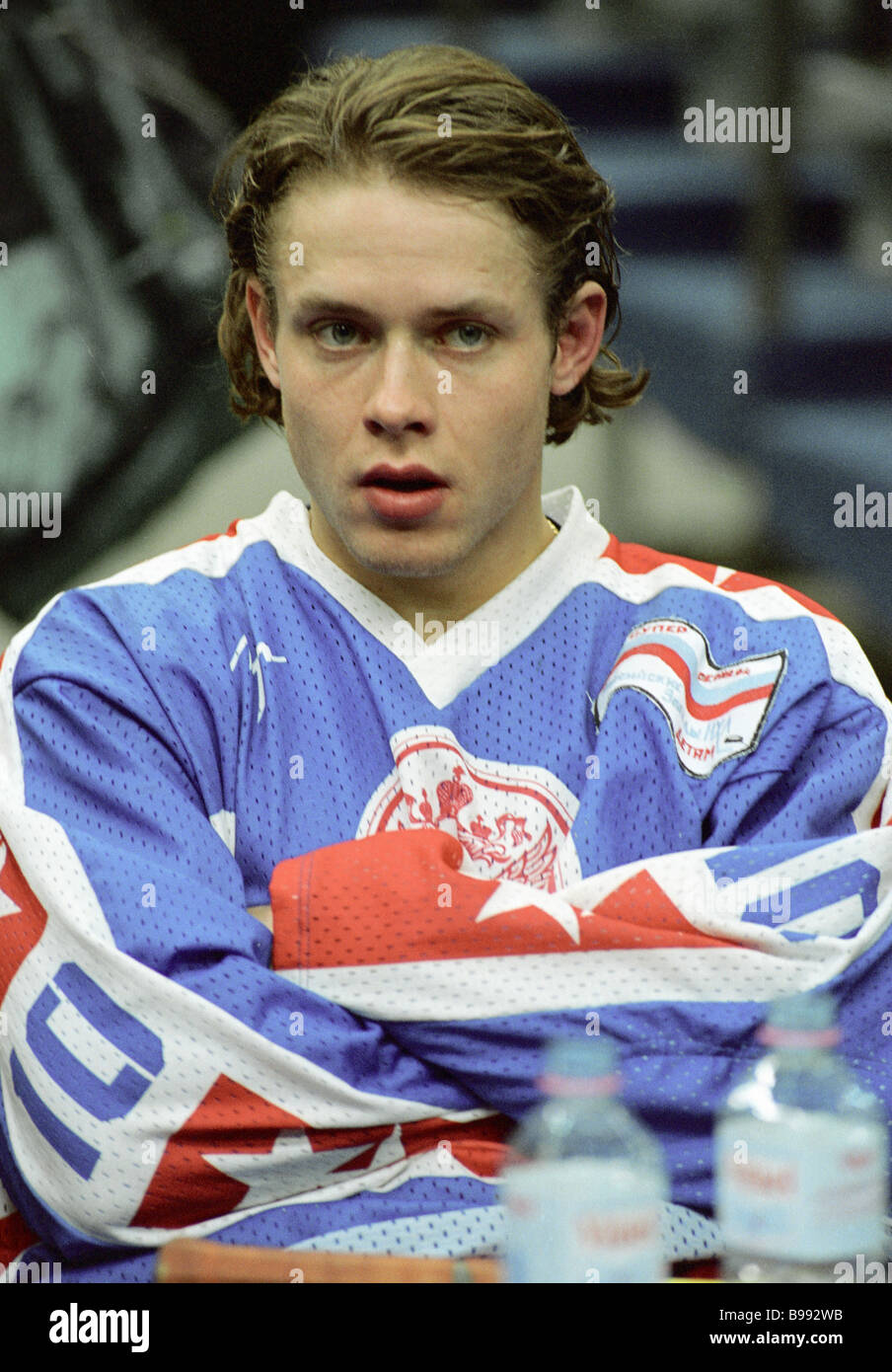
Pavel Bure
 Russia
Also known as: Russian Rocket, Pavel Vladimirovich Bure
Birthday
March 31, 1971
Birth Sign
Aries
Birthplace
Moscow, Soviet Union
Age
55 years old
Height
5 ft 10 in (178 cm)
About
Pavel Bure is a Russian former professional ice hockey player who lit up the NHL with his explosive speed and lethal shot. Nicknamed "the Russian Rocket," he played right wing for 12 seasons, most memorably with the Vancouver Canucks, and remains one of the most exciting scorers the league has ever seen. His career numbers are staggering: 437 goals and 779 points in just 702 games, a rate that still ranks among the best in history.
Today, Bure is a Hockey Hall of Famer and an icon in both North America and his native Russia. He was inducted into the Hall in 2012 and named one of the 100 Greatest NHL Players in 2017. Though injuries cut his career short, his legacy as a game-breaker endures, and he remains a beloved figure among Canucks fans and hockey purists alike. As of 2026, he stays involved in the sport through appearances and alumni events, and his reputation as one of the fastest skaters ever to lace up skates is untouchable.
Early Life & Background
Pavel Bure grew up in Moscow, the son of Vladimir Bure, a former Olympic swimmer who competed for the Soviet Union. That athletic pedigree was evident early; Pavel and his older brother Valeri both gravitated toward hockey, and Pavel's natural speed was apparent from the time he was a kid. He spent his childhood in the Soviet capital, where hockey was a serious business, and he joined the youth system of the famed Central Red Army club.
At 16, Bure made his senior debut with CSKA Moscow during the 1987-88 season, playing alongside future NHL stars like Sergei Fedorov and Alexander Mogilny. Over the next three seasons, he honed his craft in the Soviet league, learning the disciplined two-way game that would later make him a complete NHL player. His international breakout came at the 1989 World Junior Championships, where he scored eight goals in seven games to help the Soviet Union win gold, and he repeated the feat with another gold in 1990. Those performances put him on the radar of NHL scouts, and when the Iron Curtain began to crack, Bure was among the first wave of Soviet stars to jump to North America.
Selected by the Vancouver Canucks in the 1989 NHL Entry Draft, Bure had to wait two years for his release. When he finally arrived in Vancouver in the fall of 1991, he was a 20-year-old with a reputation for blazing speed and a deadly wrist shot. The transition wasn't easy, but he adapted quickly, and his first NHL season would announce him as a force to be reckoned with.
Career Growth
Pavel Bure's NHL debut came on November 5, 1991, and he wasted no time making an impact. He scored 34 goals and 60 points in his rookie season, earning the Calder Memorial Trophy as the league's top rookie. The following year, he exploded for 60 goals, becoming just the fifth player in NHL history to reach that mark at the time. In the 1993-94 season, Bure led the league with 60 goals again and powered the Canucks to the Stanley Cup Final, where they fell in seven games to the New York Rangers. That playoff run cemented his status as a superstar.
After a contract dispute led to a trade in 1999, Bure went to the Florida Panthers, where he won back-to-back Rocket Richard Trophies as the NHL's leading goal scorer in 1999-00 and 2000-01. His 59 goals in 1999-00 and 58 in 2000-01 were remarkable for a team that struggled to make the playoffs. A knee injury cut his time in Florida short, and he was traded to the New York Rangers in 2002. He played parts of two seasons there but was never the same player, and he retired in 2005 after the lockout.
Bure's international career was just as decorated. He won Olympic silver with Russia in 1998 and bronze in 2002, and he was a dominant force at the World Championships, winning gold in 1990. After retiring, he served as general manager of Russia's national team at the 2006 Olympics, though the team failed to medal. His individual accolades include induction into the Hockey Hall of Fame in 2012 and the IIHF Hall of Fame the same year.
Career Timeline
Public Image & Style
Pavel Bure's public image was built on pure electricity. He wasn't just fast; he was faster than everyone else, and fans packed arenas to see him break away. His style was a blend of European finesse and North American grit, and he made the highlight reel look routine. In Vancouver, he was the face of the franchise during the 1990s, and his number 10 was retired by the Canucks in 2013. Media coverage often focused on his explosive acceleration and his ability to score from anywhere, and he was frequently compared to a video game character come to life. Off the ice, Bure was shy and reserved, but that only added to his mystique. Russian fans adored him as a national hero, and his Olympic performances only strengthened that bond. Today, he's remembered as one of the most exciting players of his generation, and his name still pops up in conversations about the fastest skaters ever.
Fame & Fandom
Pavel Bure's fanbase is defined less by an organized army and more by a shared reverence for the "Russian Rocket" moniker, which serves as the primary identifier for supporters who witnessed his electrifying tenure with the Vancouver Canucks. This unofficial cult of personality emerged during a period of intense hockey fever in British Columbia, where fans viewed Bure not just as a player but as a cultural touchstone whose speed revitalized the franchise's popularity. While there is no formal name like the "12th Man" or specific modern fan-funded projects dedicated solely to him, the audience maintains enduring rituals at Rogers Arena, honoring his legacy through the retirement of his jersey number. His appeal remains rooted in individual adoration of a singular talent rather than a collective organizational identity, with fans often citing his back-to-back 60-goal seasons as the peak of regional sports history. Despite his superstar status, Bure's quiet demeanor and humility fostered a deep connection with his followers, who continue to revere him as one of the greatest players in franchise history long after his departure from Vancouver. The mythology surrounding his unparalleled skating speed and dramatic impact on the ice has cemented his status as a verified historical legend, ensuring that the "Russian Rocket" remains a symbol of skill and the golden age of Soviet hockey players in the NHL. These enduring sentiments are quantified by the iFANN Global Fame Rankings. Pavel Bure is currently the 17th most famous person in Ice Hockey, a position he holds steady from the previous cycle.
Interesting Facts and Legends
Bure's nickname "the Russian Rocket" was inspired by his blazing speed, and he was often compared to a missile on skates. He had a famous pre-game ritual of taping his stick in a specific way, and he was known to be superstitious about his equipment. Off the ice, Bure was a car enthusiast and owned a collection of luxury vehicles. He also had a brief foray into the restaurant business in Vancouver. One quirky fact: his brother Valeri also played in the NHL, and the two faced off against each other on several occasions. Bure's 60-goal season in 1992-93 made him the first European-trained player to hit that mark in the NHL. A story fans still retell involves his reliance on teammate Gino Odjick's physicality to protect him, with Bure famously stating that Odjick would "step up for anybody," adding emotional depth to the legend of the Rocket. In 2026, reports resurfaced detailing how the Detroit Red Wings lost out on signing Bure due to an NHL rule blunder, further cementing the story of his elusive nature. Additionally, anecdotes from recent years describe interactions with Belarusian President Alexander Lukashenko, who sent birthday greetings acknowledging Bure as an "USSR Honored Master of Sports," adding a layer of international celebrity to his hockey legacy.
Notable Quotes
“I just try to play my game. I know I can score goals, and I try to do that every night.”
“The speed is my weapon. I always had it, and I used it.”
“When I have the puck, I feel like I can do anything.”
“I love the game. It gave me everything.”
“The fans in Vancouver were amazing. They always supported me.”
Family & Personal Life
Pavel Bure comes from a family of athletes. His father, Vladimir Bure, was a four-time Olympic medalist in swimming for the Soviet Union, and his mother, Tatiana, was a teacher. He has an older brother, Valeri, who also played in the NHL for teams like the Montreal Canadiens and Calgary Flames. The brothers grew up in Moscow and were both products of the Central Red Army system. Pavel has been married once, to Alina Khabibullina, a former model, but they divorced in 2015. He has no children from that marriage. In recent years, he has kept his personal life private, but he has been linked to a few high-profile Russian celebrities, though nothing has stuck. He currently splits his time between Moscow and Miami.
Notable Connections
Pavel Bure is closely associated with the Vancouver Canucks, where he played his best years and became a franchise icon. His brother Valeri Bure also played in the NHL, and the two were teammates on the Russian national team. Bure's linemates in Vancouver included Trevor Linden and Cliff Ronning, and he played alongside future Hall of Famers like Mark Messier later in his career. Internationally, he was often paired with fellow Russian stars Sergei Fedorov and Alexander Mogilny, forming one of the most feared lines of the era.
Relationships & Dating History
Pavel Bure has kept his personal life relatively private, but a few relationships have come to light. In the mid-1990s, he dated a Vancouver-based model, but nothing long-term came of it. He later married Alina Khabibullina, a Russian model, in 2012, but the marriage was short-lived, and they divorced in 2015. The split was amicable, and they have no children together.
Since the divorce, Bure has been linked to a few Russian celebrities, including socialite Ksenia Sobchak, who in January 2026 shared a story about an awkward date with him where he made her watch his goal highlights. However, that was a one-off encounter, and Bure has remained single. As of 2026, he is reportedly single and focused on his business ventures and occasional hockey appearances.
- MarriedAlina Khabibullina2012 - 2015Married to the Russian model, but divorced in 2015; no children.
- RumouredKsenia Sobchak2026 - 2026Socialite shared an anecdote about an awkward date; not a confirmed relationship.
Salary, Net Worth In 2026
$90 Million
iFANN Editorial Team estimate
Per iFANN's editorial analysis, Pavel Bure's net worth in 2026 is estimated at around $90 million, a figure that reflects his lucrative NHL contracts, endorsement deals, and smart investments. During his peak years with the Canucks, he signed a five-year, $25 million deal in 1993, which was among the richest in the league at the time. His later contracts with Florida and New York were also substantial, with the Panthers paying him $10 million per season in the early 2000s. Beyond his playing salary, Bure earned from endorsements with brands like Nike and various Russian companies. After retiring, he invested in real estate in Russia and Florida, and he has been involved in several business ventures, including a sports management company. His net worth has grown steadily over the years, and while he's not as publicly visible as some former stars, his financial portfolio remains solid. As of 2026, he continues to earn from appearance fees and alumni events, and his estate planning has kept his wealth intact.
Awards Won (7)
Pavel Bure's trophy case is a testament to his scoring brilliance. He won the Calder Memorial Trophy as the NHL's top rookie in 1992 and captured the Rocket Richard Trophy twice as the league's leading goal scorer, in 2000 and 2001. He was also a two-time Olympic medalist, taking silver with Russia in 1998 and bronze in 2002. His crowning achievement came in 2012 when he was inducted into the Hockey Hall of Fame, followed by the IIHF Hall of Fame the same year.
2012 · Player
Career
2012 · Player
International career
Known For
Vancouver Canucks
1991 · Right Wing
Florida Panthers
1999 · Right Wing
New York Rangers
2002 · Right Wing
Keywords
Sources
Quick Facts
- Profession
- ice hockey player
- Born
- March 31, 1971
- Birthplace
- Moscow, Soviet Union
- Gender
- Male
- Height
- 5 ft 10 in (178 cm)
- Nickname
- Russian Rocket
Personal Details
- Full Name
- Pavel Vladimirovich Bure
- Height
- 5 ft 10 in (178 cm)
- Children
Frequently Asked Questions
Who is Pavel Bure?
What teams did Pavel Bure play for?
What is Pavel Bure's net worth in 2026?
When did Pavel Bure retire?
Is Pavel Bure in the Hall of Fame?
Similar People
Join the community
fans discussing