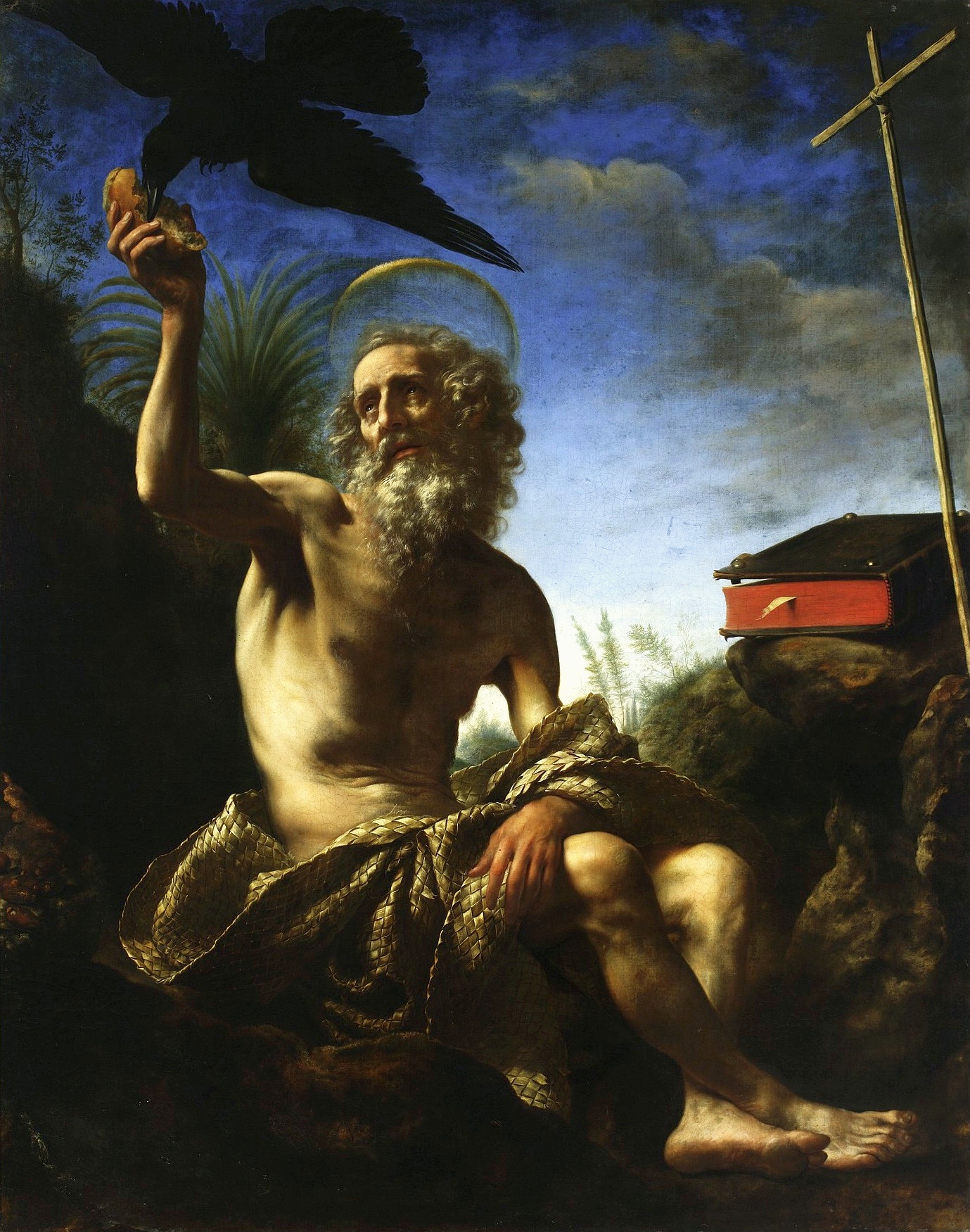
Paul of Thebes
 Egypt
EgyptBirthday
+0227
Birth Sign
Birthplace
Egypt
Age
Died at 115
About
Paul of Thebes, also known as Paul the First Hermit or Paul the Anchorite, was an Egyptian monk and saint who lived in the desert of Thebes in Roman Egypt during the third and fourth centuries. Born around 227 AD, he is traditionally regarded as the first Christian hermit, having retreated into solitude at the age of 16 and remained there until his death at approximately 113 years old, around 341 AD. His life of extreme asceticism and isolation profoundly influenced the development of Christian monasticism, and he is venerated as a saint by the Catholic, Eastern Orthodox, and Oriental Orthodox Churches.
Fame & Fandom
Paul of Thebes maintains a measured presence within the global historical record, his renown sustained by centuries of liturgical tradition rather than contemporary media cycles. Current metrics from the iFANN Global Fame Rankings place him as the 77th most famous person from Egypt, a position down from 75th last cycle. Within the specific sector of religious history, he is ranked as the 56th most famous figure among Religious Leaders, down from 55th last cycle. These placements reflect a steady, enduring interest that tracks across historical archives and devotional literature worldwide. Despite this consistent visibility, the subject does not possess a formalized modern fanbase or an organized community with a specific designation; the audience for his life remains a dispersed collection of believers and scholars without a unified collective name. No campaigns, rituals, or digital movements have emerged to organize his veneration under a single banner, distinguishing his legacy from figures whose fame is driven by active, self-identifying crowds.
Interesting Facts and Legends
Paul of Thebes is traditionally recognized as the first Christian hermit, retreating into the desert at age sixteen to escape Roman persecution. He lived in solitude for over a century until his death around 341 AD at the estimated age of 113. A central narrative in his hagiography involves his meeting with Saint Anthony the Great, who was sent by Abba Macarius to find him. This encounter is widely retold as the moment Paul shared the Eucharist with Anthony before passing away. His biography was preserved primarily through the writings of St. Jerome, whose account became the definitive source for later generations. While some modern dates reference unrelated individuals named Paul Gura or Russian delegations visiting Egypt, these events do not constitute legends associated with the saint himself. The story of his friendship with Jerome remains the primary literary link connecting his solitary life to the broader church history.
Death & Aftermath
Died
+0342 (aged 115)
Death Place
desert of Thebaid, Egypt
Cause of Death
Natural causes
The life of Paul of Thebes was immortalized in the text known as The Life of St. Paul of Thebes, written by St. Jerome around 375 AD, which established him as the father of monasticism and secured his veneration across multiple Christian traditions. This posthumous recognition transformed a solitary figure into a foundational saint for the Catholic, Eastern Orthodox, and Oriental Orthodox Churches, with his feast day commemorated annually on January 15. The immediate aftermath of his passing involved a private burial conducted in the desert of Thebaid, Egypt, where he had lived for over nine decades. According to traditional accounts recorded by Jerome, the monk died in approximately 342 AD at the age of roughly 115 within the cave that served as his hermitage.
His final days were marked by a visit from St. Anthony the Great, who arrived to find Paul shortly before his natural death following their shared meal. The burial rites were performed by Anthony himself, assisted by a lion that brought a tunic to cover the body, an event that remains a central element of the hagiographical tradition rather than a forensic fact. The site of his cell eventually became a destination for pilgrims, leading to the construction of St. Paul Monastery nearby, though the precise location remains a subject of historical debate.
Awards & Accolades
Keywords
Quick Facts
- Profession
- monk
- Born
- +0227
- Birthplace
- Egypt
- Died
- +0342
- Death Place
- Thebaid
- Gender
- Male
Join the community
fans discussing