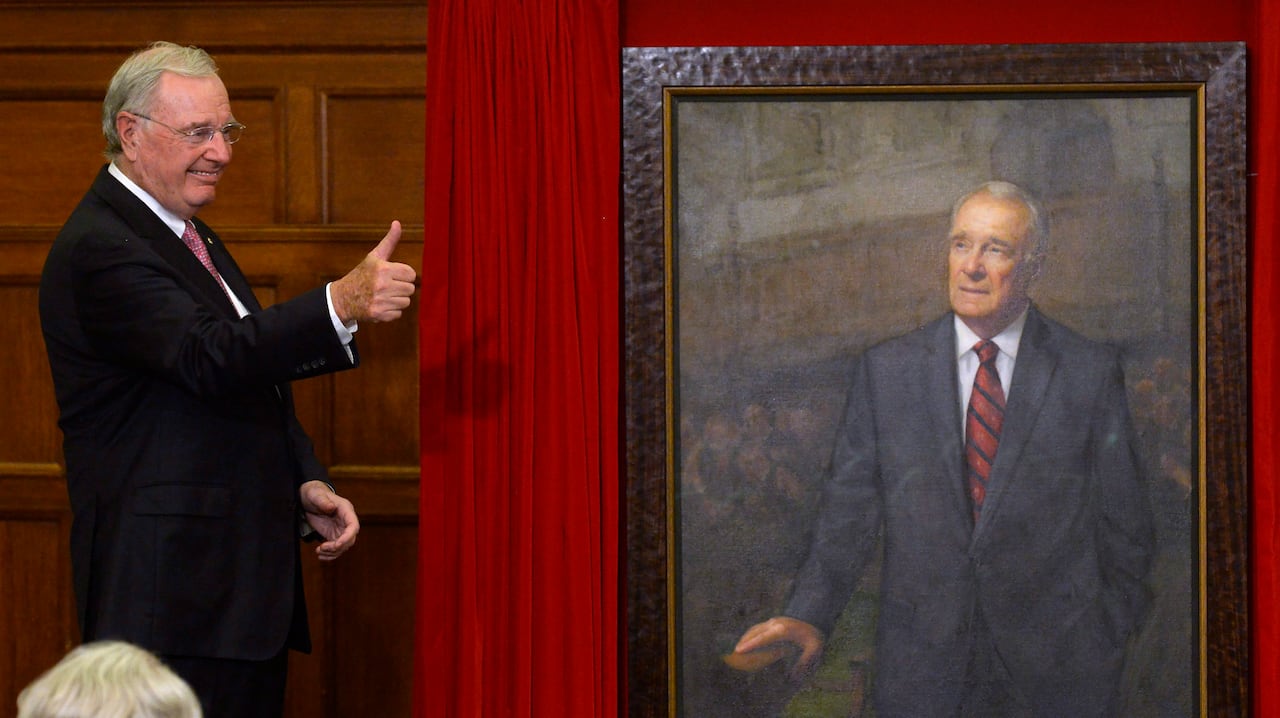
Paul Martin
 Canada
politician•lawyer•entrepreneur
Also known as: Paul Martin Jr., The Boy Wonder of Finance
Birthday
August 28, 1938
Birth Sign
Virgo
Birthplace
Windsor, Ontario, Canada
Age
88 years old
Height
5 ft 11 in (180 cm)
About
Paul Edgar Philippe Martin is a Canadian lawyer, businessman, and retired politician who served as the 21st prime minister of Canada from 2003 to 2006. Born in Windsor, Ontario, Martin is best known for his decade as minister of finance, where he eliminated Canada's federal deficit, and for his brief but consequential time as prime minister. Today, at 87, he remains an active voice in public policy, particularly on Indigenous reconciliation and global health initiatives.
Martin's political career was built on a reputation for fiscal discipline and managerial competence. As finance minister from 1993 to 2002, he slashed spending and reformed programs, leading Canada to its first balanced budget in nearly 30 years. His prime ministership, though short, saw landmark legislation on same-sex marriage and Indigenous rights, but was overshadowed by the sponsorship scandal. After leaving office, Martin pivoted to global advocacy, serving on advisory boards for the Health Impact Fund and Canada's Ecofiscal Commission.
Early Life & Background
Paul Martin grew up in Windsor, Ontario, in a household steeped in Liberal politics. His father, Paul Martin Sr., was a senator and secretary of state for external affairs, and young Paul absorbed the rhythms of political life from an early age. He attended the University of Toronto, earning a degree in history and political science before completing a law degree in 1965. Called to the Ontario Bar in 1966, Martin briefly practiced law before pivoting to the corporate world.
In 1966, he joined Power Corporation of Canada, moving to its shipping subsidiary, Canada Steamship Lines, in 1969. By 1973, at age 34, Martin became president and CEO of CSL, a role he held until 1988. Under his leadership, CSL grew into one of the world's largest bulk cargo shipping companies, operating on the Great Lakes and St. Lawrence Seaway. This business success made Martin a wealthy man and gave him a reputation as a sharp, results-driven manager, a reputation that would define his political persona.
Martin's entry into politics came in 1988, when he won a seat in the House of Commons for the Montreal riding of LaSalle, Émard as a Liberal candidate. The Liberals lost that election, and Martin began his parliamentary career as a backbencher in opposition, but his sights were already set on higher office.
Career Growth
Martin's breakthrough came in 1993 when, after the Liberals won the federal election, Prime Minister Jean Chrétien appointed him minister of finance. Over the next nine years, Martin engineered a dramatic fiscal transformation. He cut government spending, reformed social programs, and by 1997 Canada posted its first balanced budget in nearly three decades. His policies were credited with turning the country's finances around, earning him the nickname "The Boy Wonder of Finance."
However, tensions with Chrétien escalated, and in June 2002, Martin was removed from the finance portfolio. He immediately began organizing a leadership challenge. In November 2003, after Chrétien announced his retirement, Martin won the Liberal leadership in a landslide and was sworn in as prime minister on December 12, 2003.
Martin's prime ministership was short and turbulent. He called a federal election for June 2004, expecting a majority, but the sponsorship scandal, a program funneling federal advertising money to Quebec firms, allegedly with kickbacks, reduced the Liberals to a minority government. Despite this, his government signed the Kelowna Accord in November 2005 and passed the Civil Marriage Act in July 2005, legalizing same-sex marriage across Canada. But the scandal continued to dog him. In November 2005, after the Gomery Commission released a critical report, the opposition passed a no-confidence motion, triggering the January 2006 election, which Martin's Liberals lost to Stephen Harper's Conservatives. Martin resigned as Liberal leader immediately and retired from Parliament in 2008.
Since leaving politics, Martin has focused on global diplomacy and philanthropy. He serves on the advisory board of Incentives for Global Health, which promotes the Health Impact Fund, and advises Canada's Ecofiscal Commission. He remains a vocal advocate for Indigenous reconciliation and pharmaceutical innovation for neglected diseases.
Career Timeline
Public Image & Style
Paul Martin's public image was defined by his corporate, businesslike demeanor. He typically appeared in conservative dark suits and was often described as "corporate" in his presentation. Canadian media portrayed him as competent but aloof, a skilled manager who lacked Jean Chrétien's folksy charisma. His speech was measured, policy-focused, and detail-oriented, often delivering lengthy, data-heavy addresses. The sponsorship scandal heavily shaped his image, overshadowing his personal reputation for integrity. Supporters within the Liberal Party were sometimes called "Martinites," a term used by political journalists to describe his faction. While he never had a fandom in the celebrity sense, his fiscal legacy earned him respect among business leaders and policy wonks, and his post-political advocacy for Indigenous reconciliation has burnished his reputation among progressives.
Fame & Fandom (iFAMOUS Rankings)
Paul Martin does not command a unified fanbase with a specific name, organized campaigns, or the viral folklore that defines modern celebrity culture. His supporters are political constituents rather than devotees who stage birthday billboards or fund charity drives in his honor. The search results confirm no single individual named Paul Martin possesses a dedicated cult following comparable to major music stars or athletes. Whether referring to the former Canadian Prime Minister, the retired NHL defenseman, or the television presenter, none have generated a formal fandom with an unofficial moniker. While hockey fans may cheer for the defenseman and viewers tune into the antiques expert, these audiences lack the ritualistic devotion seen elsewhere. iFANN has evaluated this profile against global data points including media coverage, search consumption signals, and public engagement metrics worldwide. The evaluation confirms that Paul Martin is currently unranked in the Global Top 1,000 or any Top-100 scope list. He holds no placement in the published rankings as of August 2026. This absence of a numerical rank reflects his status as a historical figure and professional leader rather than a pop-culture icon generating the intense, quantifiable noise required for a leaderboard slot. The lack of a documented fandom name further underscores that his influence remains within the spheres of policy, sports, and broadcasting rather than the realm of entertainment mythology.
Interesting Facts and Legends
Martin's nickname among colleagues was "The Boy Wonder of Finance" during his early years as finance minister. He was known for arriving at his office by 6:00 AM and working long hours throughout his political career. A practicing Roman Catholic, Martin has spoken about the role of faith in his life. He was an avid sailor and owned a sailboat he used on the St. Lawrence River. His relationship with Jean Chrétien was famously frosty, the two reportedly did not speak for years at a time. Martin's sale of Canada Steamship Lines to his sons in 2003, just before becoming prime minister, drew criticism as a potential conflict of interest, though no wrongdoing was ever established. Despite his high-profile career, there are no widely retold stories or extraordinary crowd reactions that have entered general pop-culture lore. Unlike entertainment figures whose legends involve stadium pandemonium or viral video incidents, Martin's legacy is defined by policy debates and political history rather than folkloric anecdotes. No specific game-winning moments or on-air incidents have transcended their original contexts to become viral myths associated with his name.
Notable Quotes
“We have to live within our means. That is not an option; it is a necessity.”
“I want to say very clearly: those who were responsible for this will be held to account.”
“This is a question of rights. It is a question of equality. It is a question of the kind of country we want to be.”
“The people have spoken. We have heard them, and we will respect their decision.”
Family & Personal Life
Paul Martin married Sheila Ann Cowan in 1965, and the couple has remained together for over six decades. They have three sons: Paul, Jamie, and David. Sheila has been a stabilizing presence throughout Martin's career, though she has largely avoided the political spotlight. Martin's father, Paul Martin Sr., was a prominent Liberal politician and senator, and his mother was Eleanor "Nelly" Martin. The family was deeply involved in politics, but Martin's sons have stayed out of public life, pursuing careers in business and medicine. Martin has spoken warmly of his family's support, crediting Sheila with keeping him grounded during turbulent political times.
Notable Connections
Paul Martin's political life was intertwined with several key figures. Jean Chrétien was his rival and predecessor, and their frosty relationship defined Liberal politics for over a decade. Stephen Harper succeeded Martin as prime minister after defeating him in 2006. John Gomery's inquiry into the sponsorship scandal shaped Martin's downfall. His wife, Sheila Martin, has been a constant support, and his father, Paul Martin Sr., inspired his political career. Key ministers in his government included Deputy Prime Minister Anne McLellan and Foreign Affairs Minister Bill Graham.
Relationships & Dating History
Paul Martin has had one known public relationship: his marriage to Sheila Ann Cowan, whom he wed in 1965. They met while both were young and have remained together for over sixty years. The couple has three sons: Paul, Jamie, and David. Sheila Martin has been a supportive and private spouse, avoiding the political spotlight but serving as a key figure in Martin's personal life. There are no public records of any other romantic relationships, affairs, or high-profile flings involving Martin. His personal life has been remarkably stable and scandal-free throughout his career. As of 2026, Paul Martin remains married to Sheila Martin, and the marriage continues to be strong.
- MarriedSheila Ann Cowan Martin1965 - presentCurrentMarried in 1965; they have three sons together and remain married as of 2026.
Salary, Net Worth In 2026
$50 Million
iFANN Editorial Team estimate
iFANN currently estimates Paul Martin's net worth at $50 Million as of 2026. His wealth stems primarily from his business career at Canada Steamship Lines, where he served as president and CEO from 1973 to 1988. Martin accumulated a significant fortune during his tenure, and in 2003 he sold his remaining interest in CSL to his sons for approximately $30 million CAD, a transaction that drew some criticism due to its timing. He also receives a substantial parliamentary pension from his decades in public office, including his time as prime minister and minister of finance. Post-political life has added income through speaking fees and advisory roles. Martin owns properties in Montreal and Ottawa. His net worth has remained stable in recent years, with his pension and investments providing a steady income.
Awards Won (3)
Paul Martin's honours reflect his political and public service legacy. He was named Canadian Newsmaker of the Year by TIME Canada in 1995 for eliminating the federal deficit. In 2005, he received the World Statesman Award from the Appeal of Conscience Foundation. In 2014, he was appointed a Companion of the Order of Canada, one of the country's highest civilian honours. He has also received honorary doctorates from several Canadian universities, including the University of Toronto, McGill, and the University of Windsor.
2014 · Civilian Honour
Public service
2005 · Leadership
Global leadership
Known For
Prime Minister of Canada
2003-2006 · 21st Prime Minister
Minister of Finance
1993-2002 · Minister of Finance
Keywords
Sources
Quick Facts
- Profession
- politician, lawyer, entrepreneur
- Born
- August 28, 1938
- Birthplace
- Windsor, Ontario, Canada
- Gender
- Male
- Spouse
- Sheila Martin
- Birth Sign
- Virgo
- Height
- 5 ft 11 in (180 cm)
- Children
- Paul, Jamie, David
Personal Details
- Full Name
- Paul Edgar Philippe Martin
- Height
- 5 ft 11 in (180 cm)
- Spouse
- Sheila Ann Cowan Martin
- Children
- Paul, Jamie, and David Martin
- Education
- University of Toronto (BA in history and political science, LLB)
Frequently Asked Questions
Is Paul Martin still alive?
What did Paul Martin do as finance minister?
Why did Paul Martin lose the 2006 election?
Who is Paul Martin's wife?
What is Paul Martin doing now?
Similar People
Join the community
fans discussing