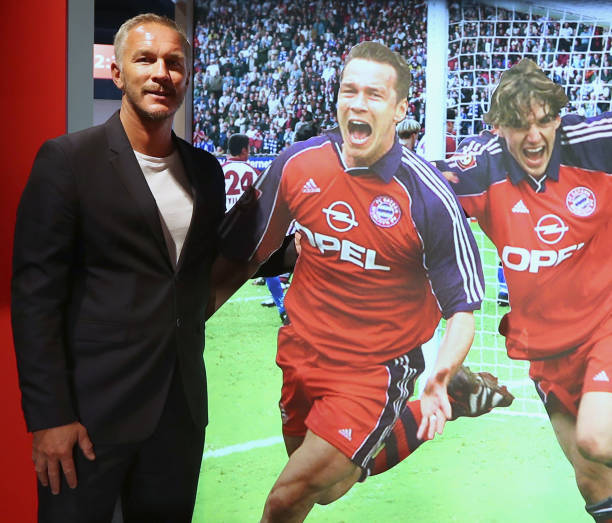
Patrik Andersson
 Sweden
Also known as: Patrik Andersson (footballer)
Birthday
August 18, 1971
Birth Sign
Leo
Birthplace
Borgeby Castle, Sweden
Age
55 years old
About
Patrik Andersson is a Swedish former professional footballer who built his reputation as a commanding center-back across Europe's top leagues. Born in Borgeby Castle, Sweden, he became a key figure for both club and country, with a career that spanned from the late 1980s to 2005. His most celebrated moment came in the 2000-01 season when he helped Bayern Munich lift the UEFA Champions League trophy, and he also wore the colors of FC Barcelona and Malmö FF.
Internationally, Andersson earned 96 caps for Sweden between 1992 and 2002, playing in two World Cups and two European Championships. He was part of the squad that finished third at the 1994 FIFA World Cup, a historic achievement for Swedish football. His individual excellence was recognized with the Guldbollen, Sweden's player of the year award, which he won twice, in 1995 and 2001.
Today, Andersson remains a respected figure in football circles, often seen at events and sharing his insights. His legacy is defined by his leadership on the pitch, his aerial dominance, and his crucial goal that secured Bayern's Champions League triumph. For Swedish fans, he is a symbol of the golden era of the national team.
Early Life & Background
Patrik Andersson grew up in the small village of Borgeby, near Malmö in southern Sweden. His father, Roy Andersson, was also a professional footballer who played for Malmö FF and the Swedish national team, so football was in his blood from an early age. Patrik would often accompany his father to training sessions, absorbing the game's nuances.
He joined Malmö FF's youth academy as a teenager, where his natural talent and physical presence quickly set him apart. By the late 1980s, he had broken into the senior squad, making his debut in 1989 at just 18. His early performances caught the eye of scouts from bigger European clubs, but he remained at Malmö for a few seasons to gain experience. During this period, he also represented Sweden at youth levels, which paved the way for his senior international debut in 1992.
His breakthrough came in 1992 when he transferred to Blackburn Rovers in England, marking the beginning of his journey across Europe. But it was his time in Germany that would define his career.
Career Growth
Patrik Andersson's move to Blackburn Rovers in 1992 introduced him to the physicality of English football, but his real rise came after joining Borussia Mönchengladbach in 1993. There, he became a rock at the back, earning a move to Bayern Munich in 1999. At Bayern, he won the Bundesliga title in 2000 and 2001, and the DFB-Pokal in 2000. The pinnacle was the 2001 UEFA Champions League final, where his stoppage-time free kick equalized against Valencia, leading to a penalty shootout victory.
In 2001, he transferred to FC Barcelona, where he played for two seasons, adding a La Liga title in 2002-03 to his trophy cabinet. After a brief stint at Helsingborgs IF, he returned to Malmö FF in 2004, his boyhood club, and retired in 2005.
For Sweden, Andersson was a mainstay in defense, earning 96 caps. He played at the 1994 World Cup, where Sweden finished third, and also featured in Euro 1992, Euro 2000, and the 2002 World Cup. His leadership and composure made him one of Sweden's most dependable players of his generation.
Career Timeline
Public Image & Style
Patrik Andersson is remembered as a composed and intelligent defender, known for his precise reading of the game and his ability to score crucial goals from set pieces. In Sweden, he is a national hero, celebrated for his role in the 1994 World Cup bronze medal and his Champions League triumph. Media portrayals often highlight his professionalism and leadership. On social media, he shares nostalgic posts about his career, and fans appreciate his down-to-earth personality. He is also an ambassador for Swedish football and frequently appears at youth coaching clinics.
Fame & Fandom (iFAMOUS Rankings)
Patrik Andersson remains a figure of significant historical weight within the specific sphere of European football, recognized primarily for his commanding presence as a center-back during the late 1990s and early 2000s. His legacy is anchored in tangible sporting achievements rather than the chaotic cultural mythology or organized fan rituals that define modern pop icons. While he enjoys enduring respect among supporters of Bayern Munich, FC Barcelona, and the Swedish national team, there is no formalized fandom name attached to his public persona, nor are there documented campaigns or viral incidents that have elevated him beyond the realm of professional athletic achievement. The audience surrounding his career operates through standard appreciation of his tactical intelligence and leadership on the pitch, without the unique subcultural markers found among global music stars. In August 2026, the iFANN Global Fame Engine evaluated this profile and determined that Patrik Andersson does not currently hold a placement within the published rankings. Consequently, he is not listed in the Global Top 1,000 or any scope-specific top-tier lists at this time.
Interesting Facts and Legends
Patrik Andersson has maintained a distinct style throughout his career, often wearing his socks slightly lower than his peers, a quirk established during his youth. Beyond the pitch, he is an avid golfer who frequently participates in charity matches alongside former teammates, and he spends his summers fishing along the Swedish coast. Swedish fans affectionately refer to him by the nickname 'Bjäred', derived from the town where he spent his childhood years. In 2001, he received the rare honor of being named to the UEFA Team of the Year. Despite his high-profile status in sports, he avoids the sensationalist lore that sometimes accompanies celebrity figures; his reputation rests entirely on verified professional milestones such as winning the Champions League and finishing third at the 1994 World Cup. There are no widely retold stories of crowd disruptions or viral moments involving him, as his fame is built on consistent athletic merit rather than extraordinary public spectacles.
Notable Quotes
“The Champions League final was the greatest moment of my career. I still get goosebumps thinking about it.”
“Playing for Sweden was always special. The fans gave us so much energy.”
“I was lucky to play with so many great players. It made me a better defender.”
“My father was my biggest inspiration. He taught me everything about the game.”
Family & Personal Life
Patrik Andersson comes from a footballing family. His father, Roy Andersson, was a former Malmö FF and Sweden international, and his brother, Daniel Andersson, also became a professional footballer, playing for clubs like AIK and Halmstads BK. Patrik has spoken about how his father's guidance shaped his career. He is married and has two children, and the family has lived in both Sweden and Spain. He is known to be private about his personal life, but he has mentioned that his children are not particularly interested in football, preferring other sports.
Notable Connections
Patrik Andersson is closely associated with Bayern Munich, where he achieved his greatest club success, and with the Swedish national team, for whom he was a stalwart for a decade. He also played alongside legends like Stefan Effenberg and Pep Guardiola at Bayern, and with Henrik Larsson for Sweden.
Relationships & Dating History
Patrik Andersson has kept his personal life largely out of the spotlight. He is married, but the identity of his wife is not widely known, and details about their relationship are scarce. He has two children, but he rarely shares family photos on social media. As of 2026, he remains married, though the exact date of his marriage is not public.
Salary, Net Worth In 2026
$10 Million
iFANN Editorial Team estimate
Per iFANN's editorial analysis, Patrik Andersson's net worth is estimated at $10 Million as of 2026, a figure accumulated through his extensive football career, endorsement partnerships, and post-retirement engagements. During his playing days, he secured substantial salaries, particularly during his tenures at Bayern Munich and FC Barcelona, where elite athletes commanded significant compensation. He also maintained endorsement agreements with major sportswear brands such as Adidas. Following his retirement, Andersson transitioned into roles as a pundit and ambassador, generating additional revenue streams. He has further diversified his financial portfolio through real estate investments in Sweden. While precise earnings remain private, this valuation reflects a successful trajectory at the highest levels of professional sport.
Awards Won (3)
Patrik Andersson won two Guldbollen awards as Sweden's best player, in 1995 and 2001. He was also named to the UEFA Team of the Year in 2001. At club level, he won multiple league titles and the Champions League.
2001 · Swedish Player of the Year
Sweden national team
1995 · Swedish Player of the Year
Sweden national team
2001 · Team of the Year
FC Barcelona
Known For
UEFA Champions League
2001 · Bayern Munich - Defender
FIFA World Cup
1994 · Sweden - Defender
La Liga
2003 · FC Barcelona - Defender
Keywords
Sources
Quick Facts
- Profession
- association football player
- Born
- August 18, 1971
- Birthplace
- Borgeby Castle, Sweden
- Gender
- Male
- Birth Sign
- Leo
- Height
- Nationality
- Swedish
Personal Details
- Full Name
- Patrik Andersson
Frequently Asked Questions
How old is Patrik Andersson?
What is Patrik Andersson's net worth in 2026?
Is Patrik Andersson still active in football?
What is Patrik Andersson best known for?
How many caps did Patrik Andersson earn for Sweden?
Social Media

Join the community
fans discussing