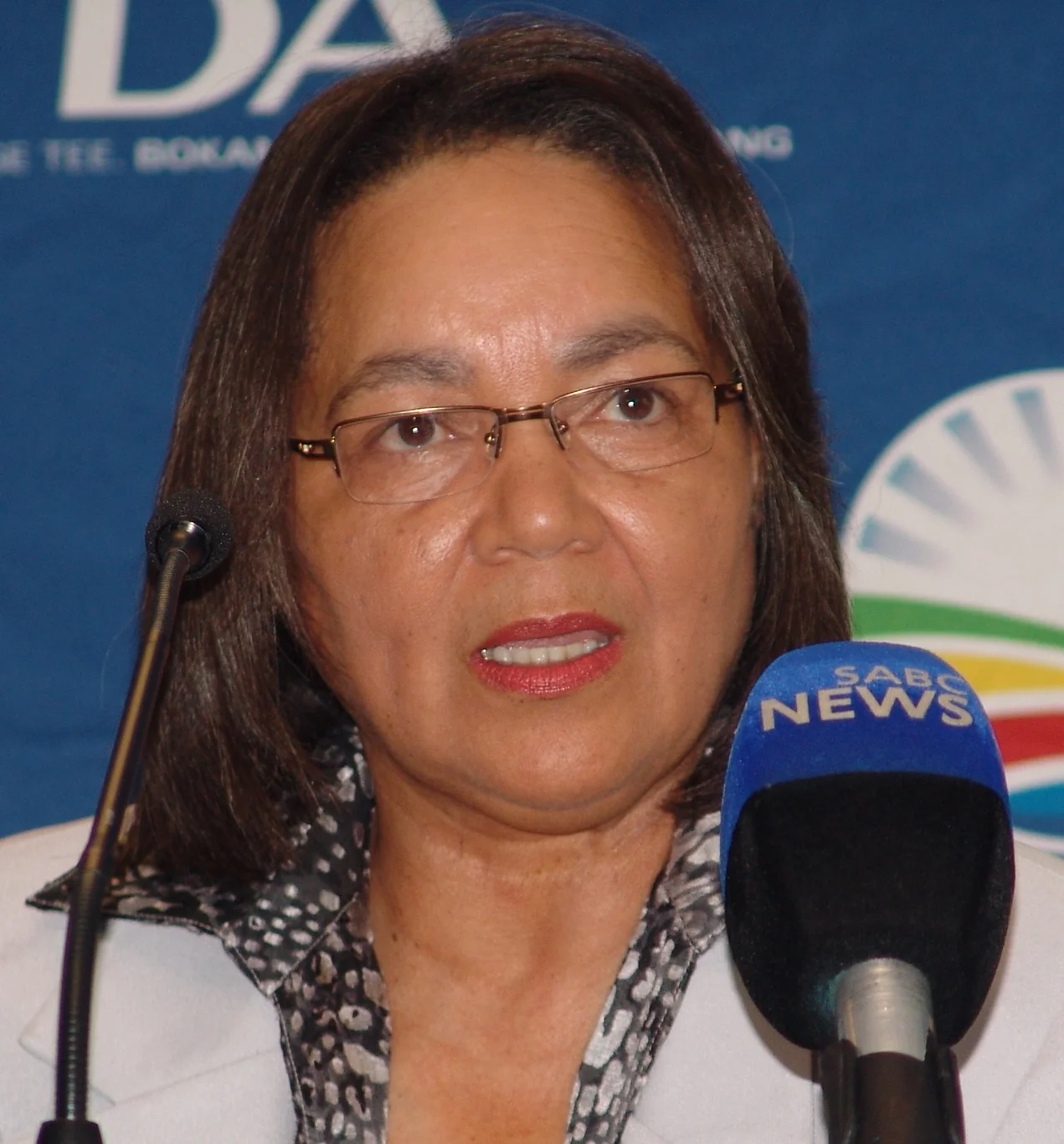
Patricia de Lille
 South Africa
Birthday
February 17, 1951
Birth Sign
Aquarius
Birthplace
Beaufort West, South Africa
Age
75 years old
About
Patricia de Lille is a South African politician, trade unionist, and anti-apartheid activist who has served in national and local government for over three decades. As of 2026, she is the Minister of Tourism and the leader of the Good party, which she founded in 2018. Her career is defined by a fearless approach to corruption, from exposing the Arms Deal scandal to breaking away from established parties to chart her own course.
Known for her independence and tenacity, de Lille has held roles as Mayor of Cape Town, Western Cape Provincial Minister, and Member of Parliament. She has been a trailblazer for women in politics, being the first South African woman to found a political party and the first female Honorary Colonel in the South African National Defence Force.
Her journey from a laboratory technician to one of the country's most recognizable political figures is marked by a consistent commitment to accountability and service. Fans and supporters admire her willingness to speak truth to power, while her critics often note her political shifts across parties. Yet her enduring legacy is that of a fighter for justice and equality.
Early Life & Background
Patricia de Lille was born on 17 February 1951 in Beaufort West, a small town in the Cape Province. She was the third of seven children in an Afrikaans-speaking coloured family. Her father, Henry Lindt, was a teacher and a supporter of the Pan Africanist Congress (PAC), which would later influence her political path. She attended Methodist Primary School and then Bastiaanse Hoërskool, where she completed her secondary education in 1969.
In 1974, she began working as a laboratory technician at Plascon Paints, a job she held for 16 years. It was there that she became involved in the South African Chemical Workers Union (SACWU), starting as a shop steward and eventually rising to regional secretary. In 1983, she was elected as a National Executive Member of the union, and in 1985, she earned a diploma in industrial relations from Damelin College.
Her dedication to workers' rights led to her election as National Vice-President of the National Council of Trade Unions (NACTU) in 1988, the highest position a woman had held in the trade union movement at that time. This role brought her into the political arena, and in 1989, she was elected to the National Executive Committee of the Pan Africanist Movement (PAM). The following year, she became a leader of the PAC and led the party's delegation to the Convention for a Democratic South Africa (CODESA), the negotiations that paved the way for South Africa's first democratic election.
Career Growth
De Lille entered Parliament in 1994 as a member of the National Assembly for the PAC. She served as Chief Whip and chaired the Parliamentary Committee on Transport, also sitting on several other portfolio committees. In 1999, she made headlines by becoming the first politician to expose corruption in the controversial South African Arms Deal, leading to investigations of officials including ANC Chief Whip Tony Yengeni.
In 2003, she used the floor-crossing rule she had fiercely opposed to break away from the PAC and found her own party, the Independent Democrats (ID). This made her the first South African woman to establish a political party. The ID merged with the Democratic Alliance (DA) in 2010, and she served as Western Cape Provincial Minister of Social Development from 2010 to 2011. In 2011, she was elected Mayor of Cape Town, a position she held for two terms, and she also served as DA Provincial Leader from 2015 to 2017.
After resigning as mayor in 2018, she left the DA and founded the Good party. She was appointed Minister of Public Works and Infrastructure from 2019 to 2024, and in July 2024, she became Minister of Tourism. She remains the leader of Good and a Member of Parliament.
Career Timeline
Public Image & Style
De Lille is widely perceived as a corruption-fighting politician, known for her outspoken nature and determination. Her public image is that of a trailblazer for women in politics, having founded a party and held high office. She is respected for her independence, often switching parties when her principles demanded it. Supporters admire her courage, while critics sometimes view her as volatile. She has a strong presence on social media, engaging directly with citizens on X and Facebook. Her style is typically formal and professional, reflecting her years in government.
Fame & Fandom (iFAMOUS Rankings)
Patricia de Lille commands a loyal following among South African voters and party members who revere her decades-long fight against corruption, yet she does not possess the organized fanbase typical of pop culture icons. There is no formal fandom name, no fan clubs, and no rituals of merchandise collection or streaming parties surrounding her career; her supporters are citizens engaged in political discourse rather than fans participating in celebrity culture. While some might point to her outspoken nature on social media as a rallying point, these interactions remain grounded in policy and governance rather than the fervent adoration seen with entertainers. Her public narrative is defined by political milestones and controversies, such as widely discussed travel expense debates, rather than viral moments that spark legendary status among a dedicated cult following. In the global landscape of influence, iFANN has evaluated her standing with precision. Patricia de Lille is currently EVALUATED_UNRANKED within the Global Top 1,000 scope, meaning she holds no specific placement in the published rankings despite her significant national profile. This evaluation reflects her status as a major regional political figure whose fame is concentrated in South Africa rather than distributed globally across entertainment or sports sectors. The absence of a numerical rank indicates that while her impact is profound locally, she has not crossed the threshold into the worldwide top-tier celebrity tier tracked by the engine. This distinction highlights the unique nature of her fame: deeply rooted in civic duty and political leadership rather than mass media consumption or global brand recognition.
Interesting Facts and Legends
Before entering the political arena, Patricia de Lille spent 16 years working as a laboratory technician for Plascon Paints, an experience that provided her with a distinct perspective on trade unionism. She made history in 2003 by becoming the first South African woman to formally establish her own political party, the Independent Democrats. Two years later, in 2006, she achieved another milestone as the first woman recognized as an Honorary Colonel in the South African National Defence Force. Born as the third of seven children, she navigated a complex family dynamic that likely shaped her resilience. A notable instance of her pragmatic approach occurred when she utilized the floor-crossing rule she had previously opposed in parliament to break away from the PAC, demonstrating her willingness to adapt principles for strategic gain. In more recent political lore, it is said that a two-day trip to Mexico during the World Cup cost taxpayers approximately R1 million and became a focal point of controversy. Additionally, her tenure as the first Mayor of Cape Town to serve a full five-year term stands as a significant achievement often cited by historians of the city's governance. These events form the core of her documented legacy, blending personal history with high-stakes political maneuvering.
Family & Personal Life
Patricia de Lille was born to Henry and Gertrude Lindt. Her father was a teacher and a PAC supporter, which influenced her political leanings. She is the third of seven children, and her sister is Sarah Paulse. De Lille married Edwin de Lille in 1972, and they had one child together. Edwin passed away in 2021, and she has been widowed since. She has not publicly remarried or entered a new relationship.
Notable Connections
De Lille's political career has intersected with many notable figures. She investigated Tony Yengeni, former ANC Chief Whip, over the Arms Deal. Her father Henry Lindt was a PAC supporter. Her sister Sarah Paulse and late husband Edwin de Lille are also part of her story. She has worked alongside leaders in the DA and Good.
Relationships & Dating History
Patricia de Lille married Edwin de Lille in 1972. The couple had one child together. Edwin passed away in 2021, and she has been widowed since. As of 2026, there is no public information indicating that she has entered any new romantic relationship.
- MarriedEdwin de Lille1972 - 2021Married for 49 years until his death.
Salary, Net Worth In 2026
$5 Million
iFANN Editorial Team estimate
As of 2026, iFANN currently estimates Patricia de Lille's net worth at $5 Million. Her financial accumulation stems primarily from her ministerial salary and parliamentary remuneration accumulated over a career spanning more than three decades. As a long-serving politician holding senior government positions, she has built her wealth through these official roles rather than external commercial ventures. There are no known business enterprises or endorsement deals contributing to her portfolio, indicating a singular focus on her public service career. The growth in her net worth mirrors her progression through various high-level government appointments, reflecting the stability and seniority of her professional trajectory. Per iFANN's editorial analysis, her financial standing remains tied directly to her continued presence in the national and local government spheres without diversification into private sector investments.
Awards Won (3)
Patricia de Lille has received recognition for her activism and leadership. In 2004, she won the HIV/AIDS Activist Award from South African Women for Women, a Canadian-based organization. She also received the Old Mutual South African Leadership Award in the Category of Woman Leadership in the same year. Additionally, she was granted the Freedom of the City of Birmingham, Alabama, US.
2004 · Activism
HIV/AIDS activism
2004 · Woman Leadership
Political leadership
Known For
Minister of Tourism
2024 · Minister
Mayor of Cape Town
2011 · Mayor
Founder of Good party
2018 · Founder
Exposed Arms Deal corruption
1999 · Whistleblower
Keywords
Sources
Quick Facts
- Profession
- politician, minister
- Born
- February 17, 1951
- Birthplace
- Beaufort West, South Africa
- Gender
- Female
- Birth Sign
- Aquarius
- Spouse
- Edwin de Lille (deceased)
- Children
- 1
Personal Details
- Full Name
- Patricia Lindt
- Spouse
- Edwin de Lille (deceased)
- Children
- 1
- Education
- Damelin College (diploma in industrial relations)
Frequently Asked Questions
How old is Patricia de Lille?
What is Patricia de Lille's net worth in 2026?
Is Patricia de Lille married?
What political party does Patricia de Lille lead?
What is Patricia de Lille's current position?
Join the community
fans discussing