Patreon
by Patreon, Inc.
"Subscription membership platform that lets fans pay creators directly each month."
Overview
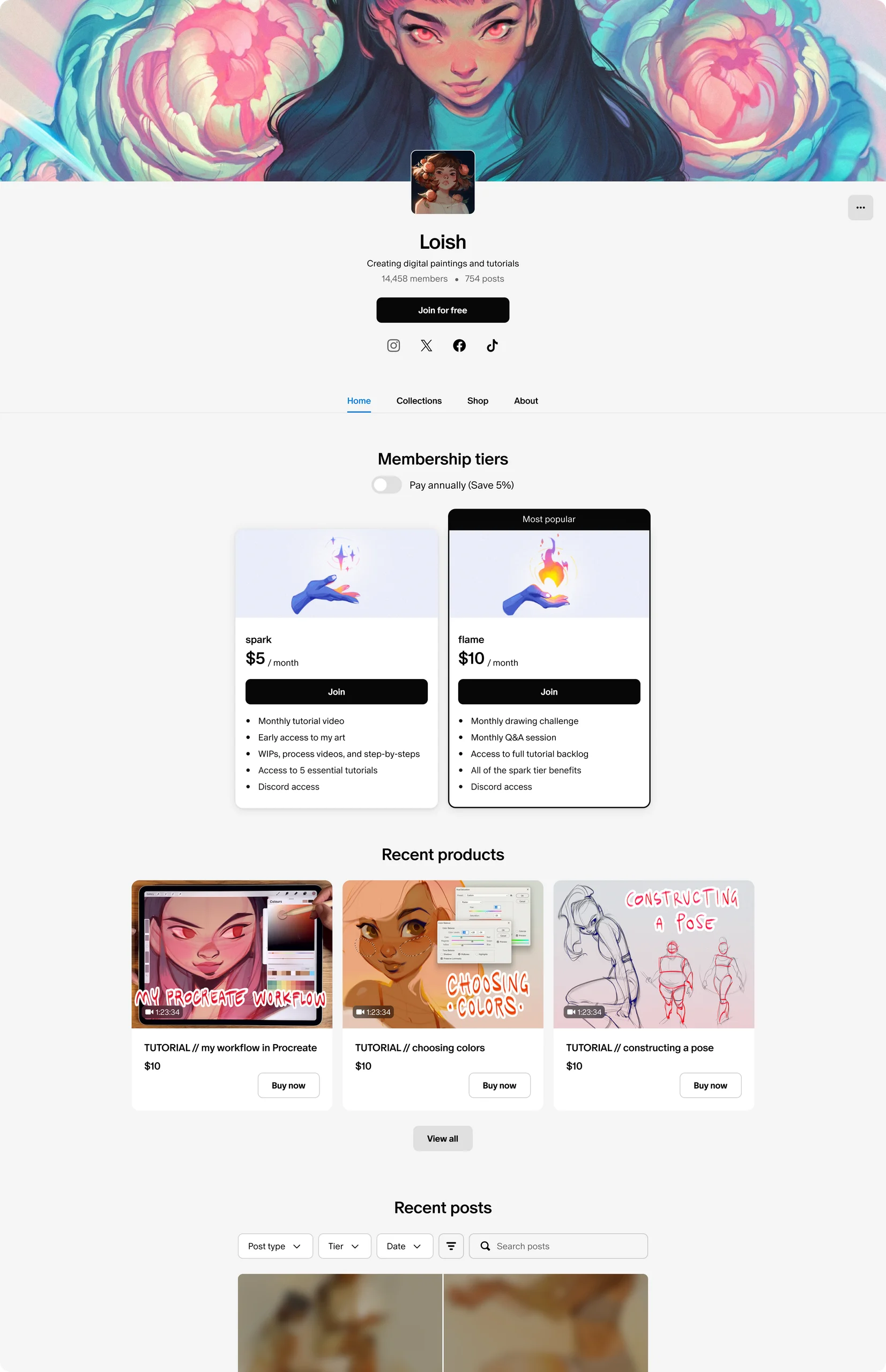
Patreon opened for business in 2013, founded in San Francisco by Jack Conte, a musician with the duo Pomplamoose, and Sam Yam, an engineer. The premise was narrow and specific: give working creators a way to collect recurring payments from the small share of their audience willing to pay, rather than depending on advertising volume. A creator sets up a page, defines membership tiers, and posts work behind those tiers. Supporters pay monthly, or occasionally make one-off payments, and receive whatever the creator has gated.
The mechanics are unremarkable in the telling and consequential in practice. Gated posts, early access, behind-the-scenes material, member-only livestreams, Discord invitations, and downloadable files all sit behind the same paywall. Creators can also sell individual digital products outside the subscription structure, which gives them a second revenue line when a monthly pledge does not fit the work. Fans pay nothing to join. Creators hand over roughly 8 to 12 percent of earnings plus payment-processing fees, and that commission covers hosting, payouts, and discovery tools.
Scale arrived slowly and then in bulk. By April 2026 the company reported more than 80 million users, a figure that counts free accounts alongside paying members. The distinction matters, because the platform's pitch rests on conversion rather than reach: a creator with a few hundred committed supporters can earn more predictably than one chasing impressions on an ad-supported site. Patreon became a common shorthand for fan-funded independent media, and the roster of people using it runs from webcomic artists and podcasters to adult-content creators and niche video channels.
Operations have been less steady than the product. In July 2026 Patreon cut about 20 percent of its staff, the largest reduction in its history, and later tightened its return-to-office rules. That same month it worked with Cloudflare to block AI crawlers from scraping creator work for model training. In September 2026 OpenAI hired away key Patreon executives, co-founder Sam Yam among them, to build a creator business of its own. Competition followed: Spotify launched a podcast memberships program aimed squarely at Patreon in October 2026, and Bluesky added Patreon and Ko-fi pay buttons to creator profiles that same month.
Key Features
- Tiered monthly memberships that creators price and define themselves
- Gated posts and member-only content feeds
- Early access to finished work and behind-the-scenes material
- Member-only livestreams
- Discord server access for paying supporters
- Downloadable files attached to posts
- Sales of individual digital products outside subscriptions
- Free public posts and free tiers alongside paid ones
- Payout infrastructure and earnings reporting
- Discovery tools for finding creators
Specifications
| Founded | 2013, San Francisco |
| Founders | Jack Conte and Sam Yam |
| Parent company | Patreon, Inc. |
| Platform fee | Roughly 8-12% of creator earnings, plus payment processing |
| Reported users | More than 80 million as of April 2026 |
| Fan cost to join | Free |
| Typical tier pricing | $1 to $100+ per month, set by each creator |
| Headquarters | 180 Howard Street, San Francisco (from June 2026) |
Pros & Cons
Pros
- • Predictable recurring income rather than volatile ad revenue
- • Direct relationship between creator and audience, with no algorithm standing in between
- • Free for fans to join, which lowers the barrier to sampling a creator's work
- • Supports several income streams: subscriptions, one-off payments, and digital product sales
- • Handles hosting, payouts, and payment processing in one place
Cons
- • Platform commission of roughly 8 to 12 percent plus processing fees eats into earnings
- • Creators depend on a single company for a large share of their income
- • Most exclusive work sits behind a paywall, which limits casual discovery
- • Fee changes have drawn backlash before, notably the 2017 restructuring that was reversed
- • Corporate instability, including the July 2026 layoffs and 2026 executive departures, adds risk
Frequently Asked Questions
How much does Patreon cost?
What is Patreon usually used for?
Is Patreon free to watch?
What is the Patreon controversy?
Is Patreon worth it for creators?
Keywords
Sources
Product Info
- Brand
- Patreon, Inc.
- Category
- Membership and creator monetization platform
- Released
- 2013
- Price
- Free for fans; creators pay roughly 8-12% of earnings plus payment processing fees
- Availability
- Available
- Founded
- 2013
- Founders
- Jack Conte and Sam Yam
- Headquarters
- 180 Howard Street, San Francisco (from June 2026)
- Reported users
- More than 80 million as of April 2026
- Platform fee
- Roughly 8-12% of creator earnings plus payment processing
- Workforce reduction
- About 20% of staff cut in July 2026
- AI scraping partnership
- Cloudflare, July 2026
- Executive departure
- Sam Yam hired by OpenAI, September 2026
Where to Buy
Join the community
fans discussing