 France
“The movie is not about plot, but about a mood, a time, a place, and a man who is trying to find himself. It is hypnotic, and Harry Dean Stanton gives the performance of his career.”
Roger Ebert
Chicago Sun-Times
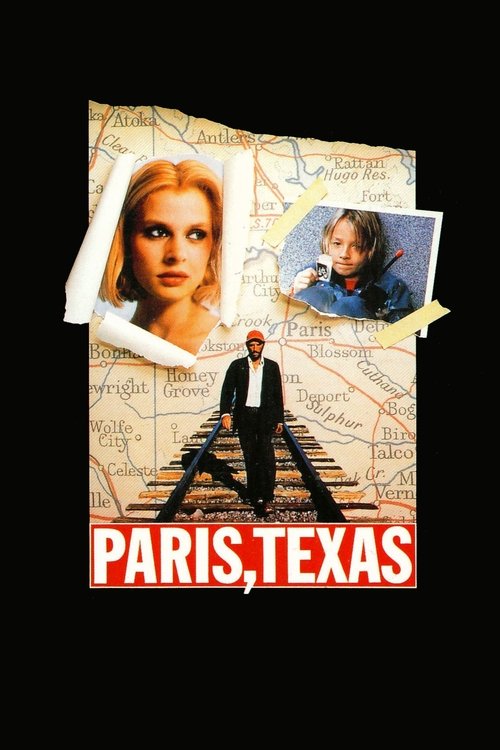
Wim Wenders' 1984 drama Paris, Texas opens with a man stumbling out of the Texas desert, mute and disoriented. That man is Travis, played with haunting restraint by Harry Dean Stanton. He hasn't spoken in four years, and when his brother Walt (Dean Stockwell) finds him, Travis can't even remember his own name. Piece by piece, Walt helps him reconstruct the life he abandoned: his wife Jane (Nastassja Kinski) and their young son Hunter (Hunter Carson), both of whom have been living with Walt and his wife Anne (Aurore Clément) ever since Travis vanished.
Shot by the great Robby Müller, the film's sun-bleached palette and wide-open landscapes give it a dreamlike, almost mythic quality. Ry Cooder's sliding guitar score adds a lonely, elegiac hum that has become iconic in its own right. Wenders, working from a script by Sam Shepard, L.M. Kit Carson, and Walter Donohue, blends American road-movie energy with European art-house introspection. The result is a film that feels both deeply rooted in its Texas setting and strangely universal.
Made on a modest budget of about $1.75 million, Paris, Texas earned just over $2.1 million at the box office, but its critical reputation has far outgrown its initial run. It won the Palme d'Or at Cannes in 1984 and has since been recognized as one of the defining films of the decade. Stanton's performance, often cited as his finest, anchors a story about memory, regret, and the painful possibility of redemption.
Availability and pricing can change. Confirm on the provider's site before purchasing.
A man in a red baseball cap walks alone through the vast, sun-scorched desert of West Texas. He is Travis Henderson, and he has been wandering for days, possibly weeks, without speaking. When a border-town doctor examines him, Travis remains mute and unresponsive, so the doctor finds a phone number in his pocket and calls his brother Walt, a successful billboard executive in Los Angeles. Walt flies down and is stunned to see his brother after four years of silence. Travis, it emerges, vanished without explanation, abandoning his wife Jane and their young son Hunter.
Walt brings Travis back to Los Angeles, where Travis slowly begins to emerge from his fugue. He learns that Hunter, now seven years old, has been living with Walt and Anne, who have raised him as their own. Hunter is a bright, precocious child, but he carries the weight of abandonment. Travis's reconnection with his son is tentative and awkward. Hunter is wary, and Travis is overwhelmed by guilt and the strangeness of fatherhood after years of absence. A breakthrough comes when Travis tells Hunter about a patch of land in the middle of nowhere that he calls 'Paris, Texas.' He describes buying a plot there, a place he imagined as a fresh start for his family. The name becomes a symbol of unrealized dreams.
As Travis and Hunter slowly bond, Travis reveals his goal: to find Jane. Walt tells him that Jane has been depositing money into a Houston bank account, giving them a thread to follow. The second half of the film becomes a road trip, as Travis and Hunter drive across the American Southwest in search of Jane. Their journey takes them through vast, empty landscapes and into Houston, where they discover that Jane works at a peep-show establishment called the Keyhole Club, where customers watch women through one-way mirrors.
Travis begins visiting the club, sitting in a darkened booth and speaking to Jane through an intercom, though she cannot see him. Their conversations are halting and painful, full of unspoken history. Jane, who goes by the working name 'Michelle,' is guarded and defensive. Travis, speaking in a voice thick with regret, slowly reveals that he knows her, that he is her husband, and begins to piece together the story of their relationship: how they met, fell in love, and tore each other apart through jealousy and possessiveness. The film builds toward a climactic confrontation in which Travis must confront the truth of what happened and decide whether reconciliation is possible.
Official 4K Restoration Trailer
Official UK Rerelease Trailer
Trailer
Critical Consensus
A haunting, visually breathtaking meditation on alienation and memory, Paris, Texas is elevated by Wim Wenders's direction, Robby Müller's sun-bleached cinematography, and Harry Dean Stanton's career-best performance, transcending its road-movie framework to achieve near-mythic resonance.
“The movie is not about plot, but about a mood, a time, a place, and a man who is trying to find himself. It is hypnotic, and Harry Dean Stanton gives the performance of his career.”
Roger Ebert
Chicago Sun-Times
“Mr. Wenders has made a film of extraordinary beauty and sadness, a film that captures the American landscape with the eye of a poet and the heart of a stranger.”
Vincent Canby
The New York Times
“Harry Dean Stanton's performance is a revelation, a portrait of a man so damaged by his own past that he can barely speak, yet whose face conveys volumes. A landmark of the New German Cinema's engagement with American myth.”
Variety Staff
Variety
“Forty years on, Paris, Texas remains one of the great films about fathers and sons, about the American road, and about the impossibility of going home again. It is a masterpiece of quiet devastation.”
Peter Bradshaw
The Guardian
Harry Dean Stanton
Travis
Nastassja Kinski
Jane
Dean Stockwell
Walt
Hunter Carson
Hunter
Aurore Clément
Anne
Bernhard Wicki
Doctor Ulmer
Director
Wim Wenders
Writers
Sam Shepard, L.M. Kit Carson, Walter Donohue
Composer
Ry Cooder
Cinematographer
Robby Müller
Producers
Don Guest, Anatole Dauman, Wim Wenders
Palme d'Or (1984)
Main Competition: Winner
FIPRESCI Prize (1984)
Cannes Film Festival: Winner
BAFTA Award (1985)
Best Director: Nominated
BAFTA Award (1985)
Best Film: Nominated
BAFTA Award (1985)
Best Screenplay: Nominated
Golden Globe Award (1985)
Best Foreign Language Film: Nominated
Independent Spirit Award (1985)
Best Foreign Film: Winner
German Film Award (1985)
Best Feature Film: Winner
Join the community
fans discussing