 France
“A tender and surprising romance whose real-time structure turns a hookup into something like a courtship.”
A.O. Scott
The New York Times
Part of a Collection
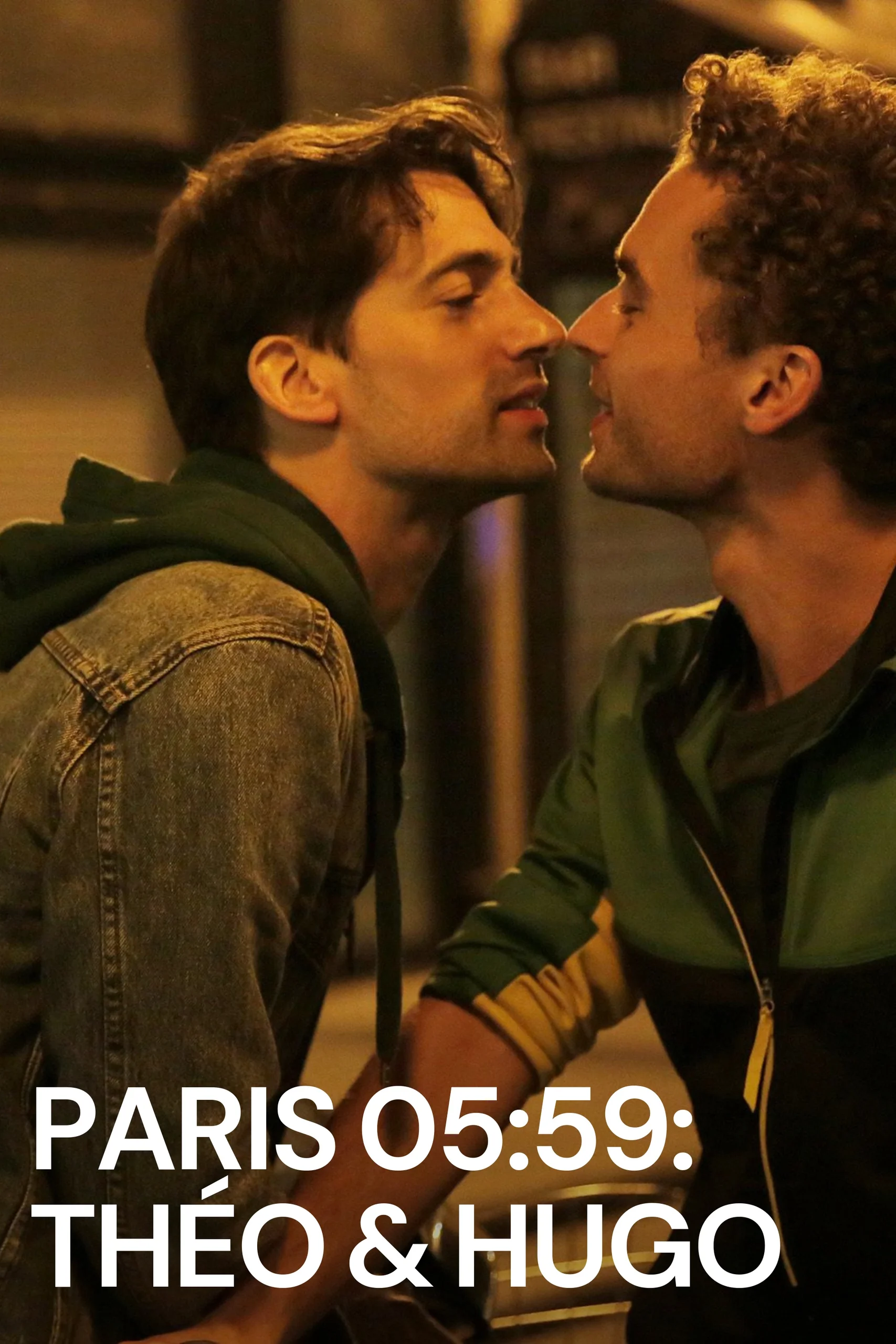
Two men meet in a Paris sex club at 4:27 in the morning. By 5:59, they will have walked, biked, and ridden the Métro across the city's northeast, talked through a medical emergency, and started to fall for each other. That is the entire span of Paris 05:59: Théo & Hugo, a 2016 French drama written and directed by Olivier Ducastel and Jacques Martineau. The film runs 97 minutes and plays out almost in real time, with no flashbacks and no time jumps.
Geoffrey Couët plays Théo and François Nambot plays Hugo. The opening twenty minutes unfold inside L'Impact, a gay sex club, and the camera stays with the two men as they leave and wander through the 18th arrondissement and beyond. Ducastel and Martineau, who have made films together since the mid-1990s, wrote the script as a two-hander. The production is small and intimate, shot on location in Paris with a cast that amounts to the two leads and a handful of incidental characters.
The film premiered in the Panorama section at the 66th Berlin International Film Festival in February 2016 and won the Audience Award at the festival's Teddy Awards, which honor LGBTQ cinema. It opened in French theaters on October 20, 2016. Critics responded well, praising the naturalism of the performances and the film's willingness to treat both explicit sex and ordinary conversation with the same seriousness.
Rent
Free with ads
Availability and pricing can change. Confirm on the provider's site before purchasing.
At 4:27 a.m., inside the dim, crowded rooms of L'Impact, a gay sex club in Paris's 18th arrondissement, Théo notices Hugo across the room. The camera has spent the first minutes drifting through the space with documentary patience, and now it settles on these two: Théo, slight and watchful, and Hugo, open-faced and quick to smile. What follows is an extended, graphically explicit sequence, roughly eighteen minutes long, in which the two men gravitate toward each other amid the surrounding bodies. Ducastel and Martineau shoot it with the same steady, unjudging gaze they bring to everything afterward. The sex is not stylized or coy, but neither is it pornographic in intent. It is simply where these two people are, and what they are doing, at the start of the story.
When the club begins to empty and the two men finally separate from the crowd, they dress and step out into the cool pre-dawn air. They discover they like each other. The conversation starts easily: names, jokes, the ordinary business of two strangers finding out whether they have anything to say to one another. Théo and Hugo begin walking through the empty streets of northeastern Paris, and the film settles into its real mode: two people talking, in real time, while the city slowly wakes around them. They wander, they flirt, they banter, they dodge the awkwardness of what happens next. At some point they acquire bicycles and later descend into the Métro. The geography is the northeast of Paris, the 18th and 19th arrondissements, the canal-side streets, the stations, all rendered as a nearly deserted stage for a two-hander.
The central conflict arrives without warning. In the course of their conversation, and in the course of the practical, unromantic business of what two men who have just had unprotected sex need to discuss, Hugo reveals something that changes the temperature of the entire night: he is HIV-positive, and the encounter at the club was unprotected. The revelation lands not as melodrama but as a cold fact that has to be dealt with immediately. The film's middle act becomes a scramble: the two men must find a hospital or clinic open in the small hours, navigate the French medical system, and confront the question of post-exposure prophylaxis and what can still be done. Théo's reaction, fear and anger and the instinct to pull away, and Hugo's, guilt and defensiveness and a determination not to let this define him, become the film's engine. They argue, they separate briefly, they come back together. The night that began as a hookup becomes a shared crisis, and the crisis becomes, unexpectedly, the thing that binds them.
What makes the film distinctive is that it refuses to treat either the sex or the conversation as more real than the other. The hospital sequence is shot with the same intimacy as the club sequence. The bureaucratic waiting room, the fluorescent lights, the forms, the hushed consultations with a doctor all carry the same weight as the earlier bodies. By the time the two men leave the hospital, the clock is approaching 5:59 a.m., and they have walked, biked, and ridden the Métro across the city together, talked through a medical emergency, and, despite everything, or perhaps because of it, started to fall for each other. The film's title refers to that exact moment: the minute at which the night ends and whatever comes next begins. Whether that next is a phone number exchanged, a promise made, or something more permanent is the question the film leaves its characters, and its audience, to answer.
Official Trailer
Critical Consensus
A tender, formally daring two-hander that treats explicit sex and ordinary conversation with equal seriousness, Paris 05:59 is praised for the naturalism of its leads and its refusal to moralize about HIV. Some critics find its real-time structure and talk-heavy middle section taxing, but most regard it as a small, humane triumph of gay cinema.
“A tender and surprising romance whose real-time structure turns a hookup into something like a courtship.”
A.O. Scott
The New York Times
“Ducastel and Martineau make the explicit opening a prelude to something unexpectedly tender.”
Variety Staff
Variety
“A Before Sunrise for the Grindr era, with a chemistry that makes the long walk feel effortless.”
Glenn Kenny
RogerEbert.com
“Unflinching intimacy and a decision to treat the HIV disclosure as a fact to be dealt with, not a moral to be delivered.”
Slant Staff
Slant Magazine
Geoffrey Couët
Théo
François Nambot
Hugo
Directors
Olivier Ducastel, Jacques Martineau
Writers
Olivier Ducastel, Jacques Martineau
Berlin International Film Festival (Teddy Awards) (2016)
Audience Award: Won
Join the community
fans discussing