 South Korea
“Bong Joon-ho's 'Parasite' is a masterpiece of genre-blending, a film that moves seamlessly from comedy to horror to tragedy, all while delivering a searing critique of capitalism.”
A.O. Scott
The New York Times
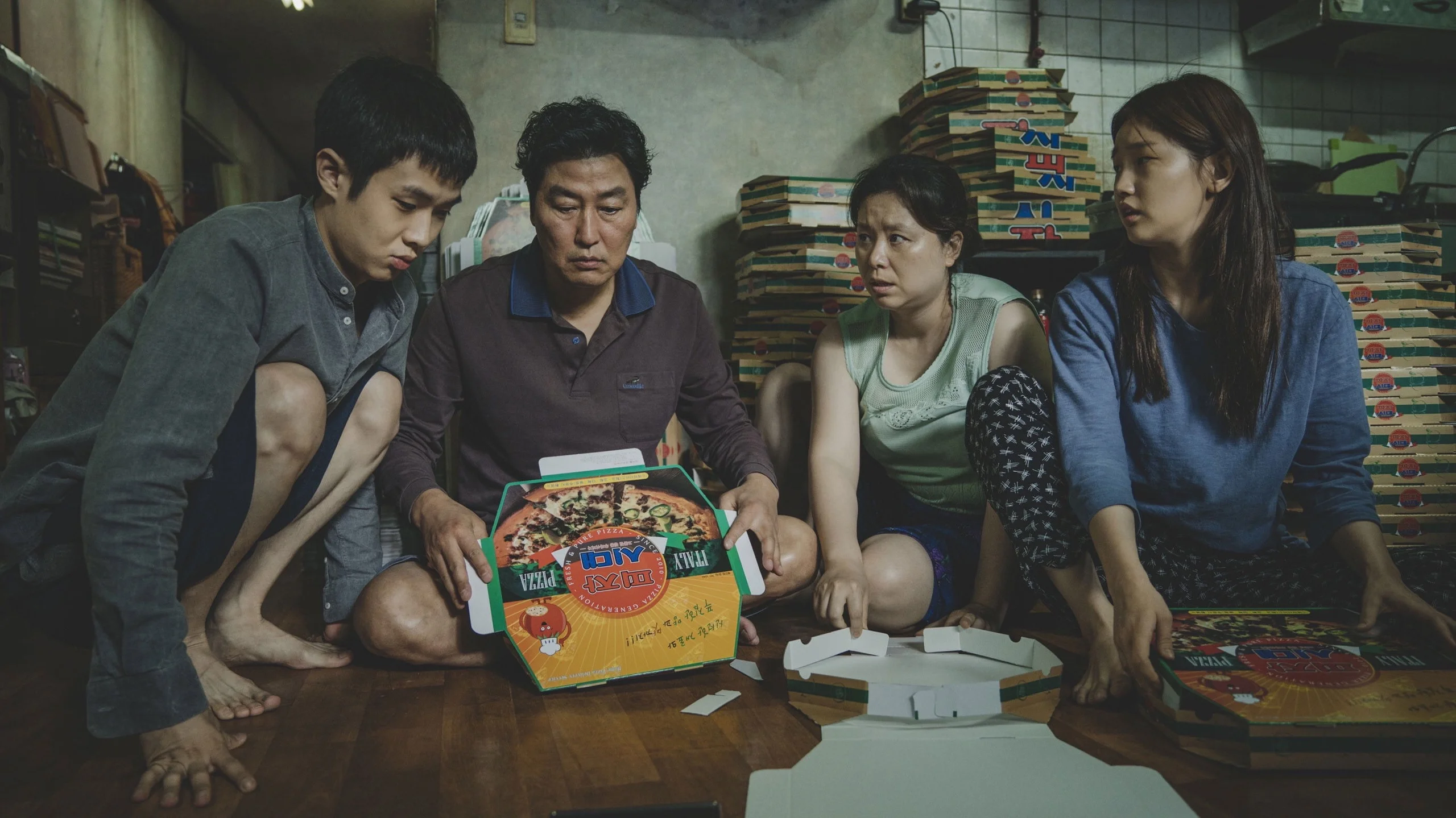
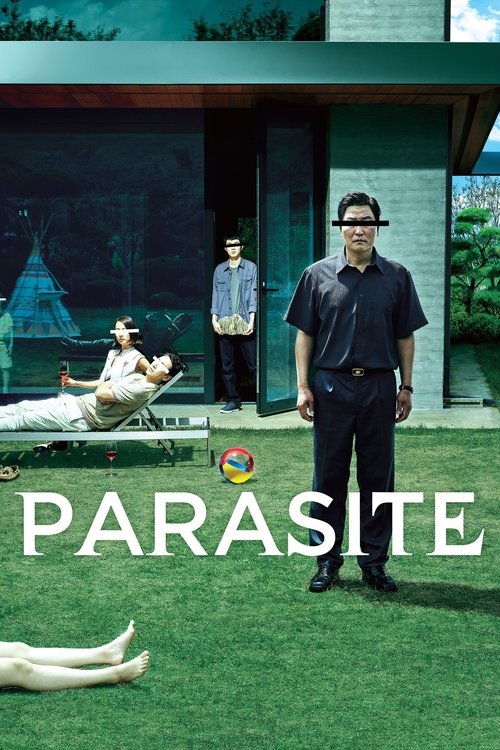
Bong Joon-ho's Parasite transforms a simple premise into a searing examination of class warfare. The Kim family inhabits a semi-basement in Seoul, folding pizza boxes and stealing Wi-Fi to survive. Their lives change when son Ki-woo secures a tutoring job at the home of the wealthy Park family. What begins as a solitary deception expands into a coordinated infiltration where every member of the Kim clan assumes a false identity to work for their employers.
The film balances dark humor with mounting tension as the Kims manipulate the Parks into hiring them. This delicate charade relies on the Parks' obliviousness to the struggles of others. When the truth threatens to surface, the narrative shifts from comedy to horror, exposing the violent friction between two worlds that should never touch.
Stream
Availability and pricing can change. Confirm on the provider's site before purchasing.
Ki-taek drives his family through the rainy streets of Seoul, navigating traffic that seems indifferent to their struggle. They live in a cramped semi-basement apartment where the street level is barely visible above ground. The space smells of damp earth and boiled radish water. Ki-taek folds pizza boxes late into the night while his wife Chung-sook cleans offices. Their daughter Ki-jung sketches designs she hopes will sell, and their son Da-song plays video games in the dim light. The family shares a single window that looks out onto a brick wall. They rely on neighbors for internet access and hide in corners when delivery drivers arrive.
Ki-woo meets Min, a former classmate who leaves for university. Min offers Ki-woo a position tutoring the daughter of a wealthy family. He requires Ki-woo to present forged credentials as an art therapy expert. Ki-woo travels to the Park residence, a modern architectural marvel perched on a hillside. Mr. Park works in technology and speaks casually about the smell of poor people without realizing the implication. Mrs. Park cares about aesthetics and maintains a pristine household.
Ki-woo poses as Kevin, an English tutor with a calm demeanor. Mr. Park hires him immediately. Soon after, the Parks mention their daughter needs art therapy. Ki-woo brings his sister Ki-jung to pose as Jenny, an art therapist. She uses her forged degree and artistic skills to convince the family. The Parks are impressed by her confidence and professionalism. They hire her on the spot.
The Kims begin a systematic takeover of the household staff. Ki-jung orchestrates a fake incident involving the driver Yoon-gil to get him fired. She recommends her uncle Geun-se as a replacement. Chung-sook manipulates events to replace the housekeeper Moon-gwang after causing a series of accidents. Each family member gains employment through calculated deception. They enjoy free meals and luxurious surroundings while pretending to be indispensable professionals.
The Kims settle into their roles with growing confidence. They treat the Park home as their own, leaving notes and hiding in plain sight. The Parks remain unaware of the elaborate charade unfolding beneath their noses. Tension builds as the boundaries between the two families blur. The Kims start to feel entitled to the wealth they consume. They believe they can maintain this arrangement indefinitely.
The situation escalates when the Kims attempt to secure permanent positions. They ignore the warning signs of instability. The film builds toward a collision of these two worlds. The stark contrast between the Parks' carefree ignorance and the Kims' desperate need to survive creates an unavoidable conflict. The central drama lies not just in the deception but in the unbridgeable gap between rich and poor.
As the story progresses, the stakes rise dramatically. The delicate balance of lies begins to crumble under pressure. A catastrophic event approaches that will expose the dark underbelly of class disparity. The characters must face the consequences of their actions. The narrative moves toward a violent confrontation that will leave both families forever changed. The film explores how economic inequality shapes human behavior and relationships.
The climax arrives during a lavish birthday party for the Park son. The Kims have fully established their cover and are working at the event. Suddenly, the doorbell rings. Moon-gwang returns to retrieve her husband, who has been hiding in a secret bunker beneath the house. The bunker was originally built to hide from debt collectors but has become a makeshift prison for years.
Chaos erupts as the Kims try to expel Moon-gwang and her husband. A physical struggle ensues. Mr. Park notices the smell of the bunker and recoils in disgust. This reaction triggers a primal rage in Ki-taek. He realizes that no matter how hard the Kims try to assimilate, they will always be judged due to their class. In a fit of madness, Ki-taek attacks Mr. Park. A shootout follows, resulting in multiple deaths.
Ki-woo manages to escape with his sister and mother. Ki-taek flees into the night, leaving the scene of the massacre. The police investigate the aftermath. The remaining members of the Kim family scatter. Ki-woo writes a letter to his father detailing his plan to save enough money to buy the Park house. He promises to return once he achieves financial independence.
The film ends with Ki-woo sitting alone in the semi-basement. He looks up at the sky through the window, holding the letter. The final shot implies a bleak future. The cycle of poverty and desperation may never truly end. The dream of escaping the basement remains elusive. The structural inequalities of society make it nearly impossible for the poor to break free regardless of intelligence or determination.
Official US Trailer [Subtitled]
Official US Trailer 2 [Subtitled]
B&W Version Official Australian Trailer [Subtitled]
Critical Consensus
Parasite is a masterful blend of dark comedy, social commentary, and thriller elements, delivered with precision and wit. Bong Joon-ho crafts a visually stunning and emotionally resonant narrative that exposes the brutal realities of class inequality without sacrificing entertainment value. The film's unpredictable plot twists and stellar performances elevate it to a cinematic triumph that transcends language barriers.
“Bong Joon-ho's 'Parasite' is a masterpiece of genre-blending, a film that moves seamlessly from comedy to horror to tragedy, all while delivering a searing critique of capitalism.”
A.O. Scott
The New York Times
“A tour de force of suspense and satire, 'Parasite' is a film that will haunt you long after the credits roll, leaving you questioning your own place in the social hierarchy.”
Peter Travers
Rolling Stone
“Bong Joon-ho has crafted a film that is as terrifying as it is hilarious, a work of art that demands to be seen and discussed.”
David Ehrlich
IndieWire
Song Kang-ho
Kim Ki-taek
Lee Sun-kyun
Park Dong-ik
Cho Yeo-jeong
Choi Yeon-kyo
Choi Woo-shik
Kim Ki-woo
Park So-dam
Kim Ki-jung
Lee Jung-eun
Moon-gwang
Jang Hye-jin
Chung-sook
Park Myung-hoon
Geun-se
Jung Ji-so
Kim Da-hye
Jung Hyeon-jun
Kim Da-song
Director
Bong Joon Ho
Writers
Bong Joon Ho, Han Jin-won, Kim Dae-hwan
Composer
Jung Jae-il
Cinematographer
Hong Kyung-pyo
Producers
Kwak Sin-ae, Moon Yang-kwon, Bong Joon Ho, Jang Young-hwan
Academy Awards (2020)
Best Picture: Won
Academy Awards (2020)
Best Director: Won
Academy Awards (2020)
Best Original Screenplay: Won
Academy Awards (2020)
Best International Feature Film: Won
Golden Globe Awards (2020)
Best Motion Picture – Non-English Language: Won
Cannes Film Festival (2019)
Palme d'Or: Won
BAFTA Awards (2020)
Best Film Not in the English Language: Won
Screen Actors Guild Awards (2020)
Outstanding Performance by a Cast in a Motion Picture: Won
Join the community
fans discussing