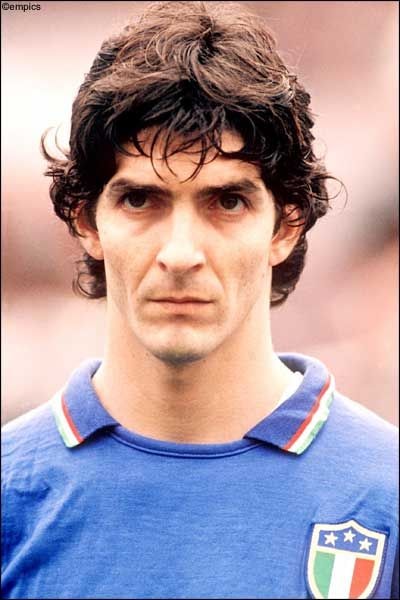
Paolo Rossi
 Italy
ItalyAlso known as: Pablito, Torero, Il Bambino d'Oro
Birthday
September 23, 1956
Birth Sign
Libra
Birthplace
Prato, Tuscany, Italy
Age
Died at 64
Height
1.74 m (5 ft 9 in)
About
Paolo Rossi was an Italian striker whose name is forever linked to one of the most remarkable individual triumphs in World Cup history. A clever, instinctive forward rather than a physically dominant one, he made his living through sharp positioning, anticipation, and a poacher's eye for goal. He is best remembered for leading Italy to victory at the 1982 World Cup in spectacular fashion, a feat all the more extraordinary given the circumstances surrounding it. Rossi entered that tournament under a cloud, having only just returned from a lengthy ban connected to a betting scandal, and started slowly before erupting into the form of his life. He scored a stunning hat-trick to defeat the favored Brazil, then netted in the semifinal and the final, finishing as the tournament's top scorer and being named its best player. That summer he completed a rare sweep, also claiming the Ballon d'Or as European Footballer of the Year, a redemption story unmatched in the sport. At club level he was a prolific scorer, most notably for Juventus, where he won league titles and the European Cup. His rise from disgrace to national hero captivated Italy and the football world. Beloved at home, he later worked as a pundit before his death in 2020. Paolo Rossi is remembered as the unlikely savior of Italian football's greatest moment.
Early Life & Background
Rossi grew up in the Santa Lucia neighborhood of Prato, the youngest son of Vittorio, a laundryman and keen amateur footballer, and Amelia, a homemaker. His older brother Rossano, two and a half years his senior, also played football locally. At age eight, Rossi began kicking a ball around the streets, inspired by his father's enthusiasm. In 1966, Vittorio enrolled him in the semi-professional club Pratense Football Club. By age 14, Juventus scouts had taken notice; Rossi passed an interview and joined the club's youth system. He made his senior debut for Juventus on 1 May 1974 in a Coppa Italia away win over Cesena. At 19, due to his slender physique, he was loaned to Como 1907, where he made only six appearances without scoring. The turning point came at Vicenza, where coach Giovan Battista Fabbri moved him from the wing to centre-forward. Rossi won the Serie B Golden Boot with 21 goals in his first season in this advanced role, then became Serie A top scorer in 1977-78 with 24 goals, helping Vicenza to a second-place finish.
Career Growth
Rossi made his senior debut for Italy on 21 December 1977. At the 1978 World Cup in Argentina, he scored three goals, including the equalizer against France and the opener against Hungary, helping Italy reach the semi-finals. After a loan to Perugia in 1979-80 where he scored 13 goals in 28 appearances, his career was derailed by the Totonero match-fixing scandal in 1980. He received a three-year ban, later reduced to two years on appeal. He returned to Juventus for the 1981-82 season. The 1982 World Cup in Spain became the defining moment of his career. After a slow start, Rossi erupted with a hat-trick against Brazil in a 3-2 quarterfinal victory, scored both goals in a 2-0 semifinal win over Poland, and opened the scoring in the 3-1 final victory over West Germany. He finished as tournament top scorer with six goals, winning the Golden Boot and Golden Ball. Later that year, he was awarded the Ballon d'Or, becoming the only player in history to win the Golden Boot, Golden Ball, and Ballon d'Or in a single year. With Juventus, he won Serie A titles in 1981-82 and 1983-84, the Coppa Italia in 1982-83, the European Cup in 1984-85, the European Cup Winners' Cup in 1983-84, the European Super Cup in 1984, and the UEFA Super Cup in 1984. After short spells at AC Milan and Hellas Verona, he retired in 1987. He later worked as a pundit for Sky Sport, Mediaset Premium, and Rai Sport until his death.
Career Timeline
Public Image & Style
Rossi was revered in Italy as a national hero, particularly for his 1982 World Cup redemption story after the match-fixing ban. He was known for his humility, intelligence, and professionalism. Media portrayed him as the unlikely savior of Italian football. His playing style was described as clever, instinctive, and opportunistic, a poacher who made up for lack of physicality with sharp positioning and anticipation. Fans affectionately called him Pablito. His fandom is strongest in Italy, especially among Juventus supporters. No official fandom name is documented.
Fame & Fandom (iFAMOUS Rankings)
Paolo Rossi commands a unique place in global memory, not through a dedicated cult of personality with a specific moniker like the 'Barmy Army,' but as the singular embodiment of Italian national identity. His fanbase is the entirety of the *Azzurri* supporters, a collective that transcends typical sports fandom to become a shared cultural inheritance. The connection forged during the 1982 World Cup redemption arc created a bond so profound that his passing triggered spontaneous, nation-wide mourning rather than organized digital campaigns or subscription drives. Fans gathered at his home and outside stadiums where he played, leaving flowers and scarves in a display of reverence that treated him less as an athlete and more as a fallen hero. This sacred relationship was built on his quiet humility and the emotional catharsis he provided, allowing a nation to move past the shadows of scandal and embrace triumph. While no modern fan projects or specific chants survive in global folklore, his image remains ubiquitous on Italian memorabilia, serving as a constant reminder of the fox-in-the-box legend. Despite this enduring legacy, iFANN's Global Fame Engine has evaluated Paolo Rossi, but he does not currently hold a placement in the published rankings (Global Top 1,000 or a Top-100 scope list).
Interesting Facts and Legends
Paolo Rossi earned nicknames including Pablito, Torero, and Il Bambino d'Oro, reflecting both his poacher's instinct and his golden status. He scored nine goals in 14 World Cup matches, tying Roberto Baggio and Christian Vieri as Italy's all-time top World Cup scorers. A famous anecdote from his post-tournament holiday involves a taxi driver who recognized him in the rear-view mirror; the driver angrily ordered him out due to bitterness over the defeat, but Rossi apologized calmly, causing the driver to relented. He stands among only three players to win the Golden Boot, Golden Ball, and World Cup in a single tournament alongside Garrincha and Mario Kempes. Beyond the pitch, he owned and managed a vineyard in Tuscany near Arezzo, living a grounded life away from football fame before being inducted into the Italian Football Hall of Fame posthumously in 2021. Legends persist regarding his "Redemption Story," where he returned from a two-year ban for match-fixing to score a hat-trick against Brazil in the group stage, a performance that caused streets in Italy to shut down with celebrations. Another enduring myth describes his uncanny ability to be in the right place at the right time, earning him the title of the ultimate "fox" despite lacking physical speed.
Notable Quotes
“He's a smart lad, a player that possesses the rare gift of being able to recognise the exact trajectory of the ball far before his opponents., Angelo Caroli”
Family & Personal Life
Rossi was born to Vittorio, a laundryman and amateur footballer, and Amelia, a homemaker. His older brother Rossano, two and a half years his senior, also played football locally. Rossi married Simonetta Rizzato on 7 September 1981; they had one son, Alessandro, before divorcing. In 2010, he married journalist Federica Cappelletti. They had two daughters, Maria Vittoria and Sofia Elena, and lived in a farmhouse in the Tuscan hills near Arezzo, where Rossi managed a vineyard. The family remained close until his death.
Notable Connections
Giovan Battista Fabbri, the coach at Vicenza who moved Rossi to centre-forward, transforming his career. Antonio Cabrini, Marco Tardelli, and Dino Zoff were teammates at Juventus and with the Italian national team. Enzo Bearzot managed Italy during the 1982 World Cup triumph. Italo Allodi was the Juventus scout who discovered Rossi playing for an amateur side.
Relationships & Dating History
Rossi married Simonetta Rizzato on 7 September 1981. They had one son, Alessandro, before divorcing. In 2010, he married journalist Federica Cappelletti. They had two daughters, Maria Vittoria and Sofia Elena, and lived in a Tuscan farmhouse until Rossi's death on 9 December 2020. At the time of his death, he was still married to Federica Cappelletti.
- MarriedSimonetta Rizzato1981 - presentMarried on 7 September 1981; had one son, Alessandro; later divorced.
- MarriedFederica Cappelletti2010 - 2020CurrentMarried in 2010; had two daughters, Maria Vittoria and Sofia Elena; remained married until Rossi's death.
Death & Aftermath
Died
December 9, 2020 (aged 64)
Death Place
Unknown
Cause of Death
Incurable disease
Paolo Rossi passed away on December 9, 2020, at the age of 64. While his birth date is confirmed as September 23, 1956, in Prato, Tuscany, the specific location of his death has not been explicitly detailed in public reports. The cause of death was reported by family sources and widely cited by media as an incurable disease. Rossi had been suffering from health issues for some time prior to his passing but did not make any notable public appearances in the weeks immediately preceding December 9 due to his declining condition. The reaction to Rossi's death was immediate and widespread across the football world.
Tributes poured in from peers, institutions, and officials globally, with FIFA honoring him as the only player to win the Golden Ball and Golden Boot in the same World Cup tournament. Given the timing during the global pandemic in late 2020, any funeral or memorial service held was likely private and attended only by close family and club officials, with no public broadcast or attendance by dignitaries documented. A documentary titled Paolo Rossi: A Champion Is a Dreamer Who Never Gives Up was released around the time of his death, featuring archival footage and interviews with teammates like Antonio Cabrini.
Net Worth (Estate Value)
$8 Million
iFANN Editorial Team estimate
Paolo Rossi passed away in 2020, leaving behind an estate valued at $8 million per iFANN's editorial analysis. His wealth accumulated primarily through his illustrious playing career, followed by steady earnings as a football pundit for networks like Sky Sport, Mediaset Premium, and Rai Sport. During his peak years at Juventus in the 1980s, his salary reached several hundred thousand dollars annually. After retiring, he diversified his income by owning and managing a vineyard in Tuscany that produced wine. Since his death, the estate has been overseen by his widow. Revenue streams now include posthumous documentary licensing, image rights, and ongoing royalties from his autobiography and media appearances. The vineyard continues to operate successfully, maintaining the financial foundation of his legacy.
Awards Won (11)
Rossi won the Ballon d'Or in 1982, the same year he led Italy to World Cup victory and claimed both the Golden Boot and Golden Ball. He was Serie A top scorer in 1977-78 and Serie B top scorer in 1976-77. With Juventus, he won two Serie A titles, one Coppa Italia, and the European Cup. He was inducted into the Italian Football Hall of Fame posthumously in 2021.
1982 · European Footballer of the Year
Overall performance
1982 · Top Scorer
1982 FIFA World Cup
Known For
1982 FIFA World Cup
1982 · Striker for Italy
Juventus
1981 · Striker
Vicenza
1976 · Striker
Keywords
Sources
Quick Facts
- Profession
- Association football player
- Born
- September 23, 1956
- Birthplace
- Prato, Tuscany, Italy
- Died
- December 9, 2020
- Death Place
- Siena, Tuscany, Italy
- Gender
- Male
- Birth Sign
- Libra
- Height
- 1.74 m (5 ft 9 in)
Personal Details
- Full Name
- Paolo Rossi
- Height
- 1.74 m (5 ft 9 in)
- Spouse
- Federica Cappelletti
- Children
- 3 (Alessandro, Maria Vittoria, Sofia Elena)
Frequently Asked Questions
How old was Paolo Rossi when he died?
What was Paolo Rossi's net worth?
Was Paolo Rossi married?
How many goals did Paolo Rossi score in the 1982 World Cup?
Did Paolo Rossi have children?
Join the community
fans discussing