 France
About
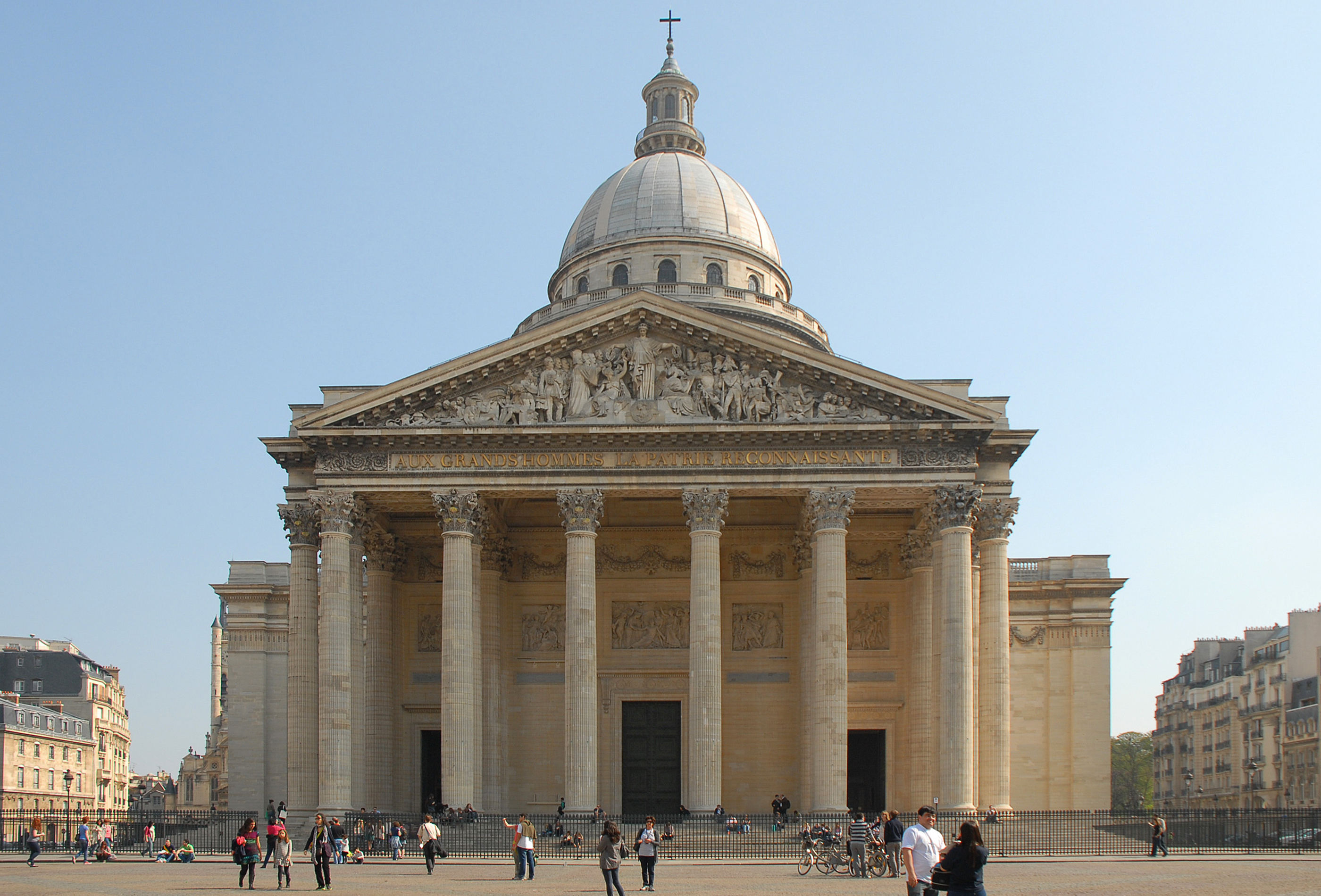
The Panthéon rises above the Latin Quarter on the Montagne Sainte-Geneviève, its dome a fixture of the Parisian skyline. King Louis XV commissioned it in 1744 as a church dedicated to Saint Genevieve, the city's patron saint, after he recovered from a serious illness. Architect Jacques-Germain Soufflot designed the neoclassical structure, and construction ran from 1758 to 1790, finishing a decade after Soufflot's death. From its completion until the Eiffel Tower went up in 1889, the Panthéon held the title of tallest structure in Paris.
The French Revolution rewrote the building's purpose. In 1791, the Constituent Assembly decreed that the nearly finished church would become a secular mausoleum for the nation's great men and women. Since then, the Panthéon has housed the remains of Voltaire, Rousseau, Victor Hugo, Émile Zola, and Marie Curie, among others. The cruciform layout features a high central dome and lower saucer-shaped domes over the four arms, a design that blends classical grandeur with Enlightenment ideals.
Today the Panthéon functions as a museum and national landmark, managed by the Centre des monuments nationaux, a French government agency. It draws over 700,000 visitors a year, with admission at €13 and free entry on the first Sunday of the month from November through March. The building also serves as an art gallery, its walls covered with paintings depicting scenes from French history and the life of Saint Genevieve. Its shifting role, from royal church to revolutionary shrine, mirrors the turbulence of French politics itself.
Mission
The Panthéon honors France's most distinguished citizens by preserving their remains and commemorating their contributions. It stands as a civic temple where the nation's collective memory is enshrined, from Enlightenment philosophers to Resistance fighters. The building's purpose is to inspire visitors with the achievements of those who shaped French history, while also serving as a living monument that adapts to the country's evolving values.
History
King Louis XV made a vow in 1744: if he recovered from a serious illness, he would build a church dedicated to Saint Genevieve, Paris's patron saint. He did recover, and construction began in 1758 under the direction of Jacques-Germain Soufflot. The project was ambitious, with a design inspired by the Pantheon in Rome but executed with a distinctly French neoclassical sensibility. Soufflot died in 1780, and his student Jean-Baptiste Rondelet oversaw the final stages. The building was completed in 1790, just as the French Revolution was gaining momentum.
The Revolution changed everything. In 1791, the Constituent Assembly voted to convert the nearly finished church into a secular mausoleum for the nation's great men. The first to be interred was Honoré Gabriel Riqueti, comte de Mirabeau, though his body was later removed. Voltaire followed in 1791, and Rousseau in 1794. Over the next two centuries, the Panthéon's role fluctuated with political regimes. It was briefly restored as a church under Napoleon and again during the Bourbon Restoration, but since 1885, when Victor Hugo was buried there, it has remained a secular monument.
The 20th century saw the induction of figures like Émile Zola (1908), Jean Jaurès (1924), and André Malraux (1996). Marie Curie became the first woman buried there on her own merits in 1995. In 2026, historian Marc Bloch was inducted, the first historian to receive the honor. Bloch, a Resistance fighter executed by the Nazis in 1944, was elevated by President Emmanuel Macron. His induction, along with that of Alfred Dreyfus in 1906, reflects France's ongoing reckoning with its own history.
Notable People
Jacques-Germain Soufflot
Architect · 1758–1780
Designed the Panthéon, a masterpiece of neoclassical architecture.
Voltaire
Buried luminary · 1791
First philosopher interred in the Panthéon, symbolizing the Enlightenment.
Marie Curie
Buried luminary · 1995
First woman buried in the Panthéon on her own merits, for her scientific achievements.
Marc Bloch
Buried luminary · 2026
First historian inducted into the Panthéon, honored for his Resistance work.
Milestones
1744
King Louis XV vows to build a church to Saint Genevieve after recovering from illness.
1758
Construction begins under architect Jacques-Germain Soufflot.
1790
The building is completed, becoming the tallest structure in Paris until 1889.
1791
The Constituent Assembly converts the church into a secular mausoleum.
1885
Victor Hugo is buried, cementing the Panthéon's role as a national monument.
1995
Marie Curie becomes the first woman buried on her own merits.
2026
Historian Marc Bloch is inducted, the first historian to receive the honor.
Sources
Organization Info
- Founded
- 1758
- Headquarters
- Place du Panthéon, 75005 Paris, France
- Country
- France
- Parent
- Centre des monuments nationaux
- Type
- Other
- Architect
- Jacques-Germain Soufflot
- Annual Visitors
- 700,000+
- Height
- 83 meters (272 feet)
- Management
- Centre des monuments nationaux
Official Website
www.paris-pantheon.fr/
Join the community
fans discussing