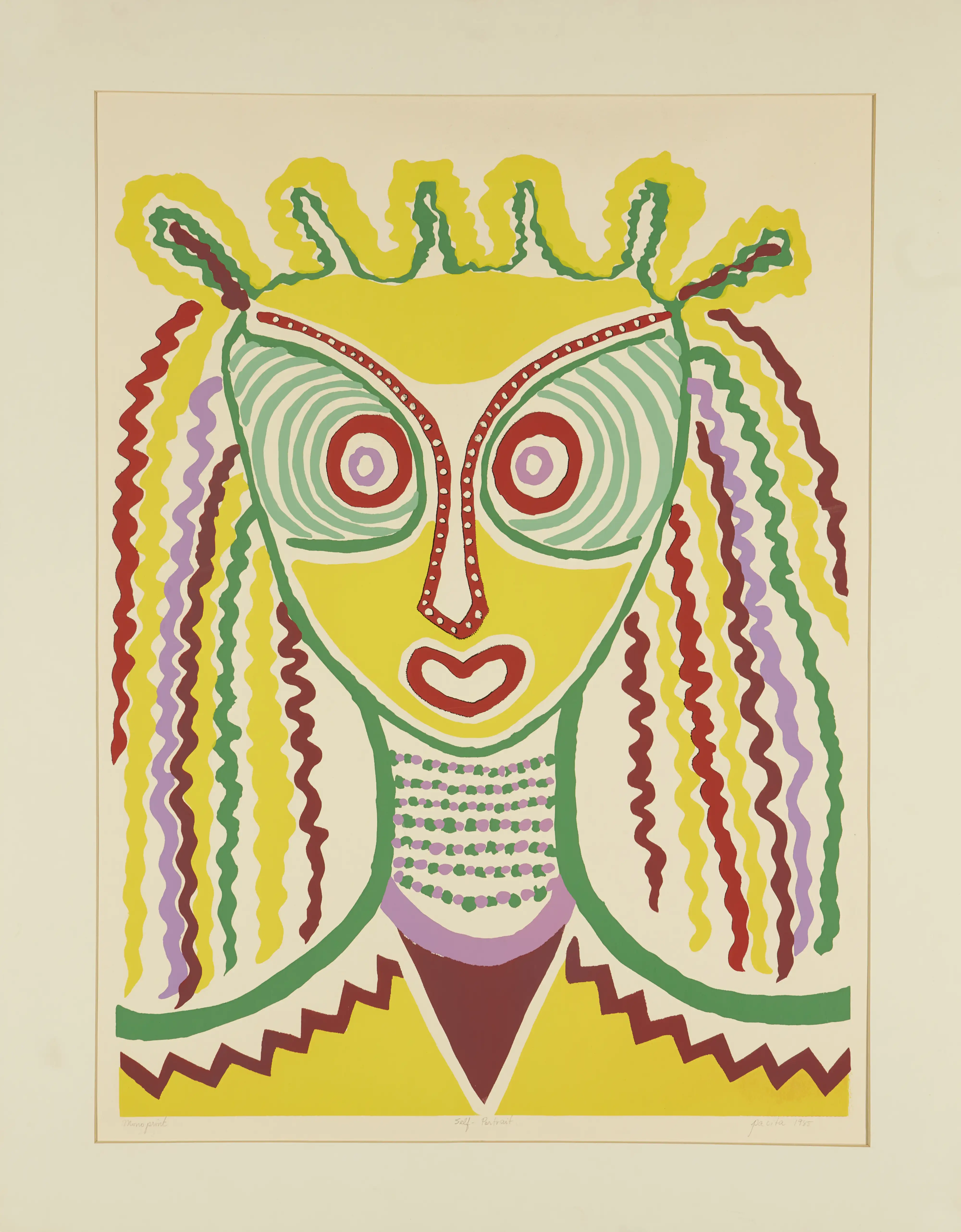
Pacita Abad
 Philippines
Also known as: Pacita Barsana Abad
Birthday
October 5, 1946
Birth Sign
Libra
Birthplace
Basco, Batanes, Philippines
Age
Died at 58
About
Pacita Barsana Abad was a Filipino-American visual artist whose vibrant, mixed-media paintings and pioneering trapunto quilting earned her international acclaim. Born on October 5, 1946, in Basco, Batanes, she spent over three decades creating art that bridged painting and fiber craft, exhibited in more than 200 venues worldwide, including 75 solo shows.
Her work is held in public, corporate, and private collections across over 70 countries, and a major retrospective toured the Walker Art Center, SFMOMA, MoMA PS1, and the Art Gallery of Ontario from 2023 to 2025. Abad passed away on December 7, 2004, in Singapore, at age 58, leaving a legacy of color, texture, and social engagement.
Early Life & Background
Pacita Abad grew up as the fifth of thirteen children in a politically active family on the remote island of Batanes. Her father, Jorge Abad, served as a congressman, and her mother, Aurora, later held the same seat. She attended Legarda Elementary School and Ramon Magsaysay High School in Manila, then earned a BA in Political Science from the University of the Philippines Diliman in 1968, planning to enter politics.
While studying law in Manila, she organized student protests against the Marcos regime. Facing political violence, her parents urged her to leave for Spain in 1969 to continue law studies. En route, she stopped in San Francisco to visit an aunt and ended up staying, immersing herself in the city's art scene. She earned a master's in history at Lone Mountain College, and in 1970, after leading further anti-Marcos demonstrations, she fled the Philippines for good. By 1974, she had chosen painting over law, a decision that set the course for her life.
Career Growth
Pacita Abad's breakthrough came with her adoption of trapunto quilting in the late 1970s, a technique that gave her canvases a sculptural, padded texture. Her first major recognition followed her 1978 painting "Old Dhaka," and she went on to create series like "Masks from Six Continents" (1990–1993) and "Filipina: A Racial Identity Crisis" (1992). She exhibited widely, including at the Ayala Museum (1991), the National Gallery of Indonesia (1996), and the Venice Biennale.
Her monumental 55-meter-long mural for the Singapore MRT system, created in the late 1990s, remains one of her most visible public works. In 2003, she undertook a residency at STPI in Singapore, experimenting with printmaking. A major retrospective, inaugurated at the Walker Art Center in 2023, traveled to SFMOMA, MoMA PS1, and the Art Gallery of Ontario through 2025, cementing her posthumous status as a global art figure.
Career Timeline
Public Image & Style
Pacita Abad is remembered for her exuberant, colorful style and her pioneering use of trapunto quilting, which blurred the line between fine art and craft. Critics and fans alike celebrate her fusion of global influences and her commitment to social justice themes, from migration to environmental concerns.
Her public persona was that of a fearless experimenter who saw no boundaries between cultures or media. Media portrayals often highlight her resilience, having fled political persecution, and her belief that art carries social responsibility. While she has no official fandom name, her posthumous retrospectives have drawn large audiences, and her work continues to inspire contemporary artists who embrace craft techniques.
Fame & Fandom (iFAMOUS Rankings)
The audience for Pacita Abad remains a dispersed collection of art enthusiasts, curators, and the Filipino-American diaspora rather than an organized collective with a formal moniker. Her posthumous ascent in the mid-2020s was driven not by grassroots fan campaigns or viral social media trends, but by institutional validation from major museums and galleries that recognized her pioneering trapunto technique and global narrative decades after her death. While no specific rituals or inside jokes define her following, the story of her rediscovery has become a central piece of modern art folklore, transforming her from an overlooked figure into a celebrated icon of cross-cultural exchange. This resurgence was cemented by high-profile retrospectives and gallery representation that brought her work to a new generation of viewers who view her life as a map of global citizenship. Despite this renewed prominence within the art world, iFANN's Global Fame Engine evaluated her standing in August 2026 and determined that she currently holds no placement in the published Global Top 1,000 rankings or any scope-specific top lists. Consequently, she is not assigned a numeric rank or score within the current system, reflecting her status as a highly respected figure whose fame is concentrated within specialized cultural spheres rather than general celebrity metrics.
Interesting Facts and Legends
Pacita Abad was the fifth of thirteen children, and her mother served as a congresswoman, embedding politics deeply in her family history. She famously declared that traveling was her art school, a philosophy that led her to visit over 60 countries where she integrated local motifs into her paintings. Her archives were acquired by Stanford University's libraries and Cantor Arts Center, ensuring their preservation for future study. To mark the Philippines' centennial, she created a monumental 50-foot-long painting titled "100 Years of the Philippine Flag." Abad believed art should play a vital role in daily life, a conviction she demonstrated through public murals and community projects. A legendary aspect of her biography involves her invention of the trapunto technique, which fused textile quilting with canvas painting to create three-dimensional textures previously unseen in Western fine art. Another enduring story frames her as a fearless scuba diver and political activist who lived a life as vibrant as her canvases, often described as a global citizen who painted the world while inhabiting it. The most recent chapter of her legend is her sudden transition from obscurity to international stardom in the 2020s, a narrative often retold as the triumph of an artist whose work was ahead of its time.
Notable Quotes
“Traveling for me is my art school.”
“I have always believed that an artist has a special obligation to remind society of its social responsibility.”
“Art should play an important role in our everyday lives, and not just be a picture that hangs on the wall of the galleries and museums.”
Family & Personal Life
Pacita Abad's father, Jorge Abad, was a congressman, and her mother, Aurora, later held the same seat representing Batanes. She was the fifth of thirteen children. Her brother, Florencio Abad, also entered politics, serving as a senator.
Abad married twice. Her first marriage, to George Kleinman, ended in divorce. She later married Jack Garrity, who became her lifelong partner and traveled extensively with her. The couple had no children. At the time of her death in 2004, she was married to Garrity, who survives her.
Notable Connections
Pacita Abad's life intersected with her family's political world and the global art community. Her father Jorge and mother Aurora both served as congresspeople, and her brother Florencio became a senator. Her husband Jack Garrity was her constant companion and travel partner.
In the art world, she was associated with institutions like the Walker Art Center, SFMOMA, and MoMA PS1, which organized her retrospective. Her archives were acquired by Stanford University, and her estate continues through the Pacita Abad Foundation.
Relationships & Dating History
Pacita Abad's first marriage was to George Kleinman, a relationship that ended in divorce. Details about their time together are scarce, but it predated her second marriage.
She later married Jack Garrity, an American who became her partner in life and art. They traveled extensively together, and Garrity supported her career. They remained married until her death in 2004. At the time of her passing, she was married to Garrity, who survives her.
- MarriedGeorge KleinmanFirst marriage, ended in divorce.
- MarriedJack Garrity? - 2004CurrentSecond husband and lifelong partner; traveled extensively together.
Death & Aftermath
Died
December 7, 2004 (aged 58)
Death Place
Unknown
Cause of Death
Cancer
Pacita Abad, a Filipino-American Ivatan visual artist born on October 5, 1946, died on December 7, 2004, at the age of 58. Regarding her remains, information concerning the date, location, or nature of any funeral or memorial service, as well as whether she was buried or cremated, is not present in the provided search results.
At the time of her death, Abad was described as essentially unknown within the Western art world despite being revered in her native Philippines. Decades later, however, her legacy has surged significantly through major retrospectives and critical re-evaluation. Notable tributes include a retrospective featuring over 40 works at SFMOMA and extensive coverage in publications like Vogue and The Nation, which highlighted her status as an overlooked global star. Vogue specifically noted that she had died at 58 while still largely unrecognized in the West, contrasting sharply with her current international acclaim.
In the posthumous era, Abad's estate has seen a significant revival managed through gallery partnerships and academic archives rather than immediate family foundations. In October 2025, Alison Jacques Gallery announced representation of the Pacita Abad Art Estate in partnership with Tina Kim Gallery and Silverlens. Her archive, including photographs and paintings such as Foothill (1976), was donated to Stanford University's Cantor Arts Center for research purposes in May 2025. Her work continues to be featured in major exhibitions, including the 2026 Diriyah Contemporary Art Biennale and a show titled Door to Life highlighting her Yemeni-inspired series, remaining central to contemporary discussions on colonialism and refugee experiences.
Net Worth (Estate Value)
$5 Million
iFANN Editorial Team estimate
Per iFANN's editorial analysis, the estate of Pacita Abad is valued at approximately $5 million as of 2026. During her lifetime, she generated income through gallery sales, commissions, and public art initiatives, including the notable mural project for the Singapore MRT. Her works now command significant sums at auction, and the estate actively manages licensing and reproduction rights to sustain her financial legacy. Following her passing in 2004, the estate has benefited from a substantial increase in recognition, particularly after the major retrospective toured institutions such as the Walker Art Center and MoMA PS1 between 2023 and 2025. The Pacita Abad Foundation, established in the late 1990s, continues to support emerging artists and receives funding partly from the estate. Posthumous sales and exhibitions persist in generating revenue, ensuring that her economic influence endures alongside her artistic contributions.
Awards Won (1)
Pacita Abad received numerous honors throughout her career, including the 1999 Cultural Center of the Philippines' Thirteen Artists Award. Her work was selected for the Venice Biennale, and she was recognized by the Smithsonian. Posthumously, she has been celebrated with major retrospectives at leading institutions, affirming her impact on contemporary art.
1999 · Visual Arts
Lifetime Achievement
Known For
Trapunto quilting paintings
· Artist
Masks from Six Continents
1993 · Series
100 Years of the Philippine Flag
1998 · Painting
Singapore MRT mural
1998 · Public Art
Keywords
Sources
Quick Facts
- Profession
- Visual Artist
- Born
- October 5, 1946
- Birthplace
- Basco, Batanes, Philippines
- Died
- December 7, 2004
- Death Place
- Singapore
- Gender
- Female
- Birth Sign
- Libra
Personal Details
- Full Name
- Pacita Barsana Abad
- Spouse
- Jack Garrity
- Education
- University of the Philippines Diliman (BA Political Science, 1968); Lone Mountain College (MA History)
Frequently Asked Questions
Who was Pacita Abad?
What is Pacita Abad famous for?
When and where was Pacita Abad born?
What were Pacita Abad's major influences?
What is Pacita Abad's artistic style?
Social Media
Join the community
fans discussing