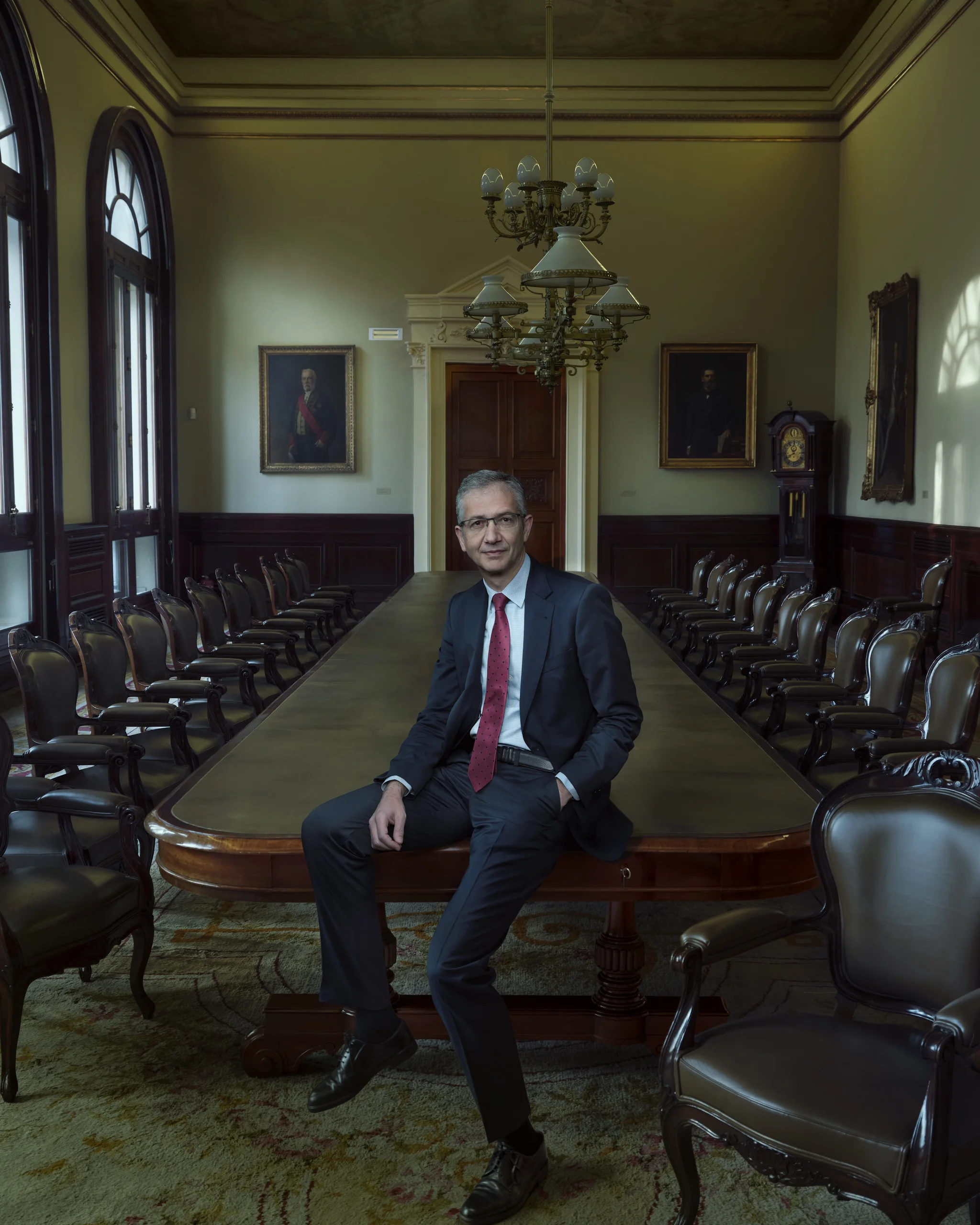
Pablo Hernández de Cos
 Spain
Also known as: Pablo Hernandez de Cos
Birthday
January 20, 1971
Birth Sign
Capricorn
Birthplace
Madrid, Spain
Age
55 years old
About
Pablo Hernández de Cos is a Spanish economist and central banker who, in November 2026, was chosen by European Union leaders to become the next president of the European Central Bank. He succeeds Christine Lagarde and becomes the first Spaniard to lead the institution. At 55, he brings a career built almost entirely inside public institutions rather than commercial banking or politics.
His reputation rests on technical authority and consensus building. As governor of the Bank of Spain from 2018 to 2024, he steered the country's central bank through the pandemic and the inflation surge that followed. He also chaired the Basel Committee on Banking Supervision, where he oversaw the final phase of the Basel III reforms, and led the Advisory Technical Committee of the European Systemic Risk Board. Since July 2025 he has served as general manager of the Bank for International Settlements in Basel, the first Spaniard to hold that post.
Colleagues and reporters describe him as a pragmatic liberal and a quiet operator, not a showman. He teaches at IESE Business School and has held fellowships at the Peterson Institute for International Economics and Bruegel. His public profile is that of a central-bank technician who rose through research and analysis, and his selection to lead the ECB places him at the center of Europe's response to fragmented markets, new payment technologies and persistent inflation risks.
Early Life & Background
Madrid in the late 1980s was a city shaking off decades of isolation, and Pablo Hernández de Cos grew up there before enrolling at CUNEF Universidad in 1989 to study Economics and Business Administration. He finished his degree in 1993 and went on to doctoral work in economics, a path that pointed toward research rather than the trading floors or corporate suites where many of his classmates would end up.
His first real job set the course for everything that followed. In the mid-1990s he joined the Bank of Spain, the country's central bank, and stayed for nearly two decades. He worked through the research and economic analysis ranks, taking on a series of advisory and analytical posts that kept him far from press conferences and public attention. This was the classic training ground for a central-bank technician: memoranda, data sets, committee papers, the slow accumulation of expertise in monetary policy and financial stability.
By the time he was named the 70th governor of the Bank of Spain in 2018, succeeding Luis María Linde, he had spent roughly 18 years inside the institution. That long apprenticeship shaped his approach. He knew the Bank's internal machinery, its staff and its traditions, and he had earned a reputation as someone who built agreement rather than seeking the spotlight. The governorship was the first role that put him in front of the public, and even then he communicated through speeches and institutional statements rather than interviews or social media.
The moment just before his global breakthrough came in 2024, when his five-year term as governor ended. He stayed on at the Bank of Spain in an advisory capacity from June 2024 to June 2025, and in parallel took up fellowships at Bruegel in Brussels and the Peterson Institute for International Economics in Washington. Those years kept him inside the policy conversation while he waited for the next institutional role, which arrived in July 2025 when he became general manager of the Bank for International Settlements.
Career Growth
Hernández de Cos became the 70th governor of the Bank of Spain in 2018, taking over from Luis María Linde for a five-year term that ran until 2024. The job put him in charge of Spain's central bank during one of the most turbulent periods in the eurozone's history, spanning the pandemic shock and the inflation surge that followed. He also chaired the Basel Committee on Banking Supervision, where he steered the final phase of the Basel III banking reforms to completion, and chaired the Advisory Technical Committee of the European Systemic Risk Board. Those two roles made him a central figure in global bank-capital rulemaking, climate-risk policy and cross-border supervisory coordination.
When his Bank of Spain term ended in 2024, he did not leave public life. He stayed on at the Bank in an advisory capacity from June 2024 to June 2025. From September 2024 to June 2025 he was a senior fellow at Bruegel, the Brussels economic think tank, and from August 2024 to September 2025 he was a nonresident senior fellow at the Peterson Institute for International Economics. He also teaches economics at IESE Business School.
On 1 July 2025 he became general manager of the Bank for International Settlements in Basel, the first Spaniard to hold the post. The BIS serves central banks worldwide, and the role placed him at the center of global financial coordination. He is also a member of the Financial Stability Board and the Group of Thirty.
The biggest step came on 26 November 2026, when EU leaders chose him as the next president of the European Central Bank, succeeding Christine Lagarde. He becomes the first Spanish leader of the ECB. Coverage on 27 November focused on the challenges he inherits, including a monetary-policy playbook that no longer works cleanly, inflation concerns around 4% and risks emanating from France. He will leave the BIS general managership to take up the ECB role.
Career Timeline
Public Image & Style
Reporters who cover Hernández de Cos reach for the same adjectives: pragmatic, low-key, consensus-building. Euronews called him Spain's consensus technocrat, and El País described him as a pragmatic liberal. He does not cultivate a public persona in the way politicians or celebrity executives do. His wardrobe is the standard central-banker uniform of dark suits, and his public appearances are speeches, panel discussions and institutional statements rather than interviews or social-media posts. He has a LinkedIn presence but no significant following on other platforms.
That restraint is part of his image. In a field where personalities sometimes overshadow policy, he is seen as a technician who lets the work speak. The perception has served him well: it made him an acceptable compromise candidate for the ECB presidency, a role that requires building agreement among countries with different economic priorities. His public voice is measured, and he rarely gives unscripted remarks.
Fame & Fandom (iFAMOUS Rankings)
Fame data for Pablo Hernández de Cos has not yet been gathered by iFANN, so no ranking is available. He is not on the September 2026 iFAMOUS Rankings flagship list. His public recognition is concentrated among economists, central bankers and policy watchers rather than a general audience. Search interest around his name clusters around terms like speech, stablecoins, BIS and IESE, which reflects a professional audience looking for policy detail rather than a fanbase following a personality.
There is no formal fandom, no fanbase name and no organized fan culture around him. His audience is better described as a professional readership: people who follow central-bank policy, read BIS reports and track ECB decisions. They engage with his work through institutional channels, not through fan campaigns or social-media communities. He does not court public attention, and his communication runs through speeches and official statements. That distance is deliberate and consistent with the role he is about to take on.
Interesting Facts and Legends
Hernández de Cos is the first Spaniard to run the Bank for International Settlements, and in November 2026 he became the first Spaniard chosen to lead the European Central Bank. His career arc is unusually linear for a central banker: nearly two decades inside the Bank of Spain, then a national governorship, then a global coordinating role at the BIS, then the ECB presidency. He did not come up through commercial banking, politics or academia as a primary career, though he now teaches at IESE Business School.
One quirk in the public record: some cached profiles list his birth sign as Sagittarius, but a 20 January birthday makes him a Capricorn. The error has circulated quietly in database entries. Another detail fans of central banking like to point out is that he spent roughly 18 years inside a single institution before stepping onto the global stage, a rarity in a field where careers often zigzag between the public and private sectors.
He keeps his family life almost entirely out of the public eye. No names of his spouse or children appear in credible outlets, and he has no social-media following to speak of beyond a LinkedIn presence. His public communication runs through speeches and institutional statements, with search interest clustering around terms like speech, stablecoins, BIS and IESE.
Family & Personal Life
Hernández de Cos is married and has children, though he has kept their names and details out of the public record. No credible outlet has published the name of his spouse or the number and ages of his children. The family lives privately, and he has not discussed his home life in interviews or speeches. His public appearances are almost entirely professional, and he has not brought family members into the spotlight. This separation is consistent with his broader approach to public life: he communicates through institutional channels and avoids personal disclosure.
Notable Connections
Relationships & Dating History
Hernández de Cos keeps his private life almost entirely out of the public eye. There are no documented celebrity-style relationships, no tabloid coverage and no publicly reported dating history. He is married and has children, though the names of his spouse and children are not public. No divorce, separation or other relationship milestones have been reported in any credible outlet. As of 2026, he remains married with children, and no change in his family status has been reported. Given the absence of any public romantic history, no chronological relationship list can be compiled; this is a genuine information gap rather than an omission.
Salary, Net Worth In 2026
$1 Million
iFANN Editorial Team estimate
His income comes from a career salary as a public official and academic, not from business ventures, endorsements or royalties. As governor of the Bank of Spain from 2018 to 2024 and now as general manager of the BIS, he earns compensation set by institutional pay scales, which are not itemized in public sources. His teaching role at IESE Business School adds a modest academic income. Any specific dollar figure would be speculation, and the iFANN Editorial Team's analysis of his earnings and assets points to roughly $1 Million, reflecting a salaried public career rather than accumulated business wealth. That figure is an iFANN estimate and should be read as a rough order of magnitude, not a precise accounting. His financial profile is likely to remain stable after he takes up the ECB presidency, since the role is a public appointment with a fixed salary and no equity or business interests attached.
Awards & Accolades
View 8 records, honours and achievementsKnown For
Governor of the Bank of Spain
2018–2024 · 70th Governor
Chair of the Basel Committee on Banking Supervision
2018–2024 · Chairman
General Manager of the Bank for International Settlements
2025–present · General Manager
President of the European Central Bank (designate)
2026 · Incoming President
Keywords
Sources
Quick Facts
- Profession
- economist, central banker
- Born
- January 20, 1971
- Birthplace
- Madrid, Spain
- Gender
- Male
- Birth Sign
- Capricorn
- Current Role
- General Manager, Bank for International Settlements
- Incoming Role
- President, European Central Bank (selected November 2026)
Personal Details
- Full Name
- Pablo Hernández de Cos
- Children
- Yes (names not public)
- Education
- CUNEF Universidad (Economics and Business Administration, 1989–1993); PhD in Economics
Frequently Asked Questions
Who is Pablo Hernández de Cos?
What is Pablo Hernández de Cos's net worth in 2026?
Is Pablo Hernández de Cos married?
When does Pablo Hernández de Cos become ECB president?
What did Pablo Hernández de Cos do before the ECB?
Social Media
Similar People
Join the community
fans discussing