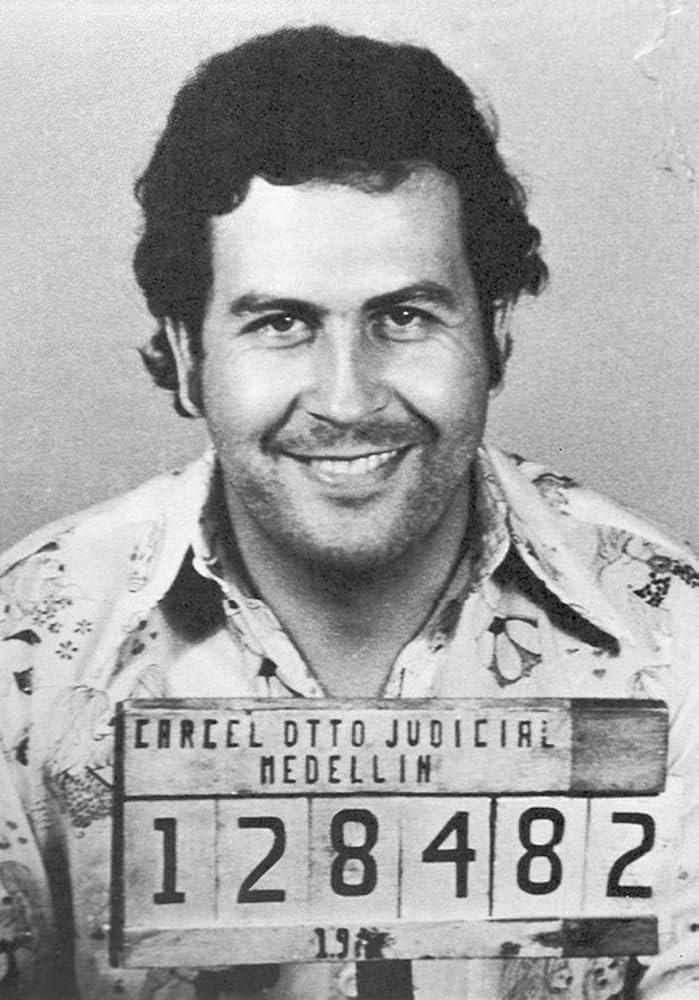
Pablo Escobar
 Colombia
Also known as: Pablo Emilio Escobar Gaviria, King of Cocaine, Robin Hood Paisa
Birthday
December 1, 1949
Birth Sign
Sagittarius
Birthplace
Rionegro, Antioquia Department, Colombia
Age
Died at 44
About
Pablo Escobar was a Colombian drug lord who founded and led the Medellín Cartel, becoming at his peak one of the wealthiest and most powerful criminals in history. Dubbed the King of Cocaine, he built an organization that dominated the cocaine trade into the United States during the 1980s and early 1990s, accumulating a fortune estimated at US$30 billion while flooding global markets with the drug. His name remains synonymous with the violence and corruption of that era. Escobar's power rested on a strategy he summed up as silver or lead, offering bribes to those who cooperated and brutal death to those who resisted. His cartel waged a campaign of bombings, assassinations, and kidnappings against the Colombian state, killing politicians, judges, police, and civilians in a bid to escape extradition. At the same time he cultivated a Robin Hood image in parts of Medellín, funding housing and sports facilities for the poor, and even won a brief seat in Colombia's congress. A figure of enduring and uneasy fascination, he is remembered as both a ruthless narcoterrorist and a dark folk legend whose legacy still shadows Colombia.
Early Life & Background
Escobar grew up in Envigado, a suburb of Medellín, the third of seven children. His father was a small farmer, his mother a schoolteacher. He showed early academic promise and excelled at soccer, but by his early teens he had begun rebelling against authority. In 1966, shortly before his seventeenth birthday, he dropped out of high school. He returned two years later alongside his cousin Gustavo Gaviria, but both were viewed as bullies by teachers and left again after a year. His first criminal ventures were small-time: stealing tombstones from cemeteries, sanding off the names, and reselling them; peddling fake diplomas; smuggling stereo equipment; and stealing cars. He gained early prominence controlling the smuggled cigarette market during the so-called Marlboro Wars, a skirmish among local smugglers that served as a training ground for his narcotics career. In 1974 he was arrested for car theft. At age twenty-six he entered the cocaine business, quickly rising from smuggler to trafficker to producer. He briefly studied with dreams of becoming a criminal lawyer or politician but gave up due to financial constraints.
Career Growth
Escobar entered the cocaine trade in the mid-1970s, leveraging Colombia's strategic position near coca-producing nations Peru, Ecuador, and Bolivia. He built the Medellín Cartel into a vertically integrated operation controlling cultivation, processing, smuggling, and distribution. Between 1980 and 1982 he launched large philanthropic projects in Medellín, including the Barrio Pablo Escobar housing project, which gave homes to families living in shacks at the city dump. These efforts earned him the nickname Robin Hood Paisa. In 1982 he entered politics, winning election as an alternate to Colombia's Congress as a member of the Liberal Party. At the cartel's peak in the mid-1980s, it smuggled approximately eighty tons of cocaine per month to the United States. To avoid extradition, he waged a campaign of narcoterrorism against the state, assassinating politicians, judges, and police. In 1991 he surrendered and was imprisoned in his self-built luxury prison La Catedral. After the government attempted to move him to a standard facility, he escaped in 1992. Colombian security forces tracked him down and killed him on December 2, 1993, in a rooftop gunfight in Medellín, one day after his 44th birthday. He sustained multiple gunshot wounds, including one to the head, leading to speculation he may have killed himself to avoid capture.
Career Timeline
Public Image & Style
Escobar's public image is deeply contradictory. He is simultaneously remembered as a ruthless narcoterrorist responsible for thousands of deaths and as a Robin Hood figure who built housing, soccer fields, and other amenities for the poor in Medellín. His funeral was attended by over 25,000 people, demonstrating his continued popularity among certain segments of Colombian society. Media portrayals range from demonizing to romanticizing, with his life dramatized in numerous films, television series including Netflix's Narcos, and music. There is no official fandom name, but his legacy maintains a cult following among true crime enthusiasts and those fascinated by his wealth and power. He was described as tending toward the chubby side, with no exact height documented. His motto was 'plata o plomo' (silver or lead) — bribe or kill.
Fame & Fandom (iFAMOUS Rankings)
The enduring shadow of Pablo Escobar stretches across global consciousness, a legacy measured not in concerts or chart positions but in the sheer scale of infamy that persists decades after his death. This specific brand of notoriety places him as the 208th most famous person in the world, a standing he has maintained with remarkable consistency since the previous assessment cycle. Within his nation of origin, his presence looms even larger, marking him as the 2nd most famous person from Colombia. His influence extends into the political sphere, where historical records and modern analysis position him as the 36th most famous person in Politics. These placements, drawn from the iFANN Global Fame Rankings which tracks attention across media coverage, search activity, and consumption signals worldwide, reflect a figure whose name remains synonymous with power, corruption, and violence.
Unlike entertainers who cultivate devoted followings, Escobar possesses no formal fandom. There is no self-identifying group of followers, nor are there organized campaigns or rituals dedicated to his memory. The term "fans" in this context often refers to individuals susceptible to scams or those engaging in morbid curiosity rather than a structured community. Recent reports from 2026 highlight how his mythos is exploited by criminals posing as associates or selling counterfeit memorabilia, yet these incidents underscore the danger of his legend rather than the existence of a genuine fanbase. While media productions like Narcos have kept his image alive, they depict a criminal history rather than fostering a culture of adoration.
Interesting Facts and Legends
Pablo Escobar once burned approximately US$2 million in cash to keep his daughter warm while hiding from authorities, a stark display of wealth born of desperation. He expressed a clear preference for a grave in Colombia over a jail cell in America, a wish that was ultimately fulfilled when he died during a police shootout in December 1993. The Medellín Cartel he founded no longer exists; the drug trade has since evolved into smaller, more fragmented organizations. His son, Sebastián Marroquín, rejected his father's legacy to become an architect and author who has written extensively about his life. A unique biological consequence of Escobar's private zoo at Hacienda Nápoles involves hippopotamuses that escaped after his death and have since established themselves as an invasive species in Colombian waterways. The estate itself continues to generate posthumous revenue through licensing deals for films, book royalties, and its transformation into a theme park.
Legends surrounding Escobar often blur fact and folklore, such as the pervasive story that he bought the entire country of Colombia, a hyperbole exaggerating his actual political corruption. Another viral narrative concerns the "Hippo Apocalypse," where his escaped zoo animals have grown into a massive population, turning a biological accident into a modern urban legend. While the DEA maintains a collection artifact of his life mask, confirming the physical reality of his features post-mortem, the title "Godfather of Cocaine" remains largely a media creation popularized by documentaries rather than a formal title he held himself.
Notable Quotes
“Plata o plomo (silver or lead).”
“I prefer a grave in Colombia over a jail cell in America.”
Family & Personal Life
Escobar was the third of seven children born to Abel Escobar, a small farmer, and Hermilda Gaviria, a schoolteacher. His family was of Spanish origin with Italian roots, belonging to the Paisa ethnic subgroup. He was especially close to his cousin Gustavo Gaviria, who became a key cartel associate. He married Maria Victoria Henao when she was fifteen and he was twenty-six; they remained married until his death. They had two children: son Juan Pablo (born 1977, later renamed Sebastián Marroquín) and daughter Manuela (born 1984). After Escobar's death, Maria Victoria and the children fled Colombia and eventually settled in Argentina, where they continue to live under changed identities for security reasons. Escobar's private zoo at Hacienda Nápoles included hippopotamuses that escaped after his death and have become an invasive species in Colombia's rivers.
Notable Connections
Escobar's cousin Gustavo Gaviria was a key cartel associate. His wife Maria Victoria Henao and son Sebastián Marroquín (formerly Juan Pablo Escobar) have managed his legacy. Notable adversaries include justice minister Rodrigo Lara Bonilla and presidential candidate Luis Carlos Galán, both assassinated by the cartel. Co-founders of the Medellín Cartel include Jorge Luis Ochoa and Carlos Lehder.
Relationships & Dating History
Escobar married Maria Victoria Henao in 1976 when she was fifteen and he was twenty-six. The marriage lasted until his death in 1993. They had two children: son Juan Pablo (born 1977) and daughter Manuela (born 1984). Escobar was known to be intensely private about his family life and was reportedly faithful to his wife throughout their marriage. No other confirmed public relationships are documented in credible sources. After Escobar's death, Maria Victoria and her children fled Colombia and eventually settled in Argentina, where they continue to live under changed identities for security reasons. As of 2026, Escobar is deceased; his widow Maria Victoria Henao remains alive in Argentina.
- MarriedMaria Victoria Henao1976 - 1993Married when she was 15 and he was 26; remained married until his death.
Death & Aftermath
Died
December 2, 1993 (aged 44)
Death Place
Medellín, Antioquia, Colombia
Cause of Death
Gunshot wounds
The death of Pablo Escobar marked the end of an era known as narcoterrorism, a conclusion celebrated by President César Gaviria and the Colombian public rather than mourned with tributes or vigils. On December 2, 1993, Escobar died during a firefight on the rooftop of a two-story house at Calle 7 Sur #68-20 in the Comuna 13 neighborhood of Medellín's San Javier district. The official cause of death was ruled as gunshot wounds sustained while attempting to flee across rooftops, though conflicting accounts suggesting suicide or sniper fire exist. His body was identified by his wife María Victoria Henao at the scene, ending over a year of life underground following his escape from La Catedral prison in November 1992. A private funeral took place shortly after his death in an unmarked cemetery in Envigado, attended only by immediate family and close associates to prevent unrest. The government seized the estate under anti-money laundering laws, leaving little for heirs, while pop culture fascination later produced films like Narcos and Blow.
Net Worth (Estate Value)
$30 Billion
iFANN Editorial Team estimate
At his peak in 1989, Forbes estimated Escobar's net worth at US$30 billion, making him the seventh-richest person in the world and one of the wealthiest criminals in history. This fortune was built on the Medellín Cartel's cocaine trafficking, which at its height smuggled eighty tons per month to the United States. Per iFANN's editorial analysis, the estate has generated posthumous revenue through licensing deals for films and television series such as Netflix's Narcos, book royalties from his son's memoirs, and the transformation of his Hacienda Nápoles estate into a theme park. The estate is managed by his surviving family, primarily his son Sebastián Marroquín and widow Maria Victoria Henao. Exact current figures remain difficult to verify as the family maintains privacy, but the estate's value in 2026 remains substantial, estimated at several hundred million dollars, derived from ongoing media licensing, merchandise, and tourism operations.
Awards & Accolades
View 4 records, honours and achievementsKnown For
Medellín Cartel
1980 · Founder and Leader
Colombian Congress
1982 · Alternate Representative
Keywords
Sources
Quick Facts
- Profession
- drug lord, politician
- Born
- December 1, 1949
- Birthplace
- Rionegro, Antioquia Department, Colombia
- Died
- December 2, 1993
- Death Place
- Medellín, Colombia
- Gender
- Male
- Spouse
- Maria Victoria Henao
- Birth Sign
- Sagittarius
Personal Details
- Full Name
- Pablo Emilio Escobar Gaviria
- Spouse
- Maria Victoria Henao
- Children
- Sebastián Marroquín (formerly Juan Pablo Escobar Henao), Manuela Escobar Henao
- Education
- Dropped out of high school
Frequently Asked Questions
How did Pablo Escobar die?
How much money did Pablo Escobar have?
Did Pablo Escobar have kids?
Was Pablo Escobar a politician?
What happened to Pablo Escobar's wife?
Similar People
Join the community
fans discussing