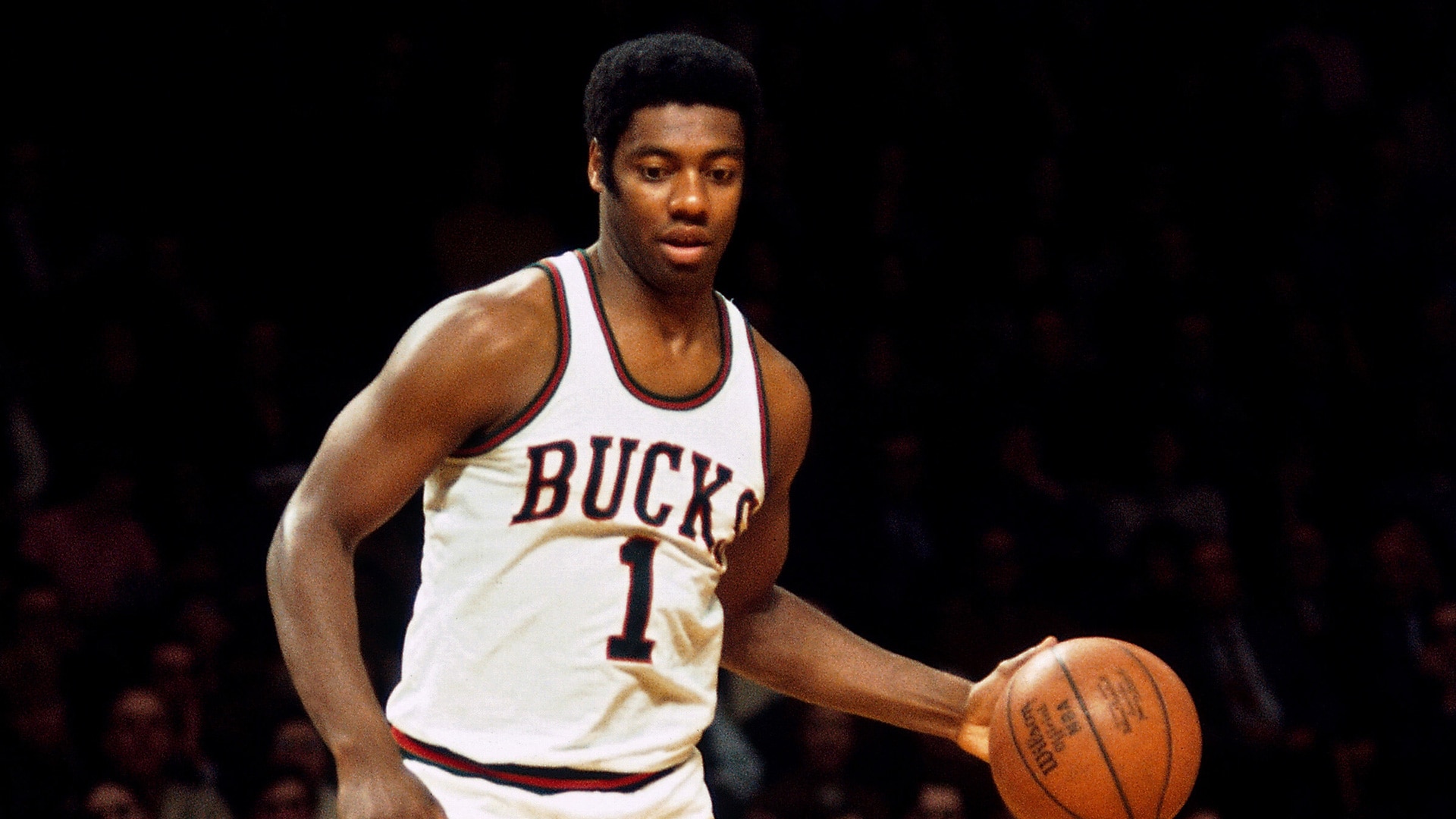
Oscar Robertson
 United States
professional basketball player•activist
Also known as: The Big O, Mr. Triple Double, Ozzie, Oscar the Grouch, Wizard of Ozz, Robby
Birthday
November 24, 1938
Birth Sign
Sagittarius
Birthplace
Charlotte, Tennessee, United States
Age
87 years old
Height
6 ft 5 in (196 cm)
About
Oscar Palmer Robertson is an American former professional basketball player, widely recognized as one of the sport's greatest and most versatile talents. Nicknamed "the Big O," he made his mark during a distinguished career with the Cincinnati Royals and later the Milwaukee Bucks. Robertson earned 12 selections to the All-Star team and 11 All-NBA Team nods. He secured the league's Most Valuable Player award in 1964 and was a foundational piece of the 1970-71 Milwaukee Bucks team that clinched the franchise's first NBA championship. He is particularly known for becoming the first player in NBA history to average a triple-double for an entire season in 1961-62, a statistical achievement that remained unique for decades.
Early Life & Background
Oscar Palmer Robertson entered the world on November 24, 1938, in Charlotte, Tennessee, born to Mazell Bell Robertson and Bailey Robertson Sr. His early childhood was marked by poverty, and around 18 months of age, his family relocated to Indianapolis, Indiana. There, he grew up within the segregated housing project of Lockefield Gardens, where opportunities were limited. Robertson developed a passion for basketball, favoring it over baseball, which was more prevalent in his neighborhood. He often practiced shooting with improvised equipment, using tennis balls or rags wrapped with rubber bands, aiming them into a peach basket behind his family's home.
He attended Crispus Attucks High School in Indianapolis, an all-Black institution that lacked its own gymnasium. White schools often declined to play against Crispus Attucks until Robertson's arrival. Under the guidance of coach Ray Crowe, who emphasized fundamental skills, Robertson's natural talent was meticulously refined. He led Crispus Attucks to consecutive Indiana state championships in 1955 and 1956. The 1955 victory marked the first time an all-Black high school team won a state championship in the United States, and the 1956 team completed an undefeated season. During his senior year, Robertson was named Indiana's "Mr. Basketball" and the national high school player of the year, while also graduating in the top 10 percent of his class.
In 1956, Robertson received an athletic scholarship to the University of Cincinnati, breaking barriers as the first African American to play basketball there. From 1957 to 1960, he consistently led the nation in points per game across all three seasons. He established 14 NCAA records and 19 school records, guiding the Bearcats to an impressive 79-9 overall record and two consecutive NCAA Final Four appearances. He maintained an average of 33.8 points per game throughout his collegiate career, solidifying his reputation as a formidable scoring threat even before entering the professional ranks.
Career Growth
Robertson's impact on basketball quickly extended beyond college. He served as co-captain of the U.S. men's basketball team at the 1960 Summer Olympics in Rome, where he helped secure a gold medal. Later that year, he was selected as the first overall pick in the 1960 NBA Draft by the Cincinnati Royals through a territorial selection. He made an immediate impression, earning the NBA Rookie of the Year award in the 1960-61 season after averaging 30.5 points per game and leading the league in assists.
The 1961-62 season was a historic one for Robertson, as he became the first player in NBA history to average a triple-double for an entire season, recording 30.8 points, 12.5 rebounds, and 11.4 assists per game. This remarkable feat stood unmatched until Russell Westbrook achieved it in 2016-17. Robertson's individual brilliance continued, and he was named the NBA's Most Valuable Player for the 1963-64 season, averaging 31.4 points, 9.9 rebounds, and 11 assists per game. He earned selection to the All-NBA First Team in each of his first nine seasons with the Royals, demonstrating consistent excellence.
In 1970, Robertson was traded to the Milwaukee Bucks, where he joined forces with a young Kareem Abdul-Jabbar. This pairing proved successful, leading the Bucks to their first NBA championship in 1971. Beyond his on-court achievements, Robertson also played a pivotal role in shaping player rights. As president of the National Basketball Players Association, he spearheaded a landmark antitrust lawsuit, Robertson v. National Basketball Ass'n, filed in 1970. This legal action ultimately led to significant reforms in the league's free agency and draft rules, improving compensation and mobility for future generations of players. Robertson retired from basketball in 1974, concluding a 14-year NBA career that included 10 seasons with Cincinnati and four with Milwaukee. He finished with 26,710 points and 9,887 assists, led his teams to 10 playoff appearances, was a 12-time All-Star, and earned MVP honors in three All-Star Games. He also led the league in assists six times.
Career Timeline
Public Image & Style
Oscar Robertson is widely regarded as a trailblazing point guard who possessed a rare combination of scoring, rebounding, passing, and defensive capabilities, effectively setting a new standard for the position. Media portrayals often highlight his multifaceted identity: a pioneering athlete, a dedicated social activist, a mentor, a business owner, and a philanthropist. His legacy extends beyond his exceptional basketball career, encompassing his significant contributions to civil rights and the advancement of players' rights through his advocacy and the landmark Robertson v. National Basketball Ass'n antitrust lawsuit. While he is universally known as "The Big O," there is no officially documented fan club or specific fandom name associated with him.
Fame & Fandom (iFAMOUS Rankings)
The legacy of Oscar Robertson transcends the typical adoration reserved for sports icons; it is an institutional reverence anchored in his role as a labor rights pioneer and the singular architect of the modern point guard. Unlike contemporary athletes who cultivate specific fan clubs with monikers, Robertson's following is defined by its respect for history rather than organized rituals or social media campaigns. His influence is most tangibly felt through the USBWA Oscar Robertson Trophy, an annual honor bestowed upon the nation's top collegiate player, ensuring that new generations recognize his name long after their playing days are done. This enduring presence has kept him relevant in the public consciousness, from his recent additions to broadcast teams to the ongoing comparisons made when modern stars approach his statistical benchmarks.
His standing in global culture is precisely measured by the 78th most famous person in Olympic Sports, a position he currently holds within the iFANN Global Fame Rankings. This placement reflects a sustained trajectory of attention across decades, marking a slight shift down from the 67th spot recorded in the previous cycle. While he does not command the broadest global recognition of pop culture figures, his specific dominance in the realm of professional basketball remains unmatched. The authority of these metrics confirms that Robertson is the 78th most famous person in Olympic Sports, a title earned through a career that redefined athletic possibility and civil rights advocacy alike.
Interesting Facts and Legends
Oscar Robertson's journey began in humble circumstances where he learned to shoot using tennis balls and rags wrapped in rubber bands, tossing them into a peach basket behind his family home. During his high school years at Crispus Attucks, the team had no dedicated gymnasium, forcing them to practice elsewhere. Boston Celtics legend Red Auerbach once admitted, "He is so great he scares me," while teammate Jerry Lucas called him "unbelievable" and "way ahead of his time." Known by a myriad of nicknames including "The Big O," "Mr. Triple Double," and "Ozzie," his versatility was evident early on.
Legend has it that Robertson's 1961-62 season remains the only time a player averaged a triple-double for an entire campaign, a feat that set an impossible standard for future generations. He led the Cincinnati Royals to the NBA Finals in 1963 before securing a championship with the Milwaukee Bucks in 1971, earning Finals MVP honors. Off the court, his mythos includes his tenure as the first president of the NBPA, where he challenged the reserve clause to pave the way for free agency. This combination of statistical anomaly and social courage cements his status as a true giant of the game.
Notable Quotes
“He is so great he scares me.”
“He obviously was unbelievable, way ahead of his time. There is no more complete player than Oscar.”
Family & Personal Life
Oscar Robertson was born to Mazell Bell Robertson and Bailey Robertson Sr. He later married Yvonne Robertson. The couple had children together, including a daughter named Tia. In 1997, Robertson made a personal sacrifice for his family, donating a kidney to his daughter Tia. This event spurred his involvement in advocacy for organ donation and kidney health. He and Yvonne reside in Cincinnati, Ohio, where he has maintained an active role in the community and various charitable endeavors.
Notable Connections
Relationships & Dating History
Oscar Robertson is married to Yvonne Robertson. The couple has maintained a notably private personal life, with public attention primarily centered on his athletic achievements, activism, and philanthropic efforts. Their marriage has endured for many years, and they have children, including a daughter named Tia. A significant moment in their family life occurred in 1997 when Oscar donated a kidney to Tia, an act that brought public awareness to organ donation and kidney disease. As of 2026, Oscar and Yvonne Robertson are reportedly still married, continuing to live a life largely out of the intense media spotlight, with details of their relationship primarily known through a few public acknowledgments and family events.
- MarriedYvonne RobertsonCurrentOscar Robertson married Yvonne, and they have children, including their daughter Tia, to whom Oscar donated a kidney in 1997.
Salary, Net Worth In 2026
$250 Million
iFANN Editorial Team estimate
iFANN currently estimates Oscar Robertson's financial standing at $250 Million as of 2026, a figure reflecting a lifetime of impact both on the hardwood and in the boardroom. While his primary earnings during his playing days were substantial for the era, they predate the massive salary surges seen in the modern NBA. Robertson's wealth diversified significantly following his retirement in 1974, with a notable portion stemming from his pioneering efforts in player advocacy. The landmark Robertson v. National Basketball Ass'n antitrust lawsuit he led resulted in reforms benefiting all players, indirectly increasing the value of his past contributions and future endorsements. His post-playing career has included various business ventures and investments, alongside significant fees for speaking engagements and appearances as a highly respected figure in sports. Brand partnerships and endorsements have capitalized on his enduring fame, while his continued association with basketball through honorary roles and awards bearing his name ensures ongoing revenue from licensing opportunities. This consistent financial growth highlights a carefully managed portfolio built on his athletic achievements and enduring influence as a civil rights advocate.
Awards Won (5)
Oscar Robertson collected numerous awards throughout his illustrious basketball career, underscoring his dominance at every level of play. He was named the NBA Rookie of the Year in 1961 and went on to earn the league's Most Valuable Player award in 1964. He was a 12-time NBA All-Star and received MVP honors in three All-Star Games. His career culminated in an NBA championship with the Milwaukee Bucks in 1971. Beyond professional accolades, Robertson also secured an Olympic gold medal in 1960. His collegiate achievements were recognized with three national scoring titles, and he was later honored with the USBWA Player of the Year award, which was eventually renamed the Oscar Robertson Trophy.
2021 · Team Selection
Career Achievement
1971 · Team Championship
Milwaukee Bucks
Known For
Averaging a Triple-Double in a Season
1962 · NBA Player
NBA Championship with Milwaukee Bucks
1971 · NBA Player
Robertson v. National Basketball Ass'n Lawsuit
1970 · NBPA President
Keywords
Sources
Quick Facts
- Profession
- professional basketball player, activist
- Born
- November 24, 1938
- Birthplace
- Charlotte, Tennessee, United States
- Gender
- Male
- Birth Sign
- Sagittarius
- Height
- 6 ft 5 in (196 cm)
- Spouse
- Yvonne Robertson
- Children
- Tia Robertson
- Education
- Crispus Attucks High School, University of Cincinnati
Personal Details
- Full Name
- Oscar Palmer Robertson
- Height
- 6 ft 5 in (196 cm)
- Spouse
- Yvonne Robertson
- Children
- Tia Robertson
- Education
- Crispus Attucks High School, University of Cincinnati
Frequently Asked Questions
Was Oscar Robertson the first to average a triple-double?
How many points did Oscar Robertson score in his career?
Did Oscar Robertson win an NBA championship?
What is Oscar Robertson's net worth in 2026?
What is Oscar Robertson known for outside of basketball?
Join the community
fans discussing