University of Pennsylvania
 United States
About
The University of Pennsylvania, commonly called Penn or UPenn, anchors a leafy campus in Philadelphia's University City neighborhood. Founded by Benjamin Franklin in 1740 and chartered in 1755, it stands as one of America's nine colonial colleges. Franklin's vision broke from tradition: he wanted a school that trained future leaders in business, government, and the professions, not just clergy. That practical spirit still drives the university today.
Penn's 12 schools include four that serve undergraduates: the College of Arts and Sciences, the School of Engineering and Applied Science, the School of Nursing, and the Wharton School, the nation's first collegiate business school. Graduate offerings span medicine, law, dentistry, design, education, and more. The university's $24.8 billion endowment supports a research enterprise that spent $2.172 billion in fiscal year 2024, ranking second among U.S. universities in the NSF's HERD survey. In 2023, U.S. News ranked Penn sixth among national universities. Its roughly 10,000 undergraduates and 12,000 graduate students come from all 50 states and over 100 countries.
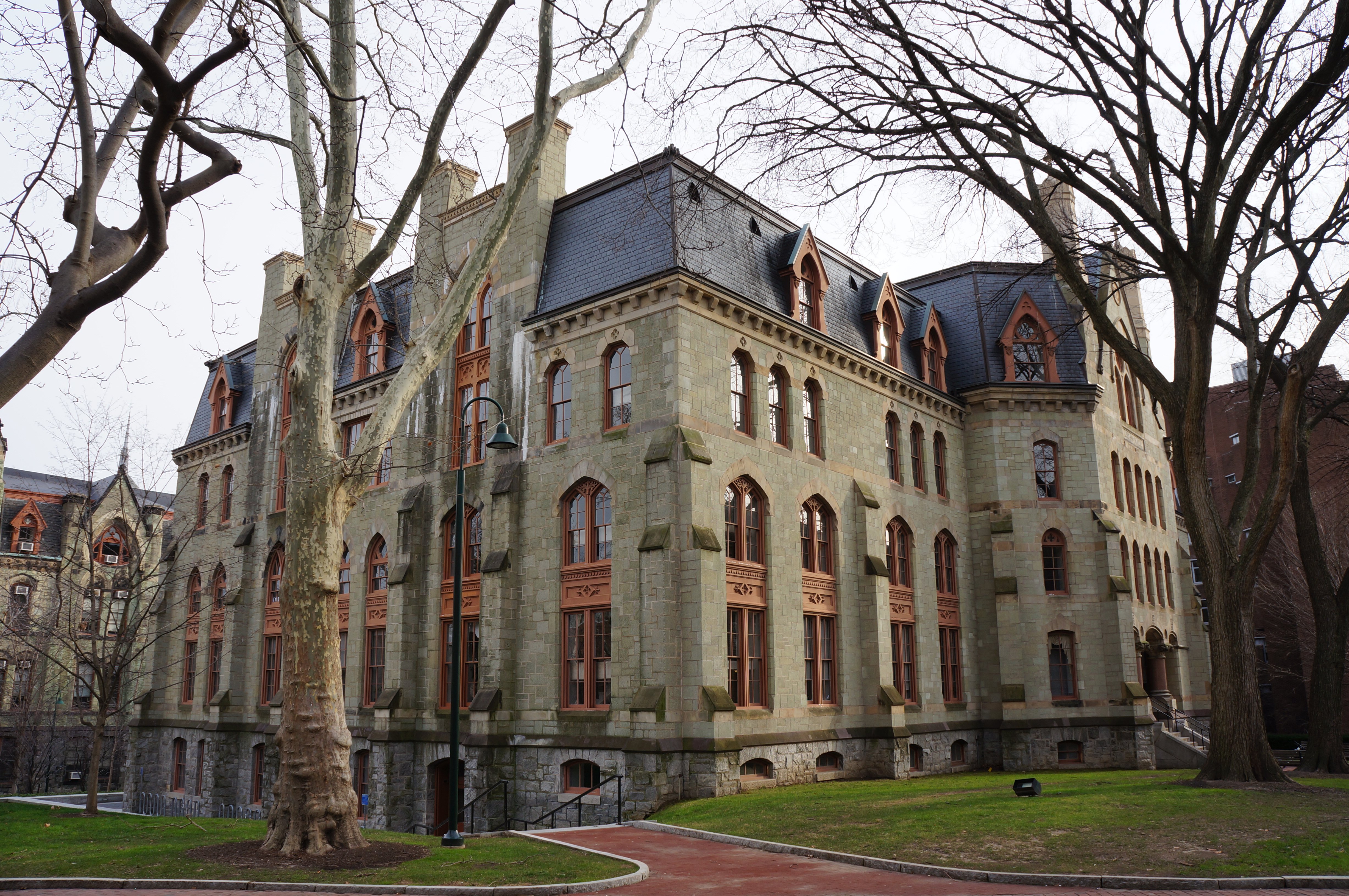
Beyond academics, Penn is a Division I powerhouse in the Ivy League, with strong programs in basketball, football, and fencing. Its alumni network includes 36 Nobel laureates, four U.S. presidents, and business figures like Elon Musk and Warren Buffett. The campus itself blends historic red-brick buildings, such as College Hall, with modern glass structures, all within walking distance of downtown Philadelphia.
Mission
Benjamin Franklin's vision for Penn was groundbreaking: he advocated for a practical, modern liberal arts curriculum that would prepare students for leadership in business, government, public service, and the professions. This pragmatic spirit continues to drive the university today, emphasizing research, innovation, and civic engagement. The university's motto is 'Leges sine moribus vanae' (Laws without morals are useless).
History
The University of Pennsylvania traces its founding to 1740, when a group of Philadelphians erected a great preaching hall for evangelist George Whitefield. Benjamin Franklin, who had arrived in the city as a 17-year-old apprentice printer, saw an opportunity. In 1749 he published 'Proposals Relating to the Education of Youth in Pensilvania,' outlining a vision for an institution that would train leaders in academia, commerce, and public service. Franklin organized 24 trustees, purchased the building, and opened the Academy and Charitable School in 1751. A collegiate charter followed in 1755, creating the College of Philadelphia.
The institution underwent several name changes: College of Philadelphia (1755-1779), University of the State of Pennsylvania (1779-1791), and finally University of Pennsylvania from 1791 onward. In 1765 John Morgan founded the first medical school in colonial America at Penn, modeled after the University of Edinburgh, effectively making the institution a university. The campus originally sat at 9th and Chestnut Streets in downtown Philadelphia from 1800 to 1872, then moved across the Schuylkill River to property purchased from the Blockley Almshouse in West Philadelphia, now known as University City. The Wharton School was founded in 1881 as the world's first collegiate business school. In 1946, Penn introduced ENIAC, the first electronic general-purpose digital computer, marking the dawn of the computer age.
Subdivisions
College of Arts and Sciences
The largest undergraduate school at Penn, offering liberal arts education.
School of Engineering and Applied Science
Offers undergraduate and graduate programs in engineering and applied sciences.
School of Nursing
One of the top nursing schools in the United States.
Wharton School
Founded in 1881 as the world's first collegiate business school.
Perelman School of Medicine
The oldest medical school in the United States, founded in 1765.
Carey Law School
One of the oldest law schools in the country, founded in 1850.
School of Dental Medicine
Offers dental education and research programs.
School of Veterinary Medicine
One of only a few veterinary schools in the Ivy League.
Graduate School of Education
Offers graduate programs in education research and practice.
Annenberg School for Communication
Focuses on communication research and education.
Stuart Weitzman School of Design
Offers programs in architecture, landscape architecture, city planning, fine arts, and historic preservation.
School of Social Policy and Practice
Focuses on social welfare, social policy, and clinical practice.
Notable People
Benjamin Franklin
Founder · 1706-1790
Founded the university and served as its first president; also a leading Founding Father of the United States.
Judith Rodin
President · 1994-2004
First woman president of an Ivy League institution.
Amy Gutmann
President · 2004-2022
Oversaw significant growth in research and endowment.
Donald Trump
Alumnus · Attended Wharton School (1966-1968)
45th President of the United States.
Joe Biden
Alumnus · Attended University of Pennsylvania Law School (1965-1968)
46th President of the United States.
Elon Musk
Alumnus · Attended Wharton School (1992-1995)
CEO of Tesla and SpaceX.
Warren Buffett
Alumnus · Attended Wharton School (1947-1949)
CEO of Berkshire Hathaway and one of the wealthiest people in the world.
John Morgan
Founder of Medical School · 1735-1789
Founded the first medical school in colonial America at Penn in 1765.
Eadweard Muybridge
Researcher · 1830-1904
Pioneered motion photography at Penn in the late 19th century.
Milestones
1740
Building erected for George Whitefield's preaching hall.
1749
Benjamin Franklin publishes 'Proposals Relating to the Education of Youth.'
1751
Academy and Charitable School opens.
1755
Collegiate charter granted as College of Philadelphia.
1765
First medical school in colonial America founded by John Morgan.
1779
Becomes University of the State of Pennsylvania.
1791
Becomes privately endowed University of Pennsylvania.
1813
Philomathean Society founded, oldest continuously existing collegiate literary society in the U.S.
1862
University of Pennsylvania Glee Club founded.
1872
Campus moves to West Philadelphia.
1881
Wharton School founded, world's first collegiate business school.
1887
Museum of Archaeology and Anthropology founded.
1895
Franklin Field begins hosting college football.
1922
Franklin Field expanded into two-tier stadium.
1946
ENIAC, first electronic general-purpose computer, introduced.
1994
Judith Rodin becomes first woman president of an Ivy League institution.
Teams
Sources
Organization Info
- Founded
- 1740-11-14
- Headquarters
- Philadelphia
- Country
- United States
- President
- J. Larry Jameson
- Type
- University
- Employees
- 19456
- Endowment
- $24.808 billion
- Research Expenditures
- $2.172 billion (FY2024)
- Motto
- Leges sine moribus vanae
- Founder
- Benjamin Franklin
Financials
- Budget
- 4.4 billion
- Endowment
- 24.808 billion
- Employees
- 19456
Official Website
upenn.edu
Join the community
fans discussing