University of Oslo
 Norway
"Norway's oldest university, a hub for research and learning since 1811"
About
On a late summer day in 1811, King Frederick VI of Denmark and Norway signed the decree that created the Royal Frederick University. For the young Norwegian nation, still bound to Denmark in a personal union, it was a declaration of intellectual independence. The university was a direct descendant of the University of Copenhagen, and its first professors came from that institution, but it quickly grew into something distinctly Norwegian. In 1939 it was renamed the University of Oslo, or Universitetet i Oslo, and today it stands as the country's foremost seat of learning.
The university operates eight faculties, from theology and law to medicine and educational sciences, plus two museums that anchor its cultural and scientific work. The Museum of Cultural History holds one of the largest archaeological collections in Europe, while the Natural History Museum in Oslo manages botanical gardens and zoological specimens that date back to the early 1800s. More than 27,000 students study here, spread across the main Blindern campus and the historic buildings along Karl Johans gate in the city center.
Internationally, UiO is a steady presence in the upper tiers of global rankings. The U.S. News Best Global Universities list places it at #105, and the QS World University Rankings for 2027 puts it at #131. Its arts and humanities programs rank #31 worldwide, and biology and biochemistry sit at #121. Four Nobel laureates have walked its halls, a record that speaks to the depth of its research tradition. The university also runs an International Summer School that has drawn students from around the world since 1969.
Recent activity shows a place in constant motion. In 2026 alone, UiO advertised PhD fellowships in human geography and political science, launched a postdoctoral position on children and digital media, and saw its affiliated hospital secure a €4.9 million EU grant for improving cancer care for older patients. The university's influence reaches beyond academia into Norwegian public life, shaping debates on everything from climate policy to migration.
Mission
The University of Oslo aims to conduct research and offer education of the highest international standard, in service of society. It seeks to advance knowledge across the humanities, social sciences, law, medicine, mathematics, natural sciences, dentistry, theology, and education, and to foster critical thinking and academic freedom. The university also commits to engaging with global challenges, from climate change to digital transformation, and to training the next generation of researchers and professionals who will shape Norway and the world.
History
The story begins with a king's decree. In 1811, Frederick VI of Denmark and Norway established the Royal Frederick University in Christiania, as Oslo was then called. The move came after decades of lobbying by Norwegian academics who wanted a local institution to train civil servants and clergy, rather than sending them to Copenhagen. The university opened its doors in 1813, with 17 professors and 40 students, operating out of rented buildings near the city center.
For much of the 19th century, the university was the epicenter of Norwegian intellectual life. Its scholars helped shape the nation's identity during the union with Sweden, which lasted from 1814 to 1905. The university produced pioneers like Niels Henrik Abel, whose work on elliptic functions made him one of mathematics' greatest minds, and Henrik Ibsen, who studied there before writing his landmark plays. By the early 1900s, the university had outgrown its downtown quarters, and construction began on a new campus at Blindern in the 1930s.
The university weathered the Nazi occupation of World War II, when many professors and students joined the resistance. After the war, UiO expanded rapidly, adding new faculties and research institutes. The 1960s and 1970s saw student numbers surge, and the university became a center for social and political debate, including the 1968 student protests that swept across Europe. In 1996, the university merged with several independent research institutes, strengthening its position as a comprehensive research university.
Renaming to the University of Oslo in 1939 was more than symbolic. It marked the institution's evolution from a royal foundation to a democratic public university, serving the whole nation. Today, UiO is a modern research powerhouse, with over 7,000 employees and a budget of billions of Norwegian kroner, yet it still carries the legacy of its founding mission: to educate Norway's elite and advance knowledge for the common good.
Subdivisions
Faculty of Theology
Studies religion, theology, and ethics, training clergy and scholars.
Faculty of Law
Norway's leading law school, offering programs in legal theory, criminal law, and human rights.
Faculty of Medicine
Educates doctors and researchers, with close ties to Oslo University Hospital.
Faculty of Humanities
Covers languages, literature, history, philosophy, and media studies.
Faculty of Mathematics and Natural Sciences
Home to physics, chemistry, biology, and mathematics research, including the Smashing Photons project.
Faculty of Dentistry
Trains dental professionals and conducts oral health research.
Faculty of Social Sciences
Includes sociology, political science, economics, and human geography.
Faculty of Educational Sciences
Focuses on pedagogy, special education, and lifelong learning.
Notable People
University of Oslo Library
Library · 1811-present
Central academic resource supporting research and education.
UiO Faculty of Mathematics and Natural Sciences
Faculty · 1811-present
Produces high-impact research in physics and chemistry.
Faculty of Humanities, University of Oslo
Faculty · 1811-present
Ranks #31 globally in arts and humanities.
University of Oslo Faculty of Medicine
Faculty · 1811-present
Trains Norway's physicians and conducts medical research.
University of Oslo Faculty of Law
Faculty · 1811-present
Leading law school in Norway.
The Faculty of Theology
Faculty · 1811-present
Educates clergy and scholars in religion.
UiO Faculty of Dentistry
Faculty · 1811-present
Advances oral health research.
Faculty of social sciences
Faculty · 1811-present
Home to influential social science research.
UiO Faculty of Educational Sciences
Faculty · 1811-present
Leads in pedagogy and special education.
Museum of Cultural History
Museum · 1811-present
Houses one of Europe's largest archaeological collections.
Natural History Museum in Oslo
Museum · 1811-present
Manages botanical gardens and extensive zoological specimens.
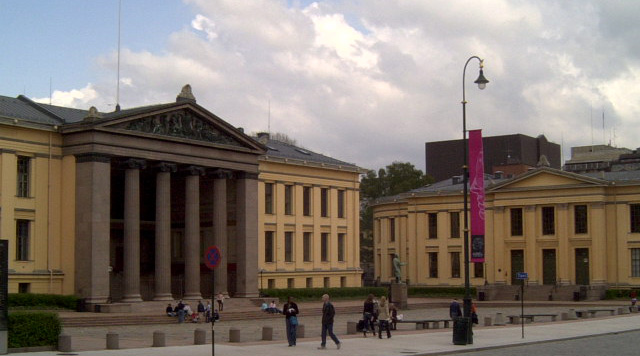
University buildings at Karl Johans gate
Campus · 1852-present
Historic landmark buildings in Oslo's city center.
Milestones
1811
Founded as Royal Frederick University by King Frederick VI.
1813
Opened with 17 professors and 40 students.
1939
Renamed to University of Oslo.
1969
International Summer School established.
1996
Merged with several research institutes.
Sources
Organization Info
- Founded
- September 2, 1811
- Headquarters
- Blindern
- Country
- Norway
- Parent
- Ministry of Education and Research of Norway
- Type
- University
- Employees
- 6194
- Founder
- Frederick VI of Denmark
Financials
- Employees
- 6194
Official Website
www.uio.no
Join the community
fans discussing