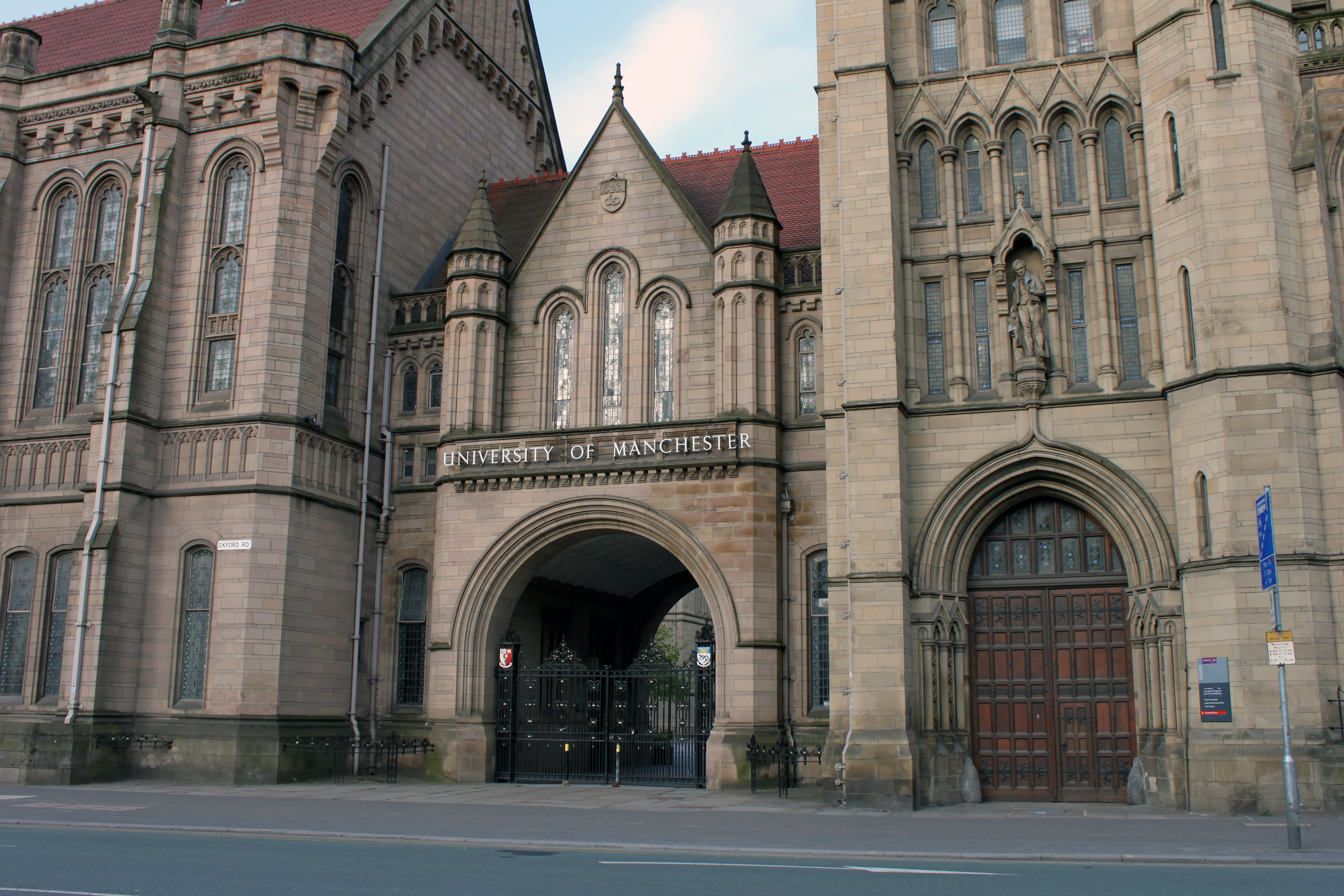
University of Manchester
 United Kingdom
About
The University of Manchester is one of the UK's largest and most respected research institutions, its main campus stretching along Oxford Road just south of the city center. Its roots reach back to the civic university movement of the late 19th century, and it carries the 'red brick' label that marks that era's commitment to bringing higher education to industrial cities. The modern university took shape in 2004, when the Victoria University of Manchester merged with the University of Manchester Institute of Science and Technology (UMIST), ending a century of close collaboration between the two institutions.
With a student body exceeding 40,000 and a research portfolio that spans everything from graphene to social inequality, the university consistently ranks among the world's top 50. Its alumni and faculty include 25 Nobel laureates, among them Ernest Rutherford, who split the atom here, and Alan Turing, whose wartime codebreaking changed the course of history. The institution's scale is matched by its ambition; it operates major facilities like the Jodrell Bank Observatory and partners with industry on projects worth hundreds of millions of pounds.
The tone is one of serious academic purpose, but the campus buzzes with student life, from the historic John Rylands Library to the modern engineering buildings. The university's reputation draws students from over 150 countries, making it a genuinely global hub. While it doesn't have a franchise link in the entertainment sense, its story is one of constant reinvention, from Victorian civic pride to 21st-century research powerhouse.
Mission
The University of Manchester describes its mission as pioneering research, outstanding teaching and learning, and a deep commitment to social responsibility. It aims to advance education, knowledge, and wisdom for the public good, and to be a globally recognized institution that contributes to societal well-being through its research and community engagement.
History
The university's story begins in 1824 with the Manchester Mechanics' Institute, a precursor to UMIST. That institute grew out of the city's industrial pride, offering practical education to working people. In 1851, Owens College opened its doors, named after the merchant John Owens, who left £96,000 to establish it. The college received its royal charter as Victoria University in 1880, becoming one of the first civic universities in England.
For over a century, Owens College (later Victoria University of Manchester) and UMIST operated side by side, sharing some facilities while maintaining separate identities. The two eventually merged in 2004, creating the UK's largest single-site university. That merger combined the strengths of a traditional red-brick university with a technological institute, forming an institution with 25 Nobel laureates among its alumni and staff.
The university's history is marked by scientific breakthroughs. Ernest Rutherford split the atom here in 1917, and in 2010 Andre Geim and Konstantin Novoselov won the Nobel Prize for isolating graphene, a discovery made at the university. The institution also played a role in the development of the first stored-program computer, the Manchester Baby, in 1948.
More recently, the university has focused on expansion. In 2026 it reached financial close on a £530 million redevelopment of its Fallowfield campus to create 3,300 new student rooms, delivered with partners Equitix, GRAHAM, and Rothesay. The same year it joined the Defence Universities Alliance, a move that sparked student protests, reflecting the institution's willingness to engage in controversial partnerships.
Subdivisions
Faculty of Biology, Medicine and Health
Covers medical, dental, and health sciences, including the Manchester Medical School.
Faculty of Science and Engineering
Includes departments in physics, chemistry, engineering, and computer science.
Faculty of Humanities
Spans arts, languages, social sciences, and law.
Notable People
Ernest Rutherford
Professor of Physics · 1907-1919
Split the atom; Nobel Prize in Chemistry 1908
Alan Turing
Reader in Mathematics · 1948-1954
Father of modern computing; codebreaker
Andre Geim
Professor of Physics · 2001-present
Isolated graphene; Nobel Prize in Physics 2010
Konstantin Novoselov
Professor of Physics · 2001-present
Co-discovered graphene; Nobel Prize in Physics 2010
Milestones
1824
Manchester Mechanics' Institute founded
1851
Owens College established
1880
Victoria University receives royal charter
1908
Ernest Rutherford wins Nobel Prize in Chemistry for work at the university
2004
Merger of Victoria University of Manchester and UMIST creates the modern University of Manchester
2010
Andre Geim and Konstantin Novoselov win Nobel Prize in Physics for isolating graphene
2026
Financial close on £530 million Fallowfield campus redevelopment
Departments
Sources
Organization Info
- Founded
- 1824
- Headquarters
- Manchester, United Kingdom
- Country
- United Kingdom
- President and Vice-Chancellor
- Dame Nancy Rothwell
- Type
- University
- Students
- 40,000+
- Nobel Laureates
- 25
Financials
- Employees
- 12000
Official Website
manchester.ac.uk
Join the community
fans discussing