University of Helsinki
 Finland
"Finland's oldest and largest university"
About
The University of Helsinki is Finland's oldest and largest institution of academic education and research, a public research university whose roots go back to the 17th century. It was founded on March 26, 1640, as the Regia Academia Aboensis in Turku, then part of the Swedish Empire, by Queen Christina of Sweden. After the Great Fire of Turku in 1827, the university moved to Helsinki in 1828, under the sponsorship of Tsar Alexander I of Russia, and was renamed the Imperial Alexander University. Today it operates as a modern, multidisciplinary research powerhouse, enrolling about 31,000 degree students in 2022, with a broader scientific community of over 40,000 students and staff members.
The university's four campuses in Helsinki house 11 faculties and numerous independent institutes, covering fields from theology to computer science. It is consistently ranked among the world's leading universities: US News places it at #109 in Best Global Universities, and it appears regularly in the Times Higher Education World University Rankings. The university's research spans everything from carbon capture to ancient Amazonian civilizations, and it has recently secured major EU funding, including ERC Advanced Grants awarded to five researchers.
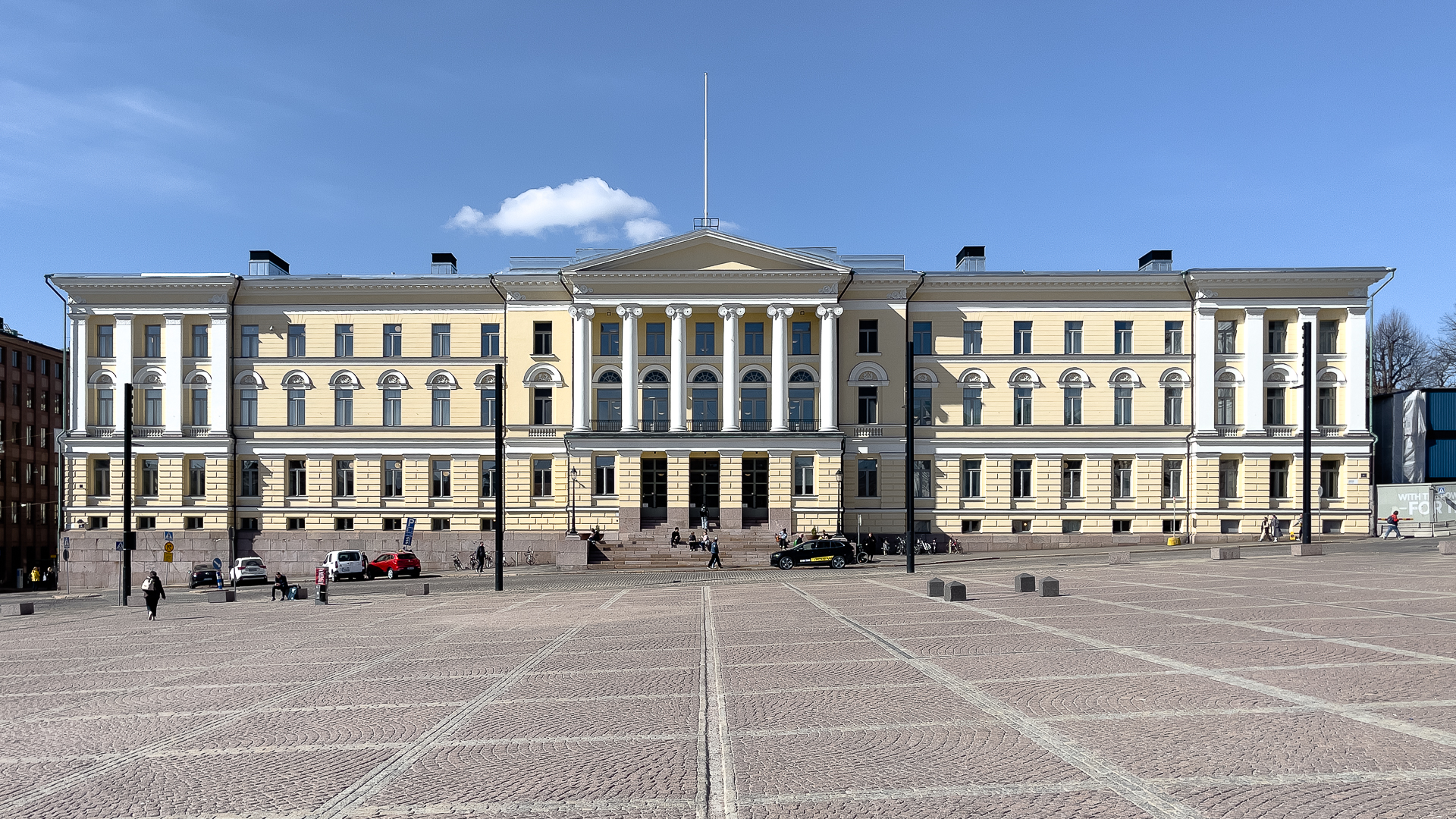
Beyond its academic role, the university has been a backdrop for Finnish cinema and a hub for cultural and scientific achievement, making it a fascinating subject for anyone interested in the forces that shape society. Its main building, designed by Carl Ludvig Engel, is an architectural landmark in the heart of Helsinki.
Mission
The University of Helsinki's mission is to advance scientific research, education, and societal impact across a wide spectrum of disciplines. It aims to be a leading multidisciplinary research university that contributes to solving global challenges, fostering critical thinking, and promoting a sustainable future. The university is committed to high-quality teaching, international collaboration, and the responsible use of knowledge for the benefit of society.
History
The University of Helsinki traces its origins to 1640, when Queen Christina of Sweden founded the Regia Academia Aboensis in Turku. It was the third university in the Swedish Empire, after Uppsala and Dorpat (Tartu). For nearly two centuries, it served as the intellectual center of Finland, training clergy, officials, and physicians. The Great Fire of Turku in 1827 devastated the city and the university's buildings, prompting the move to Helsinki, which had become the administrative capital of the Grand Duchy of Finland under Russian rule.
In 1828, the university reopened in Helsinki as the Imperial Alexander University, named after Tsar Alexander I. It quickly became the engine of Finnish national awakening, with scholars like Elias Lönnrot collecting the folklore that would become the Kalevala. After Finland gained independence in 1917, the university was renamed the University of Helsinki in 1919. Over the 20th century, it expanded rapidly, adding new faculties and research institutes, and became a truly modern research university.
Recent decades have seen the university embrace internationalization and interdisciplinary research. In 2026, it identified four top research areas: Future Technologies, Learning and Evolving Societies, Precision Health, and Sustainable Development. That same year, it won a competitive bidding process to develop Finland's official citizenship test, a project that will begin the following year. The university has also been active in innovation, with startups emerging from its research, including a programme focused on resilience and security for early-stage teams.
Subdivisions
Faculty of Theology
Studies in theology and religious studies.
Faculty of Law
Legal education and research.
Faculty of Medicine
Medical education and research, including the Helsinki University Hospital.
Faculty of Arts
Humanities disciplines, including languages, literature, and philosophy.
Faculty of Science
Natural sciences, including physics, chemistry, and mathematics.
Faculty of Pharmacy
Pharmaceutical sciences.
Faculty of Biosciences
Biology, ecology, and related fields.
Faculty of Agriculture and Forestry
Agricultural sciences, forestry, and environmental management.
Faculty of Social Sciences
Sociology, political science, economics, and communication.
Faculty of Educational Sciences
Teacher education and educational research.
Faculty of Computer Science
Computer science and data science.
Notable People
Sari Lindblom
Rector · 2019–
First female rector of the University of Helsinki.
J. K. Paasikivi
Alumnus · 1897
President of Finland (1946–1956).
Risto Ryti
Alumnus · 1906
President of Finland (1940–1944).
Artturi Ilmari Virtanen
Alumnus and Professor · 1919–1960
Nobel Prize in Chemistry (1945).
Elias Lönnrot
Alumnus · 1820s
Compiler of the Kalevala, Finnish national epic.
A. I. Virtanen
Alumnus and Professor · 1919–1960
Nobel Prize in Chemistry (1945).
Milestones
1640-03-26
Founded as the Regia Academia Aboensis in Turku by Queen Christina of Sweden.
1828
Moved to Helsinki and renamed the Imperial Alexander University after a fire destroyed Turku.
1919
Renamed the University of Helsinki after Finnish independence.
1945
A. I. Virtanen becomes the first Nobel laureate associated with the university.
2026
Identified four top research areas and won the contract to develop Finland's citizenship test.
Sources
Organization Info
- Founded
- 1640-03-26
- Headquarters
- University of Helsinki main building
- Country
- Finland
- Rector
- Sari Lindblom
- Type
- University
- Founder
- Christina of Sweden
- Students
- 31,000 (2022)
- Staff
- 8,000
- Annual Budget
- €750 million
Financials
- Budget
- €750 million (annual budget)
- Employees
- 8,000 (staff)
Official Website
www.helsinki.fi/en
Join the community
fans discussing