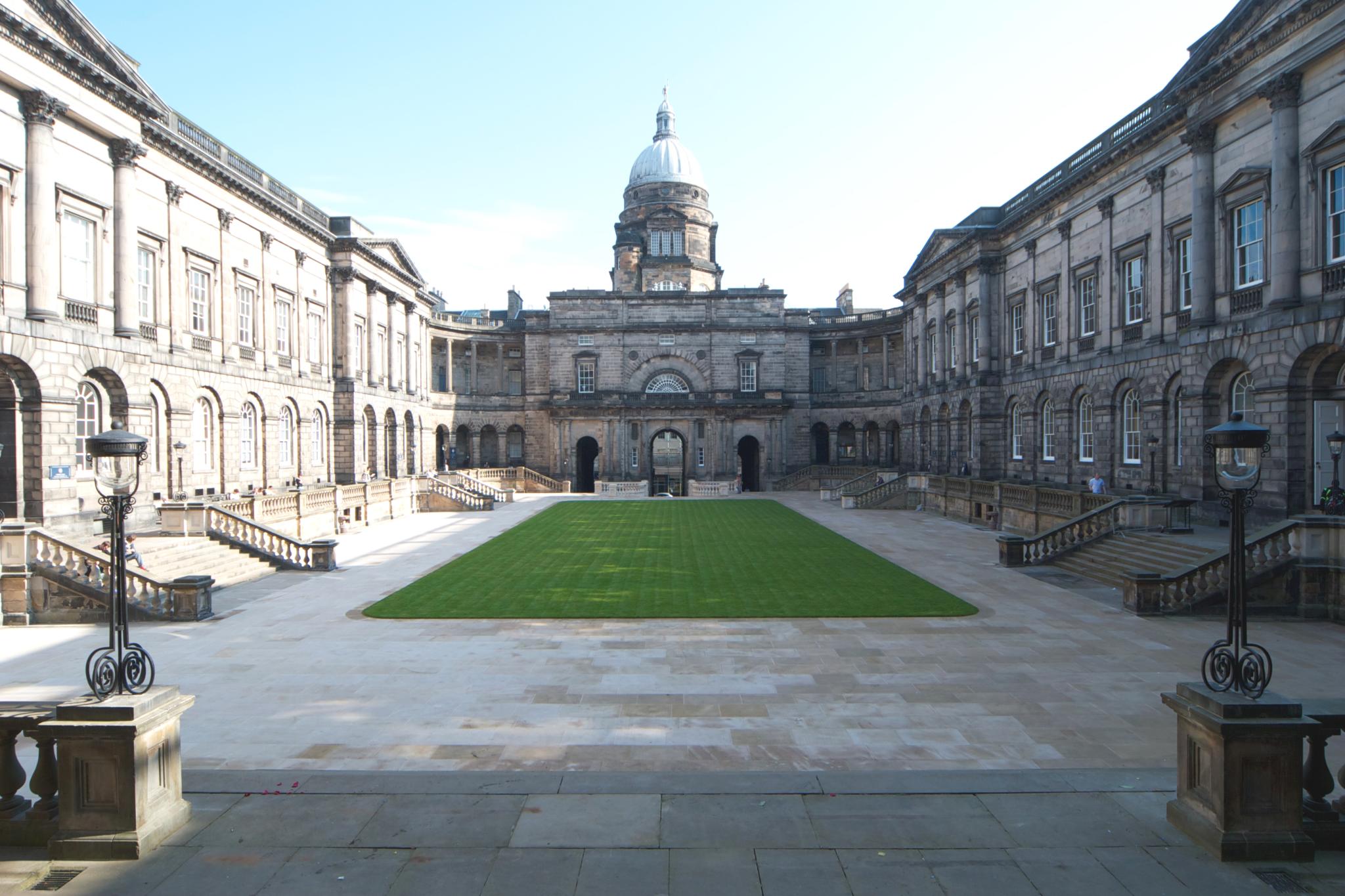
University of Edinburgh
 United Kingdom
"Influencing the world since 1583"
About
The University of Edinburgh is a public research university rooted in the Scottish capital, tracing its origins to a royal charter from King James VI in 1582. When it opened its doors in 1583, it became Scotland's fourth ancient university and the sixth-oldest in the English-speaking world. Unusually for its time, the institution was founded by the city's town council rather than the church, a civic spirit that shaped its character from the start. Today, its historic Old Town campus sits alongside modern research facilities, hosting more than 40,000 students from around 156 countries.
The university operates across three main campuses. The central area around George Square houses the College of Arts, Humanities and Social Sciences, while the King's Buildings campus in the south hosts the College of Science and Engineering. The Easter Bush campus, on the city's edge, is home to the Royal (Dick) School of Veterinary Studies and the Roslin Institute, where Dolly the sheep was cloned in 1996. With an annual budget exceeding £1 billion and over 13,000 staff, the university is a major economic engine for Edinburgh and a magnet for international talent.
Edinburgh's reputation rests on centuries of intellectual achievement. Its alumni include Charles Darwin, Alexander Graham Bell, and Sir Walter Scott, and its faculty has included philosophers David Hume and Adam Smith, and physicist James Clerk Maxwell. The university counts 20 Nobel laureates among its former students and staff. It consistently ranks in the world's top 50 across major league tables, including QS, Times Higher Education, and the Academic Ranking of World Universities.
Mission
The University of Edinburgh's mission is to influence the world through world-class teaching and research. It aims to advance knowledge and understanding, foster critical thinking, and contribute to the cultural, social, and economic well-being of society. The university is committed to providing an outstanding educational experience, conducting research that addresses global challenges, and engaging with communities locally and internationally.
History
Edinburgh's story begins in the late 16th century when the town council, inspired by the Protestant Reformation's push for educated clergy, petitioned King James VI for a charter. The king granted it in 1582, and the university opened a year later in a former college building near St Giles' Cathedral. From the outset, it was a civic institution, funded by the city and open to students regardless of social rank, a radical idea for the era.
The 18th century brought the Scottish Enlightenment, and Edinburgh became its epicenter. Figures like David Hume, Adam Smith, and William Robertson taught or studied here, and the university's medical school, established in 1726, grew into one of Europe's finest. Joseph Lister, working at the Royal Infirmary in the 1860s, introduced antiseptic surgery, saving countless lives. The university also produced James Clerk Maxwell, whose equations of electromagnetism laid the groundwork for modern physics.
The 20th century saw expansion and consolidation. The Edinburgh College of Art began integrating in 1966 and fully merged in 2011. The Royal (Dick) School of Veterinary Studies joined in 2002. In 1996, the Roslin Institute, affiliated with the university, announced the birth of Dolly the sheep, the first mammal cloned from an adult cell, a breakthrough that sparked global debate.
More recently, the university has grappled with its historical links to colonialism and slavery, acknowledging them in official statements. In January 2026, it completed what is believed to be the first international repatriation of Muscogee Nation ancestral remains, a step toward reconciliation. The university continues to evolve, opening a private 5G test network for the Edinburgh Festival Fringe in August 2026 and signing a quantum computing agreement with Quantinuum, Rolls-Royce, and Riverlane in July of that year.
Subdivisions
College of Arts, Humanities and Social Sciences
Includes the Business School, Law School, School of Divinity, School of Economics, School of Health in Social Science, School of History, Classics and Archaeology, School of Literatures, Languages and Cultures, School of Philosophy, Psychology and Language Sciences, and the Edinburgh College of Art.
College of Medicine and Veterinary Medicine
Comprises the Edinburgh Medical School, the Royal (Dick) School of Veterinary Studies, and Biomedical Sciences.
College of Science and Engineering
Includes the School of Informatics, School of Engineering, School of Mathematics, School of Physics and Astronomy, School of Chemistry, School of Biological Sciences, School of GeoSciences, and the School of Computer Science.
Notable People
Charles Darwin
Alumnus · 1825–1827
Developed the theory of evolution by natural selection, published in On the Origin of Species.
Alexander Graham Bell
Alumnus · 1868–1870
Invented the telephone.
Sir Walter Scott
Alumnus · 1789–1792
Prolific novelist and poet, author of Ivanhoe and Waverley.
James Clerk Maxwell
Alumnus · 1847–1850
Formulated the classical theory of electromagnetic radiation.
David Hume
Alumnus · 1723–1726
Philosopher and historian, central figure of the Scottish Enlightenment.
Adam Smith
Alumnus · 1737–1740
Economist and author of The Wealth of Nations, founder of modern economics.
Arthur Conan Doyle
Alumnus · 1876–1881
Creator of Sherlock Holmes.
Robert Louis Stevenson
Alumnus · 1867–1872
Author of Treasure Island and Strange Case of Dr Jekyll and Mr Hyde.
Joseph Lister
Alumnus · 1848–1852
Pioneer of antiseptic surgery.
James Hutton
Alumnus · 1740–1744
Father of modern geology.
Gordon Brown
Alumnus · 1972–1975
Prime Minister of the United Kingdom from 2007 to 2010.
Milestones
1582
Royal charter granted by King James VI
1583
University opens its doors
1726
Faculty of Medicine established
1966
Edinburgh College of Art begins integration
2002
Merger with the Royal (Dick) School of Veterinary Studies
2011
Edinburgh College of Art fully integrated
2024
Dame Sue Black appointed Chancellor
2026
First international repatriation of Muscogee Nation ancestral remains
Sources
Organization Info
- Founded
- 1583
- Headquarters
- Edinburgh
- Country
- United Kingdom
- Principal and Vice-Chancellor
- Professor Sir Peter Mathieson
- Type
- University
- Students
- 40,000+
- Staff
- 13,000+
- Annual budget
- £1 billion+
- Nobel laureates
- 20
Financials
- Revenue
- $1.1 billion
- Budget
- £1 billion+
- Endowment
- £500 million+
- Employees
- 13000
Official Website
www.ed.ac.uk
Join the community
fans discussing