 Syria
SyriaAbout
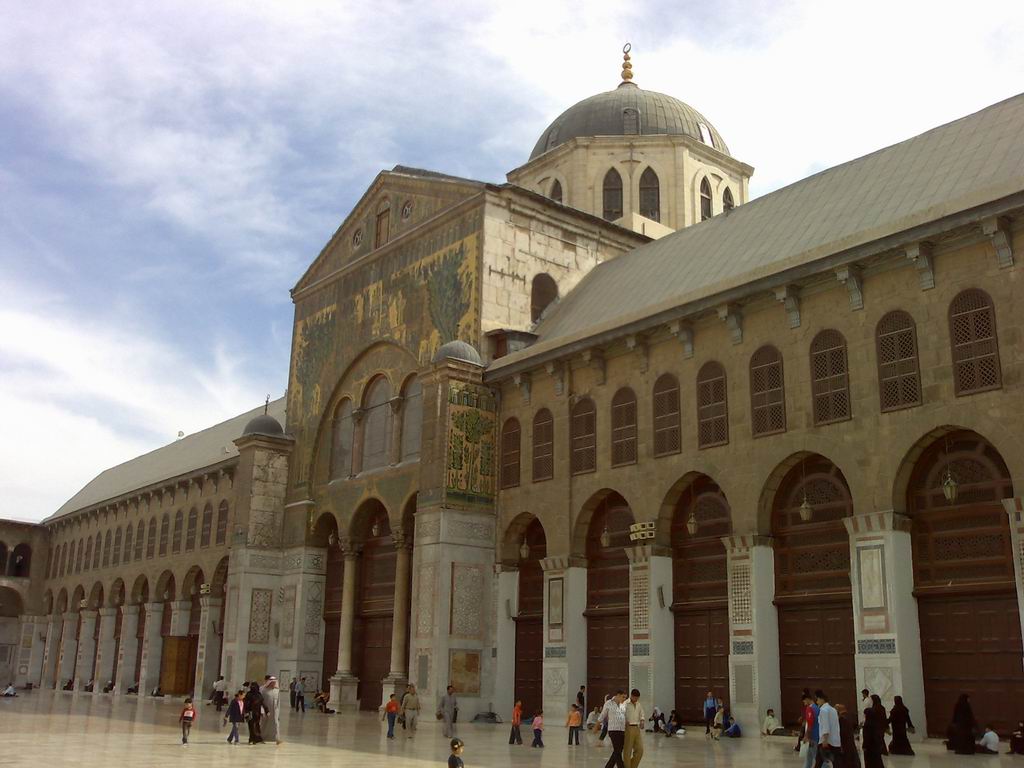
In the heart of Damascus's old city, the Umayyad Mosque rises with a presence that has anchored the city for over thirteen centuries. Known as the Great Mosque of Damascus, it ranks among the oldest and largest mosques in the world, a place where Roman columns, Byzantine mosaics, and Islamic prayer halls share the same sacred ground. Built between 705 and 715 CE on the orders of Caliph al-Walid I, the mosque transformed a former Christian basilica into a grand Islamic sanctuary, employing thousands of artisans and craftsmen in the effort. Its vast courtyard, intricate mosaics, and three minarets, including the famous Minaret of Jesus, define the Damascus skyline and represent the artistic peak of the Umayyad dynasty.
The site's religious history stretches back to the 10th century BCE, when a temple to the storm god Hadad stood here. Later came a Roman temple to Jupiter, then a Christian church dedicated to St. John the Baptist. When al-Walid I ordered the new mosque, he demolished the Byzantine cathedral but preserved the outer Roman temple walls and foundations, a decision that left visible traces of earlier faiths. The relics of St. John the Baptist remain enshrined in a small marble aedicule inside the mosque, drawing both Muslim and Christian visitors who come to pay their respects.
Today, the Umayyad Mosque functions as an active congregational mosque, capable of holding thousands of worshippers, and it remains a major tourist destination despite the challenges of regional conflict. Historians and travelers alike have praised its architectural harmony and the serene atmosphere of its courtyard. The mosque has been featured in countless documentaries and travel features, yet it stands not merely as a monument to the past but as a living, breathing place of worship. Its significance extends beyond religion, serving as a powerful symbol of the layered heritage of the Middle East, where Roman, Christian, and Islamic traditions converge in stone and light.
Mission
The Umayyad Mosque serves as a congregational mosque for the Muslim community of Damascus, providing a space for daily prayers, Friday sermons, and religious education. It also functions as a pilgrimage site, drawing visitors who come to honor the relics of St. John the Baptist and to experience one of Islam's holiest places. Beyond its religious role, the mosque acts as a guardian of cultural heritage, preserving the architectural and artistic achievements of the Umayyad dynasty for future generations.
History
The story of the Umayyad Mosque begins long before Islam, with a temple to the storm god Hadad, founded between the 10th and 9th centuries BCE. That structure was later replaced by a Greek temple to Jupiter, which the Romans rebuilt in the 1st century CE. In the 4th century, the site was Christianized, and a church was built to house the relics of St. John the Baptist. When Caliph al-Walid I came to power, he sought to create a mosque worthy of the Umayyad capital. Around 705 CE, he ordered the demolition of the Byzantine cathedral, but he retained the outer Roman temple walls and foundations, integrating them into the new design. The construction employed thousands of workers and took a decade to complete, resulting in a mosque that blended Roman engineering with Islamic artistry.
Over the centuries, the mosque has endured fires, earthquakes, and invasions. In 1069, a fire damaged the building, and it was later restored by the Seljuks. The Mongols sacked Damascus in 1260, but the mosque survived. During the Ottoman era, it was renovated and maintained. In the 20th century, the mosque remained a focal point of Syrian religious life. The recent Syrian civil war brought new challenges, with the mosque suffering some damage from stray shells, but it has remained operational, a testament to its resilience.
Throughout its long history, the Umayyad Mosque has been a center of learning and worship. It has hosted scholars, pilgrims, and travelers from across the Islamic world. Its library once held a vast collection of manuscripts. The mosque's influence on Islamic architecture is profound, with its layout and decorative schemes copied in mosques across the region. Even today, it stands as a living link to the past, a place where the layers of history are visible in every stone.
Subdivisions
Prayer Hall
The main sanctuary, supported by rows of arcades, where congregational prayers are held.
Courtyard
A vast open space surrounded by porticoes, featuring a central ablution fountain and intricate mosaics.
Minaret of Jesus
One of the three minarets, believed to be the place where Jesus will descend at the end of times.
Notable People
Al-Walid I
Founder · 705-715
Commissioned and oversaw the construction of the Umayyad Mosque, transforming the site into a grand Islamic sanctuary.
Milestones
10th-9th century BCE
Temple to the god Hadad founded on the site.
1st century CE
Roman temple to Jupiter constructed.
4th century CE
Church of St. John the Baptist built.
705-715 CE
Construction of the Umayyad Mosque under Caliph al-Walid I.
1069
Fire damages the mosque; later restored by the Seljuks.
1260
Mongol sack of Damascus; the mosque survives.
Sources
Organization Info
- Founded
- 705
- Headquarters
- Old City, Damascus, Syria
- Country
- Syria
- Type
- Religious
- Founder
- Al-Walid I
- Capacity
- Thousands of worshippers
- Minarets
- 3
Join the community
fans discussing