 France
About
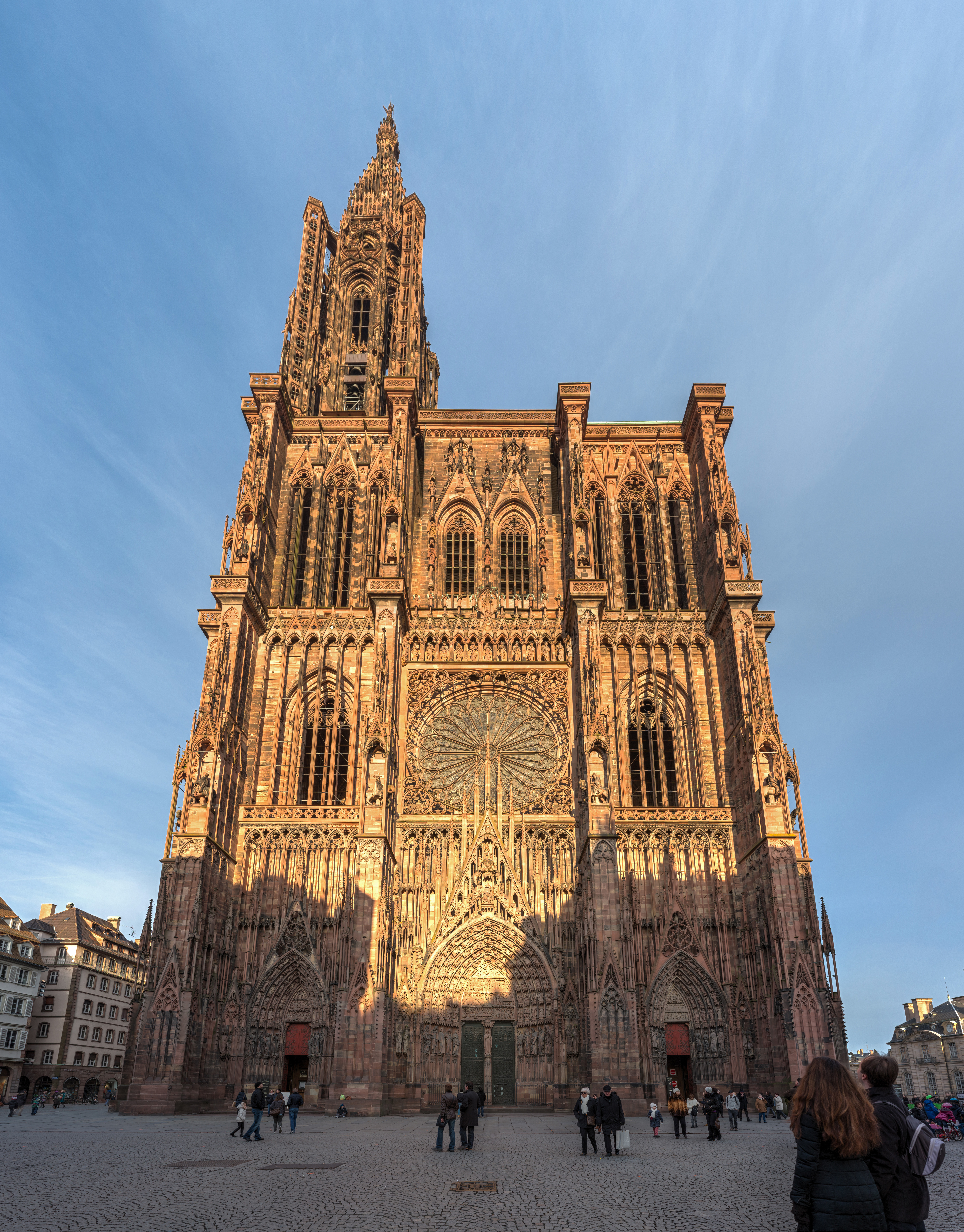
Strasbourg Cathedral, officially known as the Cathedral of Our Lady of Strasbourg, dominates the skyline of France's eastern city with its soaring single spire. This Roman Catholic church stands as a premier example of Rayonnant Gothic architecture, blending elements from earlier Romanesque structures into a unified design that took over four centuries to complete. Construction began in 1015 on a site previously occupied by Carolingian churches and a Roman sanctuary, evolving through fire and reconstruction before reaching its final form.
The building reaches a height of 142 meters (466 feet), holding the title of the world's tallest structure for 227 years between 1647 and 1874. Its intricate sandstone facade features the famous Pilier des Anges, a sculptural column depicting the Last Judgment, while the interior houses a complex astronomical clock installed in the 16th century. The cathedral serves as both an active place of worship for the Archdiocese of Strasbourg and a major cultural landmark that reflects the region's unique Franco-German identity.
Mission
The institution functions as a dual-purpose center dedicated to Catholic liturgy and the preservation of Alsatian heritage. It hosts daily masses, diocesan celebrations, and religious services while simultaneously managing tourism for millions of annual visitors who come to view its architectural treasures. The cathedral acts as a bridge between French and German cultures, maintaining its role as a spiritual home for the local community and a global symbol of European history.
History
A catastrophic fire in 1176 destroyed the original Romanesque structure, prompting a massive reconstruction effort that adopted the emerging Gothic style. The 13th-century architect Erwin von Steinbach played a pivotal role in shaping the cathedral's distinctive appearance, particularly the elaborate west facade that remains one of the finest examples of medieval stonework. The construction project spanned nearly 425 years, concluding with the completion of the iconic single spire in 1439.
The cathedral maintained its status as the world's tallest building from 1647 until 1874, a record held for 227 years. In 1988, it was designated a UNESCO World Heritage Site as part of the Grande Île district. Recent developments include the return of a lost medieval angel sculpture in June 2026 after decades of absence, reinforcing its status as a living museum of medieval art alongside its function as a place of worship.
Notable People
Erwin von Steinbach
Master Mason · 13th century
Defined the Gothic character of the west facade
Pilier des Anges
Sculptural Column · 13th century
Renowned masterpiece of Gothic sculpture
Milestones
1015
Construction of the original Romanesque cathedral begins
1176
Fire destroys the original structure, prompting Gothic reconstruction
1439
Spire completed, marking the end of main construction
1647
Becomes the world's tallest building
1874
Loses the title of world's tallest building
1988
Designated a UNESCO World Heritage Site
2026
Lost medieval angel sculpture returned to the cathedral
Sources
Organization Info
- Founded
- 1015
- Headquarters
- Place de la Cathédrale, Strasbourg, France
- Country
- France
- Archbishop
- Archbishop of Strasbourg
- Parent
- Archdiocese of Strasbourg
- Type
- Religious
- Height
- 142 meters (466 feet)
- Visitors (2019)
- 2.5 million
- World's tallest building
- 1647–1874
Official Website
www.cathedrale-strasbourg.fr/
Join the community
fans discussing