Natural History Museum
 United Kingdom
"Creating advocates for the planet"
About
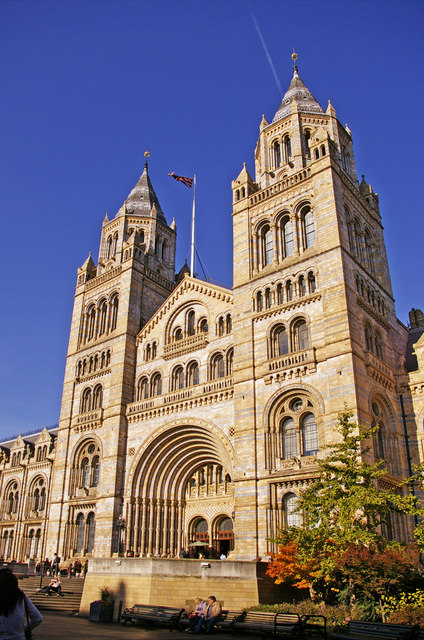
London's Natural History Museum houses one of the world's most comprehensive collections of natural history specimens. Located on Exhibition Road in South Kensington, it shares this prestigious cultural district with the Science Museum and the Victoria and Albert Museum. The museum's grand Romanesque facade on Cromwell Road announces a vast repository of life and earth science specimens, totaling around 80 million items. These are organized into five main collections: botany, entomology, mineralogy, paleontology, and zoology. The museum's origins trace back to Sir Hans Sloane's collection, which became the foundation of the British Museum before being transferred to its own building in 1881. Today, it serves as both a research institution and a public attraction, drawing over five million visitors annually. The museum's iconic Hintze Hall, dominated by a blue whale skeleton suspended from the ceiling, welcomes guests into a space that blends Victorian architecture with modern interactive exhibits.
Beyond the public galleries, the museum is a powerhouse of scientific research. Its scientists conduct fieldwork on every continent, studying biodiversity, climate change, evolution, and conservation. The museum's collections are used by researchers worldwide and are essential for understanding life on Earth. The museum also operates the Natural History Museum at Tring in Hertfordshire, home to the Walter Rothschild Zoological Museum. As a non-departmental public body sponsored by the Department for Culture, Media and Sport, it operates as an exempt charity with the Secretary of State for Culture, Media and Sport as its principal regulator.
Mission
The Natural History Museum's mission is to create advocates for the planet. Its vision is of a future where both people and the planet thrive. To achieve this, the museum harnesses three key assets: its collection of 80 million specimens, its scientific research, and its reach to a worldwide audience. The museum aims to discover, interpret, and disseminate knowledge about the natural world through scientific research and education.
History
Sir Hans Sloane's collection of natural history specimens, acquired by the British Museum in 1753, formed the seed of what would become the Natural History Museum. For over a century, the natural history departments remained within the British Museum in Bloomsbury, but by the 1850s the collections had outgrown the space. Richard Owen, the paleontologist who coined the term 'dinosaur,' argued passionately for a dedicated building. In 1864, a site was purchased in South Kensington, and architect Alfred Waterhouse was commissioned to design a structure that would be both functional and awe-inspiring.
Construction of the Romanesque building, often called a 'Cathedral of Nature,' took place between 1873 and 1880. The museum opened to the public on April 18, 1881. Owen's vision was of a museum that would educate the public and advance science. The building itself was a showcase of natural history, with terracotta panels depicting living and extinct species. In 1963, the museum formally separated from the British Museum, becoming an independent institution. The Darwin Centre, a state-of-the-art research and storage facility, opened in two phases: Phase I in 2002 and Phase II (the Cocoon) in 2009. In 2017, Hintze Hall underwent a major renovation, with the iconic blue whale skeleton suspended from the ceiling replacing Dippy the diplodocus cast.
Subdivisions
Botany
Plant specimens
Entomology
Insects
Mineralogy
Minerals, gems, and meteorites
Paleontology
Fossils, including dinosaur skeletons
Zoology
Animal specimens
Natural History Museum at Tring
Walter Rothschild Zoological Museum in Hertfordshire
Notable People
Richard Owen
Founder and first Superintendent · 1856-1883
Coined the term 'dinosaur'; championed the creation of the museum building
Hans Sloane
Original collection donor · 1753
His collection of natural history specimens formed the basis of the British Museum's natural history holdings
Alfred Waterhouse
Architect · 1873-1880
Designed the iconic Romanesque building on Exhibition Road
David Attenborough
Trustee and supporter
Longtime advocate for the museum's mission and public engagement
Patrick Vallance
Chairman · 2021-2023
Former UK Government Chief Scientific Adviser; oversaw museum's climate advocacy
Milestones
1753
Sir Hans Sloane's collection forms the basis of the British Museum's natural history holdings
1856
Richard Owen appointed Superintendent of the natural history departments
1864
Site in South Kensington purchased for the new museum building
1873
Construction of Alfred Waterhouse's building begins
1881
Museum opens to the public on April 18
1963
Museum becomes independent from the British Museum
2002
Darwin Centre Phase I opens
2009
Darwin Centre Phase II (the Cocoon) opens
2017
Hintze Hall renovated; blue whale skeleton suspended from ceiling replaces Dippy the diplodocus
2020
Dr. Douglas Gurr appointed Director
Departments
Sources
Organization Info
- Founded
- 1881-04-18
- Headquarters
- Cromwell Road, South Kensington, London, SW7 5BD, United Kingdom
- Country
- United Kingdom
- Director
- Douglas Gurr
- Type
- Museum
- Founder
- Richard Owen
- Collection Size
- 80 million specimens
- Annual Visitors
- Over 5 million
Financials
- Employees
- 800
Official Website
www.nhm.ac.uk
Join the community
fans discussing