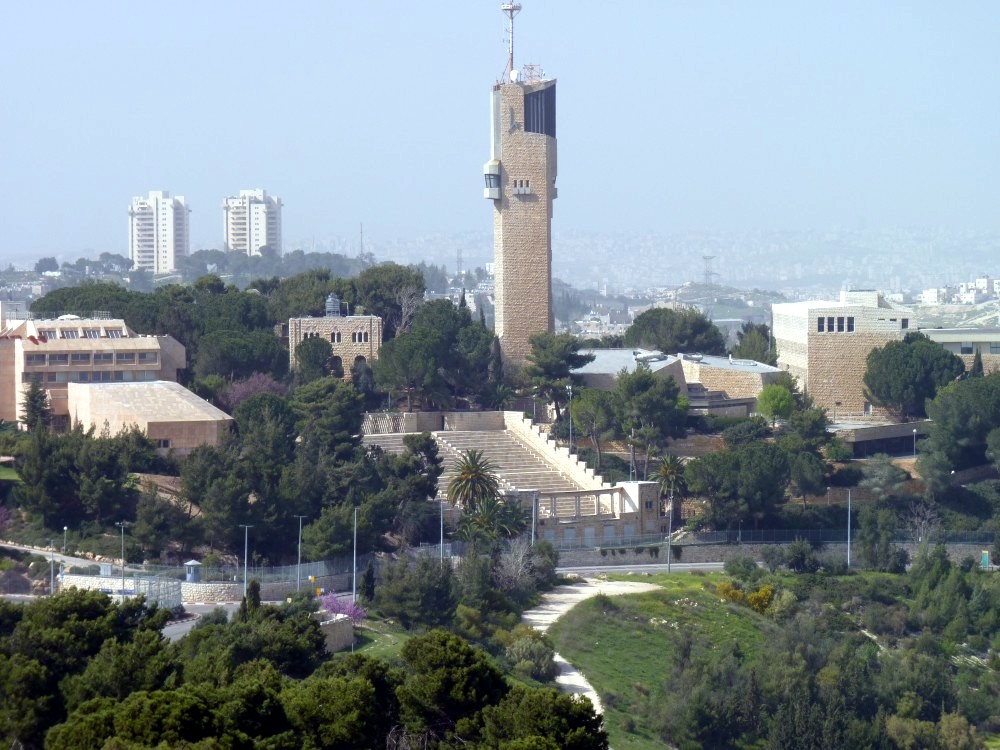
Hebrew University of Jerusalem
 Israel
"Israel's premier research university"
About
The Hebrew University of Jerusalem, often called HUJI, is Israel's oldest and most prestigious institution of higher learning. Founded in 1918, it predates the state of Israel by three decades, a fact that underscores its role as a cornerstone of the nation's intellectual life. The university's creation was driven by two towering figures: Albert Einstein, who later served as a governor, and Chaim Weizmann, who became Israel's first president. Their vision was to build a world-class center of Jewish learning and research that would serve both the Jewish people and the global academic community.
Today, the university operates across three campuses in Jerusalem, enrolling more than 25,000 students and employing around 1,200 faculty members. Its annual budget exceeds 1 billion shekels, funding research that spans everything from cancer therapy to quantum physics. HUJI is consistently ranked among the top universities globally, particularly strong in computer science, mathematics, the humanities, and the natural sciences. The Nature Index tracks its output in high-quality scientific journals, and its researchers regularly publish in leading outlets.
The university's cultural and historical weight is immense. It has produced generations of innovators and leaders, with numerous Nobel laureates among its alumni and faculty. Its founding figures, Einstein and Weizmann, are among the most important Jewish figures of the 20th century, and their legacy continues to shape the institution's identity. For anyone seeking to understand Israel's intellectual heartbeat, the Hebrew University is an essential starting point.
Mission
The Hebrew University of Jerusalem's mission, as articulated by its founders Albert Einstein and Chaim Weizmann, is to advance knowledge and scholarship across all fields, serving as an intellectual cornerstone of Israeli society and a global academic hub. The university aims to foster cutting-edge research, provide top-tier education, and contribute to the betterment of humanity through discovery and innovation. It is committed to maintaining the highest standards of academic excellence while promoting values of tolerance, critical thinking, and social responsibility.
History
The Hebrew University of Jerusalem was founded on July 24, 1918, at a time when the land of Israel was still under Ottoman rule. The initial impetus came from a group of Zionist leaders, including Albert Einstein and Chaim Weizmann, who envisioned a university that would serve as a cultural and scientific beacon for the Jewish people. The university formally opened its doors on April 1, 1925, with a grand ceremony held on Mount Scopus, attended by dignitaries from around the world. From the outset, it was designed to be a research-intensive institution, with a strong emphasis on the humanities and the natural sciences.
In the years following its opening, the university quickly established itself as a center of excellence, attracting scholars from Europe and the United States. The 1930s and 1940s saw significant growth, despite the challenges of the Second World War and the struggle for Israeli independence. In 1948, the university found itself on the front lines of the war, and the Mount Scopus campus was cut off from the rest of Jerusalem. It was not until 1967, after the Six-Day War, that the campus was reunified with the city and the university could fully resume its activities there. Meanwhile, new campuses were developed in Givat Ram and Ein Kerem, which now house the majority of the university's faculties.
Throughout its history, the university has been a magnet for some of the brightest minds in the world. Its faculty and alumni have won numerous Nobel Prizes, including in chemistry, physics, and economics. The university has also been a pioneer in fields like computer science, with early work in cryptography and algorithms. Despite periodic political tensions and security challenges, the university has remained a bastion of academic freedom and a symbol of Israel's commitment to education and research.
Subdivisions
Faculty of Humanities
Covers disciplines like philosophy, history, literature, and languages, with a strong emphasis on Jewish and Israeli studies.
Faculty of Science
Includes departments in mathematics, physics, chemistry, and computer science, known for high-impact research.
Faculty of Medicine
Trains physicians and conducts biomedical research, affiliated with major hospitals in Jerusalem.
Faculty of Law
Offers programs in Israeli and international law, with a focus on legal theory and practice.
Faculty of Agriculture, Food and Environment
Researches agricultural science, food technology, and environmental sustainability.
Faculty of Social Sciences
Encompasses economics, political science, sociology, and communication studies.
Notable People
Albert Einstein
Co-founder and Governor · 1918-1955
Co-founded the university and served as a governor; his papers are housed in the Einstein Archive at the university.
Chaim Weizmann
Co-founder and first President of Israel · 1918-1952
Played a key role in establishing the university; later became Israel's first president.
Haim Sompolinsky
Professor of Physics and Neuroscience · 1980s-present
Awarded the 2026 Dirac Medal for contributions to statistical physics and neuroscience.
Gil Kalai
Professor of Computer Science · 1990s-present
Known for research in combinatorics and quantum computing; holds a position at Reichman University as well.
Milestones
1918
Co-founded by Albert Einstein and Chaim Weizmann
1925
Formally opened on Mount Scopus
1948
Mount Scopus campus became an enclave after the War of Independence
1967
Campus reunified with Jerusalem after the Six-Day War
2002
Tragic bombing on campus killed students
2026
Prof. Haim Sompolinsky awarded the Dirac Medal; cornerstone laid for the Einstein House
Departments
Sources
Organization Info
- Founded
- July 24, 1918
- Headquarters
- Jerusalem, Israel
- Country
- Israel
- President
- Asher Cohen
- Type
- University
- Employees
- 1200
- Students
- 25,000+
- Budget
- 1 billion shekels
Financials
- Budget
- 1 billion shekels
- Employees
- 1200
Official Website
new.huji.ac.il/
Join the community
fans discussing