 Armenia
About
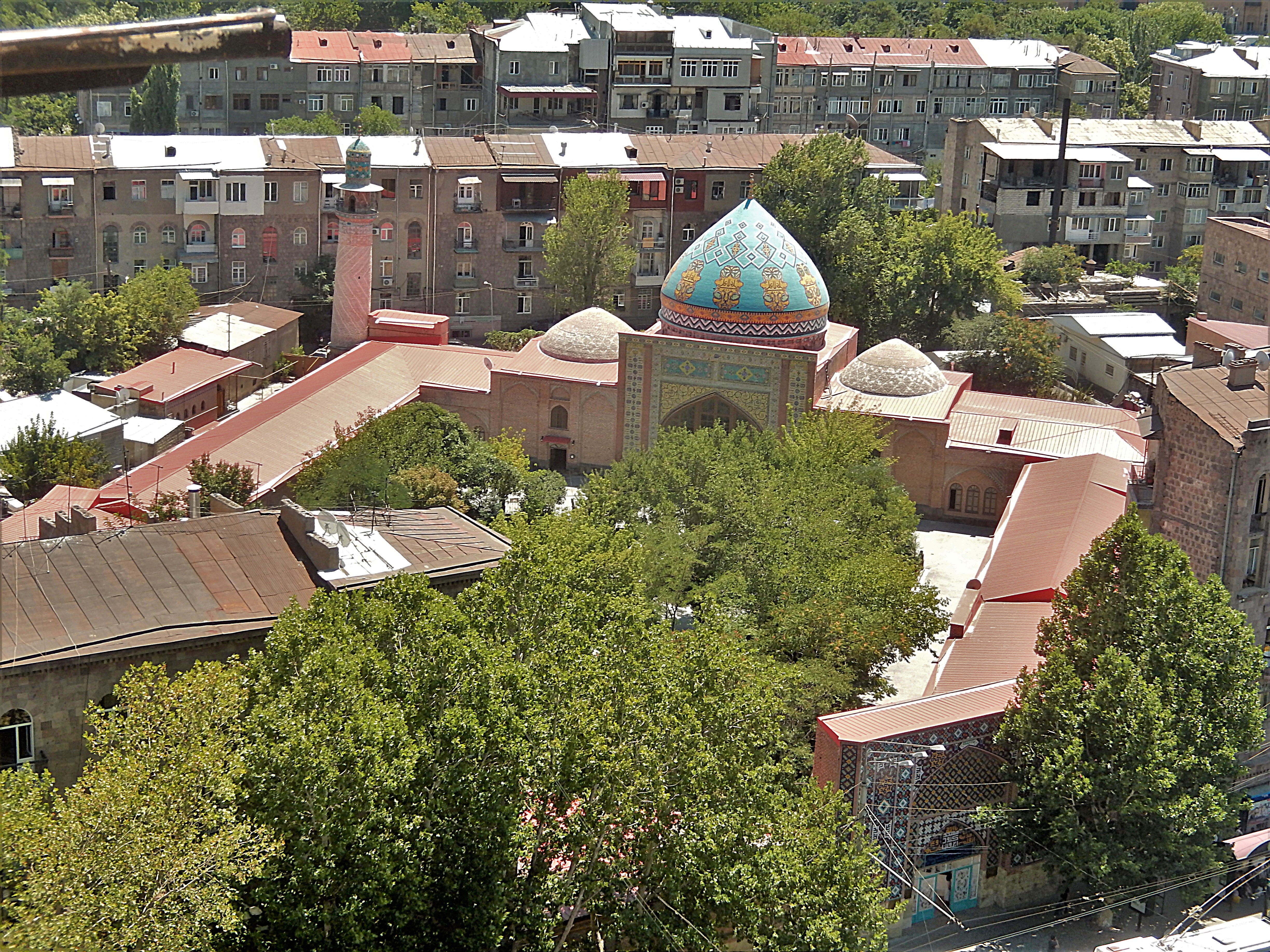
On a busy stretch of Mesrop Mashtots Avenue, a 24-meter minaret and a dome covered in turquoise tiles rise above the traffic. This is the Blue Mosque, the only active mosque in Armenia and the oldest surviving structure from Yerevan's Iranian period. Commissioned by Hoseyn Ali Khan, the khan of the Erivan Khanate, it was completed in 1766 and was the largest of the eight mosques that once stood in the city. Its Persian name, Masjed-e Kabūd, and Armenian name, Kapuyt mzkit, both simply mean "blue mosque," a nod to the vivid faience that decorates the building.
Today the mosque operates under the auspices of the Iranian Embassy in Yerevan, serving as both a place of worship for the city's small Shia Muslim community and a cultural center for Iranians living in or visiting Armenia. The complex, which originally included a madrasa, a library, and a bathhouse, now centers on a large courtyard, a vaulted iwan, and the main prayer hall. The architecture blends Persian and Ottoman elements, and the tilework, with its deep blues and geometric patterns, remains the building's most striking feature.
The mosque is a rare example of a functioning religious site in a predominantly Christian country, and its presence is often cited as a symbol of Armenian-Iranian friendship. It draws tourists, historians, and worshippers alike, and its quiet courtyard offers a sharp contrast to the bustle of the avenue outside. Though it does not have a dedicated website, it is well documented on travel platforms and in academic literature, and it was submitted by the Armenian government for UNESCO World Heritage consideration in 2018.
Mission
The Blue Mosque exists to serve the spiritual needs of Yerevan's Shia Muslim community while also acting as a cultural bridge between Armenia and Iran. It provides a space for daily prayers, Friday sermons, and religious observances, and it hosts cultural events that promote Iranian heritage and Armenian-Iranian dialogue. The mosque's leadership emphasizes its role as a peaceful oasis where both faithful and curious visitors can learn about Islamic architecture and the region's shared history.
History
The story of the Blue Mosque begins in the 1760s, when Yerevan was the capital of the Erivan Khanate, a principality under Iranian suzerainty. Hoseyn Ali Khan, the local khan, ordered the construction of a grand mosque that would serve as the city's main place of worship. Completed in 1766, it was the largest of eight mosques in Yerevan, reflecting the city's Persian cultural and political ties. The original complex included a madrasa, a library, and a bathhouse, making it a hub of religious and intellectual life.
After the Russian Empire conquered the khanate in 1827, the mosque's fortunes changed. Under Russian rule, it continued to function for a time, but by the Soviet era, religious practice was suppressed. The building was secularized and used as a museum, and much of the original complex fell into disrepair. The madrasa, library, and bathhouse were lost, leaving only the prayer hall, courtyard, iwan, and minaret.
A turning point came in the 1990s, following the collapse of the Soviet Union and Armenia's independence. In 1996, the Armenian and Iranian governments signed an agreement to restore the mosque, and a major renovation took place between 1996 and 1999. The restoration returned the building to its religious function, and it has operated as an active mosque ever since. In January 2018, the Armenian government formally submitted the Blue Mosque for consideration as a UNESCO World Heritage Site, a process that remains ongoing.
Subdivisions
Prayer Hall
The main hall for daily and Friday prayers, featuring the mosque's distinctive blue-tiled interior.
Courtyard
A large open courtyard surrounded by arcades, used for gatherings and as a tranquil public space.
Madrasa (historical)
A theological school that was part of the original complex but has not survived.
Library (historical)
Once housed manuscripts and religious texts; no longer extant.
Bathhouse (historical)
A traditional hammam that served the community but has been lost to time.
Notable People
Hoseyn Ali Khan
Founder and Khan of the Erivan Khanate · 18th century
Commissioned the construction of the Blue Mosque in the 1760s, making it the largest mosque in Yerevan at the time.
Mahmoud Movahedifar
Imam · 2020s
Leads Friday prayers at the mosque and appears in media coverage of the site.
Anahit Meliksetyan
Architectural researcher · 2010
Produced a detailed sketch of the mosque's layout, contributing to academic study of its architecture.
Milestones
1766
Construction of the Blue Mosque completed under Hoseyn Ali Khan.
1827
Russian conquest of the Erivan Khanate; the mosque's role begins to change.
Soviet era
Religious activity suppressed; the building is repurposed as a museum.
1996-1999
Major restoration funded by Armenian-Iranian cooperation; mosque reopens for worship.
2018
Armenia submits the Blue Mosque for UNESCO World Heritage consideration.
2025
Azerbaijan's Caucasus Religious Council appoints a representative to serve Azerbaijanis in the region, intersecting with the mosque's contested religious landscape.
2026
The mosque hosts a memorial for Minab Girls' School victims, highlighting its community role.
Sources
Organization Info
- Founded
- 1766
- Headquarters
- Mesrop Mashtots Avenue, Yerevan, Armenia
- Country
- Armenia
- Imam
- Mahmoud Movahedifar
- Parent
- Iranian Embassy in Yerevan
- Type
- Religious
- Denomination
- Twelver Shia
- Minaret height
- 24 meters
- Status
- Active mosque and cultural center
Join the community
fans discussing