 Germany
About
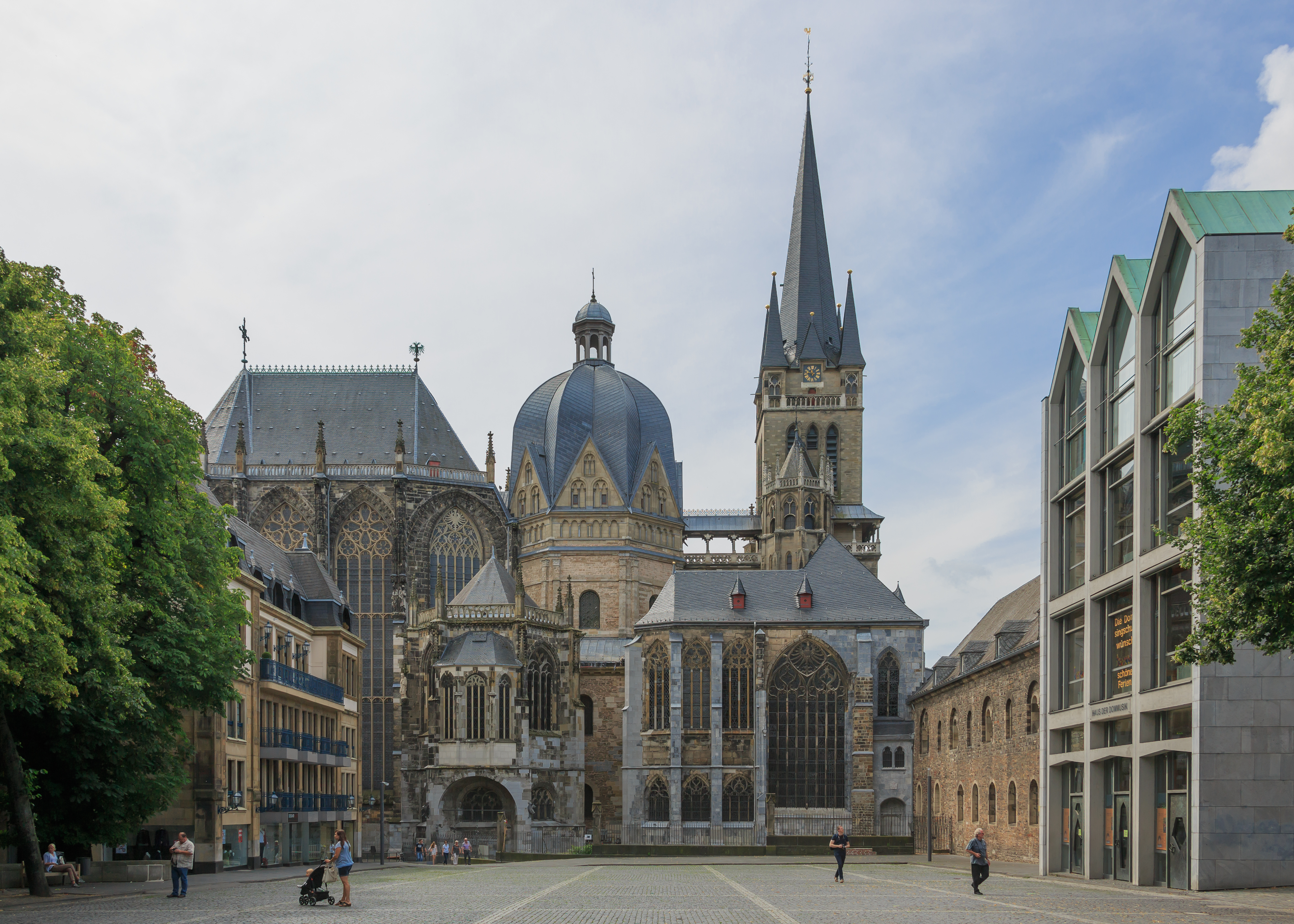
Aachen Cathedral, known in German as Aachener Dom, is a Catholic church in Aachen, Germany, serving as the seat of the Diocese of Aachen. It stands as one of the oldest cathedral buildings in Europe, with its origins tracing back to the royal chapel of Emperor Charlemagne's Palace of Aachen. Charlemagne was buried here in 814, and from 936 to 1531, the original Palatine Chapel witnessed the coronation of thirty-one German kings. Over the centuries, the structure underwent significant expansion, evolving from a chapel to a minster and collegiate church, and briefly becoming a cathedral from 1803 to 1825 before its current status.
The cathedral is a masterpiece of Carolingian and Gothic architecture, blending elements that reflect its long and storied history. Its octagonal core, inspired by Byzantine models, and the later Gothic choir, with its towering windows, create a unique architectural ensemble. As a UNESCO World Heritage Site, it attracts visitors from around the globe, drawn not only to its spiritual significance but also to its artistic treasures, including the famous Pala d'Oro and the Barbarossa Chandelier. The cathedral remains an active place of worship, hosting regular services and special events, while also serving as a monument to the enduring legacy of Charlemagne and the Holy Roman Empire.
Beyond its role as a house of worship, the cathedral houses the Domschatzkammer, one of the most significant ecclesiastical treasuries in Europe, holding relics, manuscripts, and liturgical objects that span over a millennium. The building's mosaics, completed in the 19th and 20th centuries, are among the finest Byzantine-inspired art in Western Europe. Each year, the cathedral also serves as the venue for the Charlemagne Prize, awarded to individuals who have advanced European unity, with Mario Draghi being the 2026 recipient.
Mission
Aachen Cathedral serves as a living Roman Catholic place of worship, open to all who seek prayer, contemplation, and participation in the liturgy. It is also a guardian of the legacy of Charlemagne and the Holy Roman Empire, preserving over 1,200 years of European history through its architecture, art, and relics. As a UNESCO World Heritage Site, the cathedral is committed to the conservation of its unique cultural heritage for future generations, while remaining a vibrant center of pilgrimage and tourism.
History
Construction of the Palatine Chapel began around 795 under the direction of Charlemagne, who envisioned a royal chapel that would rival the great churches of Byzantium. The design, attributed to architect Odo of Metz, drew inspiration from the Basilica of San Vitale in Ravenna, with an octagonal plan and a central cupola. Pope Leo III consecrated the chapel on January 17, 801, and Charlemagne was buried there in 814.
Over the following centuries, the cathedral witnessed the coronation of thirty-one German kings, starting with Otto I in 936 and ending with Ferdinand I in 1531. A major expansion came in the 14th century with the addition of the Gothic choir, built between 1355 and 1414 to accommodate the growing number of pilgrims. The choir's soaring stained-glass windows and ribbed vaulting marked a dramatic shift from the earlier Carolingian style.
The cathedral weathered the Reformation and subsequent wars, but the most perilous moment came in 1944 during World War II. As Allied forces bombed Aachen, the city was reduced to rubble, yet the cathedral survived largely intact, thanks in part to an American soldier who helped prevent its destruction. In 1978, Aachen Cathedral became one of the first twelve sites inscribed on the UNESCO World Heritage List, recognizing its outstanding universal value. Since then, ongoing preservation efforts have ensured that this 1,200-year-old monument remains a living church and a symbol of European heritage.
Subdivisions
Palatine Chapel (Octagon)
The Carolingian core, consecrated in 805, featuring an octagonal basilica with a cupola.
Gothic Choir
Added in the 14th century (1355–1414), featuring towering stained-glass windows.
Cathedral Treasury (Domschatzkammer)
Housing one of the most significant ecclesiastical treasuries in Europe.
All Saints Chapel
A chapel within the cathedral complex.
Matthias Chapel
A chapel within the cathedral complex.
Notable People
Charlemagne
Founder and Holy Roman Emperor · 742–814
Commissioned the construction of the Palatine Chapel and was buried here in 814.
Odo of Metz
Architect · late 8th century
Designed the original Palatine Chapel.
Pope Leo III
Pope · 795–816
Consecrated the original chapel in 801.
Frederick Barbarossa
Holy Roman Emperor · 1155–1190
Donated the Barbarossa Chandelier in the 12th century.
Otto III
Holy Roman Emperor · 996–1002
Died in 1002 and is buried at the cathedral.
Milestones
801
Consecration of the Palatine Chapel by Pope Leo III.
814
Burial of Charlemagne at the cathedral.
936–1531
Thirty-one German kings crowned at the cathedral.
1355–1414
Construction of the Gothic choir.
1978
Inscribed on the UNESCO World Heritage List as one of the first twelve sites.
2023
Installation of a high-tech fire prevention system in partnership with ABB.
Sources
Organization Info
- Founded
- January 17, 801
- Headquarters
- Aachen, North Rhine-Westphalia, Germany
- Country
- Germany
- Bishop
- Bishop of Aachen
- Parent
- Diocese of Aachen
- Type
- Religious
- Architect
- Odo of Metz
- Burials
- Charlemagne, Otto III
- Coronations
- 31 German kings (936–1531)
- UNESCO Inscription
- 1978
Official Website
www.aachenerdom.de/
Join the community
fans discussing