“A majestic, melancholy epic that ranks among the finest Westerns ever made.”
Dave Kehr
Chicago Reader
Part of the America trilogy series
Series community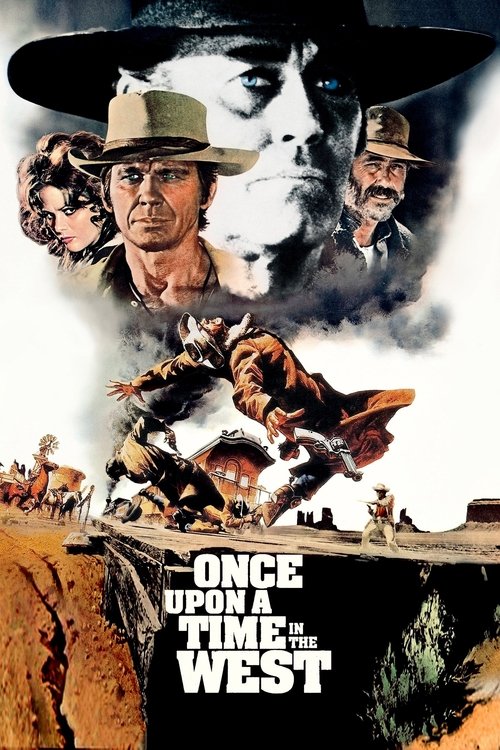
 United States
"There were three men in her life. One to take her… one to love her —and one to kill her."
When a mysterious harmonica-playing stranger arrives in the Arizona desert, he sets off a chain of events that will reshape the lives of everyone around him. This 1968 epic from director Sergio Leone stands as one of the most celebrated Spaghetti Westerns ever made, a sprawling tale of revenge, greed, and the death of the Old West.
The film opens with one of cinema's most famous sequences: three gunmen wait at a dusty train station for nearly fifteen minutes, their faces filling the screen in extreme close-up. The tension is unbearable, broken only by the screech of a train and the arrival of Charles Bronson's character, known only as Harmonica. This meticulous pacing defines Leone's style, building drama through silence, music, and the vast landscapes of Monument Valley and the Spanish desert.
Ennio Morricone's score, composed before filming began, weaves through every scene with haunting themes for each character. The harmonica melody becomes a character itself, a mournful cry that drives the story forward. Leone shot the film in Techniscope, using extreme wide shots and tight close-ups to create a visual language that feels both operatic and intimate.
Stream
Availability and pricing can change. Confirm on the provider's site before purchasing.
Jill McBain, a former prostitute from New Orleans, arrives in the small town of Flagstone, Arizona, expecting to begin a new life with her husband Brett. But when she reaches the McBain ranch, she finds Brett and his three children brutally murdered. The killer is Frank, a cold-blooded gunman working for railroad tycoon Morton. Morton wants the McBain land because it contains the only water source for miles, essential for his railroad's expansion to the Pacific.
Frank plants evidence to frame the outlaw Cheyenne for the murders. Cheyenne, a charming but dangerous bandit, is captured and jailed. Meanwhile, Harmonica appears in town, seemingly on his own mission. He kills three of Frank's men in a saloon and frees Cheyenne, forming an uneasy alliance with the outlaw.
Jill is determined to keep the land, despite Morton's attempts to buy her out and Frank's threats. She discovers that Brett had already sold the land to the railroad without her knowledge, but the sale is invalid because she is the rightful heir. Morton, desperate to complete the railroad before his illness kills him, orders Frank to get the land at any cost.
Harmonica and Cheyenne protect Jill from Frank's attacks. In a tense scene at a hotel, Harmonica confronts Frank, playing his harmonica and forcing Frank to remember a past encounter. Frank, usually unshakable, is visibly disturbed. The two men circle each other, their shared history hinted at but not yet revealed.
The railroad construction continues, inching closer to Sweetwater. Morton, frustrated with Frank's failure, tries to double-cross him, but Frank kills Morton's men and leaves him stranded in the desert. Frank then decides to take the land by force, leading his remaining gang to the ranch for a final showdown.
Trailer
Critical Consensus
Sergio Leone's Once Upon a Time in the West is an operatic, elegiac masterpiece that elevates the Western genre with its epic scope, stunning visuals, and unforgettable score. It masterfully blends grand spectacle with intimate character drama, creating a timeless exploration of revenge and the end of an era.
“A majestic, melancholy epic that ranks among the finest Westerns ever made.”
Dave Kehr
Chicago Reader
“Leone's operatic masterpiece... a sprawling, elegiac epic that feels like the culmination of the director's career.”
Geoff Andrew
Time Out
“This is the gold standard of spaghetti westerns, a true epic.”
Fanboydestroy.com
Fanboydestroy.com
Claudia Cardinale
Jill
Henry Fonda
Frank
Jason Robards
'Cheyenne'
Director
Sergio Leone
Writers
Sergio Donati, Sergio Leone, Dario Argento, Bernardo Bertolucci, Mickey Knox
Composer
Ennio Morricone
Cinematographer
Tonino Delli Colli
Producer
Fulvio Morsella
David di Donatello Awards (1969)
Best Foreign Film: Won
Nastro d'Argento (1969)
Best Cinematography: Won
Nastro d'Argento (1969)
Best Original Score: Won
Join the community
fans discussing