 United States
“A bold, brutal, and beautifully acted series that redefines what a police drama can be. Dennis Franz is nothing short of a revelation.”
Vincent Canby
The New York Times
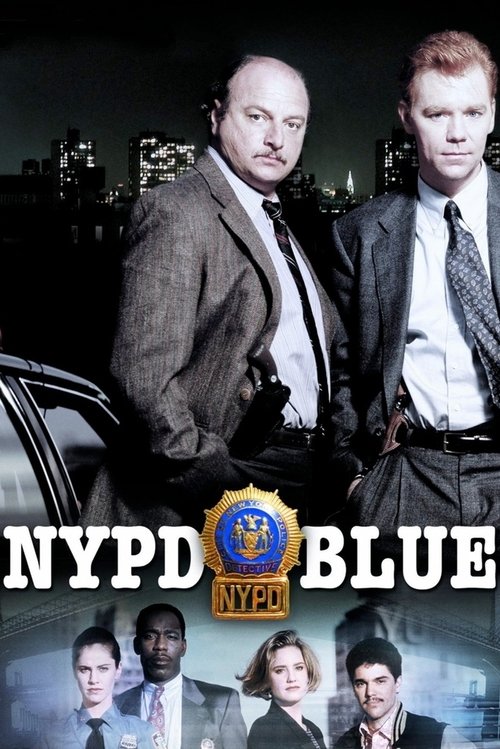
David Milch and Steven Bochco crafted a gritty, unflinching look at the inner workings of New York City police work with NYPD Blue. Premiering on ABC in September 1993, this drama shattered many conventions of the genre by featuring raw language, nudity, and moral ambiguity. The series ran for twelve seasons until March 2005, delivering 261 episodes that followed the officers of Manhattan's fictional 15th precinct through their professional and personal crises.
The show distinguished itself from predecessors like Hill Street Blues by refusing to sanitize the profession. It placed cameras directly into the chaotic streets and cramped squad rooms, capturing the exhaustion and ethical compromises faced by its characters. Dennis Franz anchored the series as Andy Sipowicz, a detective whose journey from alcoholic brute to respected mentor became the emotional core of the program. This character-driven approach allowed the show to explore complex themes of race, family trauma, and institutional corruption without relying on formulaic resolutions.
Availability and pricing can change. Confirm on the provider's site before purchasing.
The narrative engine of NYPD Blue revolves around the daily grind of the detectives assigned to the 15th Precinct in Manhattan. The early seasons establish a specific dynamic between two men: Detective John Kelly, a young, idealistic cop played by David Caruso, and his partner Detective Andy Sipowicz, portrayed by Dennis Franz. Sipowicz enters the show as a deeply flawed figure who has alienated his family and colleagues due to severe alcoholism and a history of brutality. His arc begins not with a sudden transformation but with a grueling process of recovery forced upon him by the department and his new partner. Kelly serves as both a foil and a mirror, challenging Sipowicz's cynicism while learning the harsh realities of the job himself.
When Caruso departed after the second season, the series pivoted to focus almost entirely on Sipowicz and his rotating partners. Jimmy Smits joined the cast as Detective Bobby Simone, bringing a steady, by-the-book demeanor that contrasted sharply with Sipowicz's rough edges. Their partnership defined seasons three and four before tragedy struck Simone's storyline, forcing another shift in the show's direction. Subsequent seasons introduced characters like Clarence Buggin, played by William Fichtner, and later John Clark Jr., portrayed by Mark-Paul Gosselaar. Each new partner brought fresh conflicts and dynamics that kept the central relationship between Sipowicz and the precinct evolving over time.
Beyond the main partnerships, the show built a rich world of recurring characters including Captain Gregory Medavoy, Lieutenant Joan Latimer, and various other detectives and civilians. These figures provided a backdrop of bureaucratic struggle and personal drama that often rivaled the criminal cases of the week. The plot structure rarely focused on solving a single mystery; instead, it used cases as vehicles to examine the psychological toll of policing. Storylines frequently tackled difficult subjects such as domestic violence, racial tension within the force, and the gray areas where the law offers no clear answers.
The series maintained a consistent tone throughout its twelve-year run, balancing hard-hitting crime drama with moments of dark humor and genuine human connection. Seasons five through eight saw the squad mature into a cohesive unit capable of handling organized crime and political scandals. Later seasons addressed the changing landscape of New York City, including the aftermath of the September 11 attacks, which deeply affected the characters and the city they served. The show concluded by focusing on the passage of time and the inevitable retirement of its central figures rather than a dramatic final showdown.
Critical Consensus
NYPD Blue revolutionized the police procedural genre by bringing unprecedented grit, moral complexity, and adult themes to prime-time television. Dennis Franz delivers a career-defining performance as the flawed, redemptive Andy Sipowicz, anchoring a show that balances hard-hitting storytelling with deep character development. While some storylines can be dark and repetitive, the series remains a landmark achievement in television history for its willingness to challenge viewers and push boundaries.
“A bold, brutal, and beautifully acted series that redefines what a police drama can be. Dennis Franz is nothing short of a revelation.”
Vincent Canby
The New York Times
“NYPD Blue is a masterclass in character-driven storytelling, where the streets of New York become a character in themselves.”
Hal Boedeker
Miami Herald
“The show's refusal to shy away from the ugly truths of police work makes it a necessary and powerful watch.”
Ken Tucker
Entertainment Weekly
“Franz's portrayal of Sipowicz is one of the greatest performances in television history, a testament to the power of good writing and acting.”
David Bianculli
New York Daily News
“NYPD Blue changed the rules of the game, proving that television could be as daring and complex as cinema.”
James Poniewozik
Time Magazine
Dennis Franz
Andy Sipowicz
Mark-Paul Gosselaar
John Clark Jr.
Henry Simmons
Baldwin Jones
Gordon Clapp
Greg Medavoy
Jacqueline Obradors
Rita Ortiz
Kim Delaney
Diane Russell
Jimmy Smits
Bobby Simone
David Caruso
John Kelly
Directors
Mark Tinker, Bill Clark, Christopher Misiano, Jeff Bleckner
Writers
David Milch, Steven Bochco, Bill Clark, Matt Olmstead, Nicholas Wootton
Composers
Christophe Beck, Michael Small
Cinematographers
Peter Levy, Arthur Albert
Producers
William M. Finkelstein, Nicholas Wootton, Matt Olmstead, Bill Clark, Mark Tinker, Steven Bochco, David Milch
Primetime Emmy Award (1995)
Outstanding Lead Actor in a Drama Series: Won
Primetime Emmy Award (1997)
Outstanding Lead Actor in a Drama Series: Won
Primetime Emmy Award (1998)
Outstanding Lead Actor in a Drama Series: Won
Primetime Emmy Award (1999)
Outstanding Lead Actor in a Drama Series: Won
Primetime Emmy Award (2000)
Outstanding Lead Actor in a Drama Series: Won
Golden Globe Award (1995)
Best Performance by an Actor in a Television Series – Drama: Won
Screen Actors Guild Award (1996)
Outstanding Performance by an Ensemble in a Drama Series: Won
Peabody Award (1995)
Excellence in Broadcasting: Won
Join the community
fans discussing