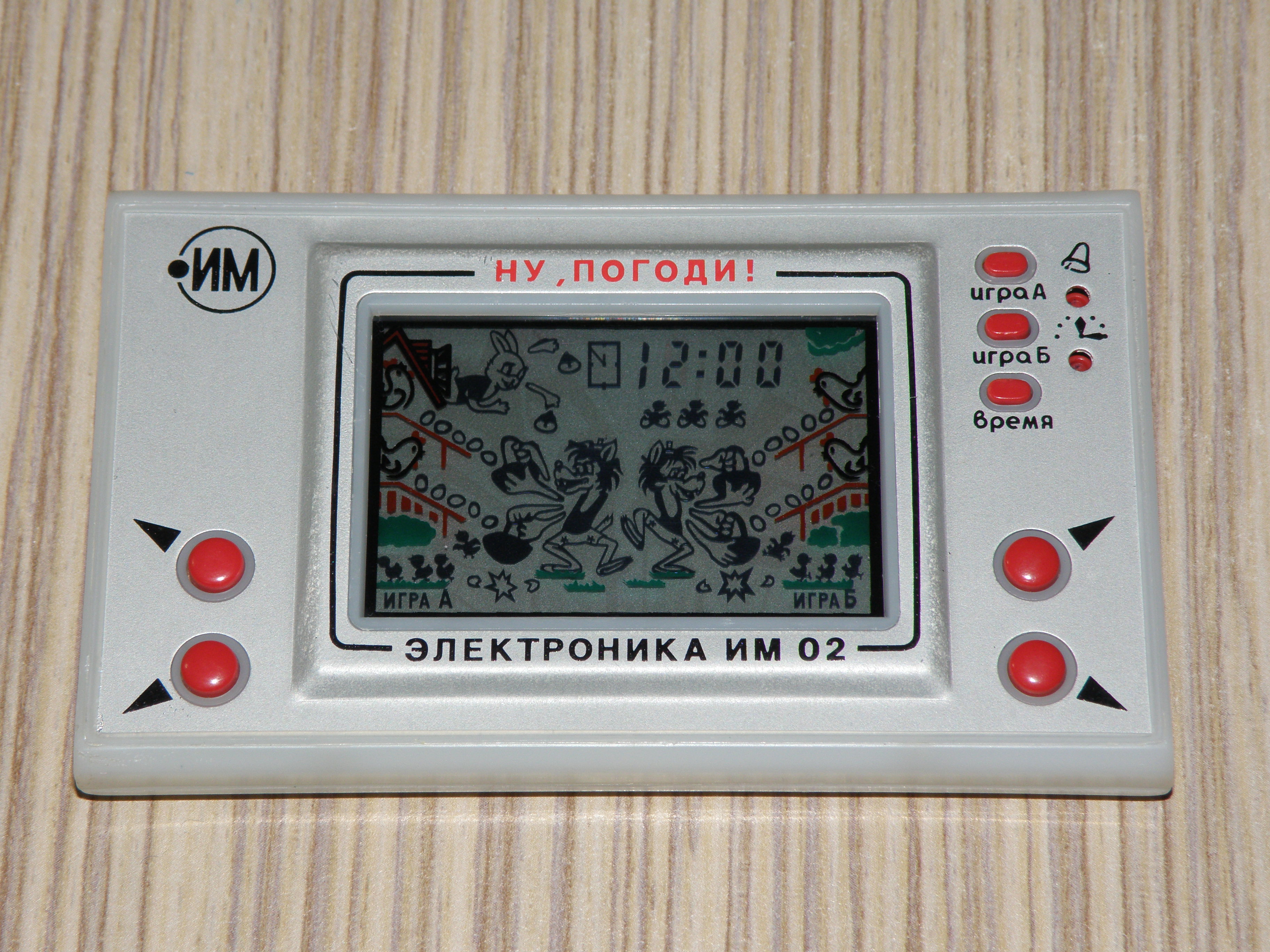
Overview
A wolf stands at the bottom of a chicken coop, eggs tumble down four chutes, and your thumb decides whether he catches them or gets clucked at. That's the whole loop of Nu, Pogodi!, the 1984 handheld that turned a Soviet cartoon rivalry into a pocket-sized reflex test. You slide the wolf left and right across four lanes to intercept falling eggs. Miss one and you lose a life; catch a set number and the pace quickens. The device also tells time, with a clock and alarm built into the same plastic shell.
Manufactured under the Elektronika brand, this was the best-known entry in the first wave of Soviet LCD handhelds. Early units carried no category number; later ones were labeled Elektronika IM-02, with IM standing for microprocessor game. A KB1013VK1-2 chip runs the show, feeding an IZhM2-71-01 display in the first batches and an IZhM13-71 in later ones. Retail price started at 25 rubles, then dropped to 23.
The design family is fixed-layout LCD, closer to Game & Watch than to anything with a scrolling screen, and the difficulty curve is pure pattern memorization plus twitch timing. There's no formal rating system attached to a 1984 Soviet toy, but the content is as mild as it gets: a cartoon wolf, some eggs, a score counter. What made it stick was availability. Millions of these consoles passed through Soviet and post-Soviet households, often as the only video game a family owned.
Gameplay
Four vertical chutes, one wolf, and a thumb on the left-right buttons. Eggs drop from the top of the coop at irregular intervals and you shift the wolf to whichever lane the next one is falling into. Each catch adds to the counter; each miss costs one of your lives. Cross a threshold and the eggs come faster, then faster still, until the timing windows shrink to a blink.
There is no scrolling and no hidden state. Every sprite sits at a fixed position on the LCD, lit or dark, which means the whole game is legible in a glance and the skill is entirely in anticipating the pattern. The clock and alarm share the same screen, so the console sat on nightstands as often as in schoolbags. Nothing about it is forgiving, and that's the point: the high score is the only progress bar.
Story
The premise comes straight from the cartoon. A mischievous, artistic Wolf spends every episode scheming to catch the Hare, and every episode the Hare slips away, a slapstick formula that critics have compared to Tom and Jerry since the series debuted from Soyuzmultfilm in 1969. The handheld borrows the Wolf and drops the chase. Here he guards a chicken coop and catches eggs instead, which is either a demotion or a steady job depending on how you look at it.
The cartoon itself ran, with long gaps, all the way to 2017 and became one of the most recognized Soviet and Russian animated series. Creator Alexander Kurlyandsky died in December 2020 at 82; animator Anatoly Sokolsky died in 2014 at 78. Their Wolf is the face on the plastic shell, and for a lot of players the game was the first place they met him.
Trailers

Keywords
Sources
Game Info
- Publisher
- Voskhod
- Release Date
- 1984
- Modes
- single-player
- Platforms
- handheld game console, dedicated console, handheld electronic game
- Brand
- Elektronika
- Model
- IM-02
- Microprocessor
- KB1013VK1-2
- Display (early units)
- IZhM2-71-01 LCD
- Display (later units)
- IZhM13-71 LCD
- Launch Price
- 25 rubles (later 23)
Join the community
fans discussing