 Italy
Italy“Nostalghia is not so much a movie as a place to inhabit for two hours.”
J. Hoberman
The Village Voice
Part of a Collection
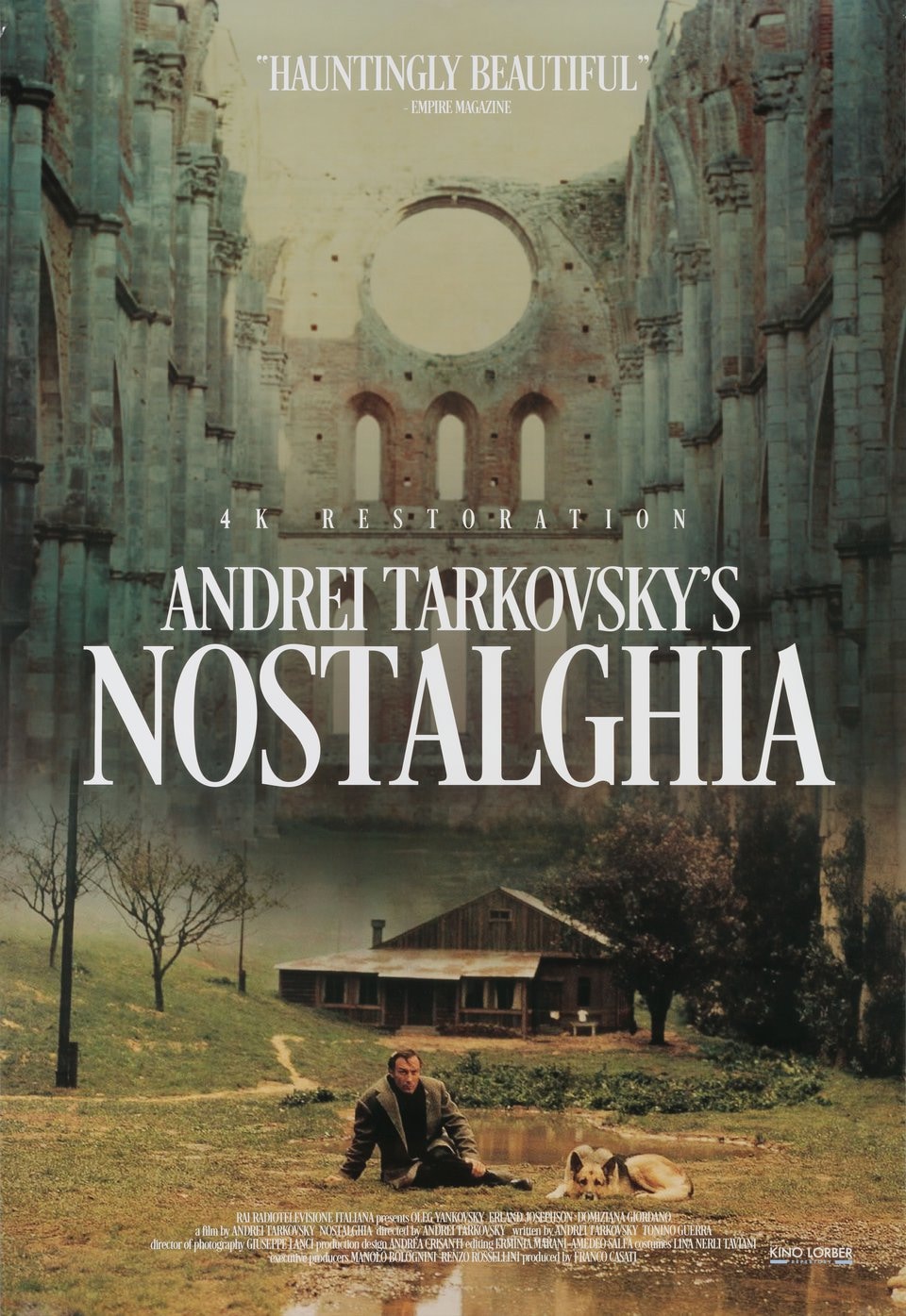
Andrei Tarkovsky's Nostalghia, released in 1983, is a deeply personal drama that follows a Russian writer named Andrei Gorchakov, played by Oleg Yankovsky, as he travels through Italy researching the life of an 18th-century composer. Accompanied by his translator Eugenia (Domiziana Giordano), Gorchakov grapples with a profound sense of homesickness that mirrors Tarkovsky's own feelings during his time in Italy. The film also features Erland Josephson as Domenico, a mysterious local who becomes a crucial figure in Gorchakov's journey. Co-written by Tarkovsky and Tonino Guerra, the movie explores themes of cultural displacement and the elusive nature of artistic expression. Shot on location in Italy, the film's production was marked by Tarkovsky's decision to work outside the Soviet Union, adding a layer of autobiographical resonance. At the 1983 Cannes Film Festival, Nostalghia won the Prize of the Ecumenical Jury, Best Director, and the FIPRESCI Prize. Critics praised its meditative pace and visual poetry, and it remains a cornerstone of Tarkovsky's filmography, earning nine votes in Sight and Sound's 2012 poll of the greatest films ever made.
Stream
Max
The Criterion Channel
Rent
Amazon Prime Video
Availability and pricing can change. Confirm on the provider's site before purchasing.
Andrei Gorchakov, a Russian poet, arrives in a foggy Italian spa town with his translator, Eugenia. He is researching the life of Pavel Sosnovsky, an 18th-century Russian composer who committed suicide after returning from Italy. Gorchakov feels disconnected from the Italian landscape, haunted by memories of his wife, children, and the Russian countryside. Eugenia tries to draw him out, but he remains distant, absorbed in his own melancholy.
In the town, Gorchakov encounters Domenico, an eccentric local man who once locked his family in their home for seven years, believing he was protecting them from the end of the world. Now ostracized, Domenico lives in a dilapidated house filled with water and debris, where he keeps a candle that he believes must be carried across the drained thermal baths of Bagno Vignoni to save humanity. Gorchakov is both repelled and fascinated by Domenico's fervent faith.
Gorchakov's dreams and memories blur with reality. He sees his wife and home in Russia, and he imagines Sosnovsky's tragic fate. Eugenia, frustrated by his emotional unavailability, leaves for Rome. Domenico asks Gorchakov to take the candle to Bagno Vignoni, a task Gorchakov reluctantly accepts. Domenico then travels to Rome, where he delivers a passionate speech about the need for human connection and spiritual renewal, before setting himself on fire in a public square. Gorchakov, learning of Domenico's death, feels compelled to honor his promise.
At the drained baths, Gorchakov begins his slow, agonizing walk with the lit candle. The wind extinguishes it twice. He relights it each time, his health visibly failing. The camera follows his halting progress in a single, extended take. He finally reaches the other side, places the candle on a ledge, and collapses. The film ends with an image of Gorchakov lying in a surreal, cathedral-like space, surrounded by fog and the sound of dripping water, a vision that merges his memory of Russia with the Italian landscape.
Critical Consensus
A visually stunning and deeply meditative work, Andrei Tarkovsky's 'Nostalghia' explores themes of displacement and the untranslatable nature of art. Its challenging pace and poetic imagery invite viewers into a profound emotional and spiritual landscape.
“Nostalghia is not so much a movie as a place to inhabit for two hours.”
J. Hoberman
The Village Voice
“Lovingly rendered by one of the cinema's true poets.”
Leonard Maltin
Leonard Maltin's Movie Guide
“Visually gorgeous and profoundly unsettling... a film of rare, haunting beauty.”
Dave Kehr
Chicago Reader
“Tarkovsky's most personal film... a spiritual and artistic testament.”
Jonathan Romney
Film Comment
Oleg Yankovsky
Andrei Gorchakov
Erland Josephson
Domenico
Domiziana Giordano
Eugenia
Patrizia Terreno
Veronica
Laura De Marchi
Maria
Delia Boccardo
Domenico's Wife
Milena Vukotic
Nun
Elena Magoia
Piero Vida
Raffaele Di Mario
Maria Cumani Quasimodo
Director
Andrei Tarkovsky
Writers
Tonino Guerra, Andrei Tarkovsky
Composers
Ludwig van Beethoven, Giuseppe Verdi
Cinematographer
Giuseppe Lanci
Producers
Manolo Bolognini, Renzo Rossellini, Daniel Toscan du Plantier
Cannes Film Festival (1983)
Best Director: Won
Cannes Film Festival (1983)
Prize of the Ecumenical Jury: Won
Cannes Film Festival (1983)
FIPRESCI Prize: Won
Nastro d'Argento (1984)
Best Foreign Director: Won
Join the community
fans discussing