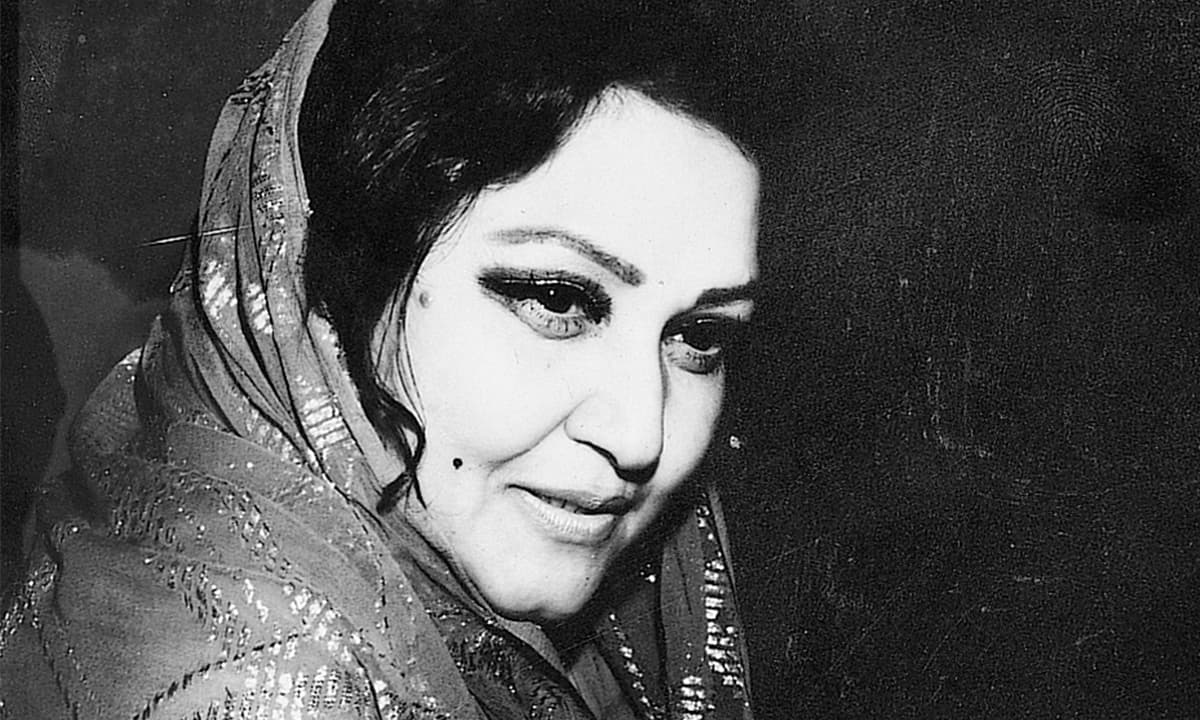
Noor Jehan
 Pakistan
Playback Singer•Actress•Film Director
Also known as: Malika-e-Tarannum, Queen of Melody, Baby Noor Jehan
Birthday
September 21, 1926
Birth Sign
Virgo
Birthplace
Kasur, Punjab, British India
Age
Died at 74
About
Noor Jehan was a Pakistani playback singer and actress whose career spanned more than six decades, from the 1930s to the 1990s. Born Allah Wasai in Kasur, she became one of the most celebrated voices in South Asian music, earning the title Malika-e-Tarannum, or "Queen of Melody." Her repertoire ranged from Hindustani classical to ghazals, and she recorded roughly 10,000 songs in Urdu, Punjabi, and Sindhi, a record in Pakistani cinema.
Her film career began in British India, where she starred in hits like Khandan (1942) and Zeenat (1945). After migrating to Pakistan in 1947, she continued acting and singing, then shifted to playback singing full-time in the early 1960s. She also made history as the first female film director in Pakistan with Chann Wey (1951). Her patriotic songs during the 1965 India-Pakistan war remain iconic. She passed away on December 23, 2000, in Karachi, at age 74, leaving a legacy that still resonates across the subcontinent.
Early Life & Background
Noor Jehan was born into a musical family in Kasur, Punjab. Her father, Imdad Ali, was a musician, and her grandmother, Amma Hasso, was a recognized singer. She began singing at age five or six, mimicking performers like Akhtari Bai Faizabadi and Mukhtar Begum. Her early talent was noticed, and she received classical training in dhrupad, khyal, and thumri under Ustad Bade Ghulam Ali Khan of the Patiala Gharana.
At age six, she appeared on stage in Calcutta as "Baby Noor Jehan." By 1935, she was performing for musician Ghulam Ahmad Chishti. Her first film break came in 1939 with Pancholi Studio's Gul-e-Bakavli, when she was just 13. That early start set the stage for a career that would soon make her a household name in pre-partition India.
Career Growth
Noor Jehan's breakthrough in Bollywood came with Khandan (1942), where she both acted and sang, and she solidified her stardom with Zeenat (1945). After partition, she moved to Lahore and continued her dual career in Pakistani cinema, starring in films like Chann Wey (1951), Dopatta (1952), Paatey Khan (1955), Chhu Mantar (1958), and Koel (1959). In 1951, she directed Chann Wey, becoming Pakistan's first female film director.
After retiring from acting in 1963, she focused on playback singing. She sang 2,422 songs for 1,148 films, a record in Pakistani cinema. Her patriotic songs during the 1965 war, such as "Aye Watan Ke Sajile Jawano," became rallying cries. She won over 15 Nigar Awards and the President's Award in 1965. Her career continued into the 1990s, with her voice remaining a staple of Pakistani film and television.
Career Timeline
Public Image & Style
Noor Jehan's public persona was as grand as her voice. She was known for her theatrical flair and glamorous style, often compared to Marilyn Monroe. Her fashion sense, with bold jewelry and flowing outfits, made her a style icon of her era. Fans adored her for her emotional depth in both acting and singing, and her patriotic songs made her a symbol of national pride. Her voice could convey both joy and sorrow, which is why she remains beloved across generations. She was a trailblazer for women in Pakistani cinema, and her legacy as the Queen of Melody endures.
Fame & Fandom
Noor Jehan's legacy is not measured in digital follower counts but in the enduring reverence of a nation that considers her voice its heartbeat. Her fanbase, universally known through the titles bestowed upon her like "The Queen of Melody" and "The Nightingale of the East," operates without a formal organizational moniker or branded membership name. Instead, devotion manifests as intergenerational cultural rituals, state-sponsored memorials, and the organic preservation of a discography that spans over six decades. This audience keeps her spirit alive through persistent efforts to maintain access to her music on streaming platforms, where tracks like "Neher Wale Pul" recently sparked unexpected resurgences among Gen Z listeners across borders. Fan-driven initiatives have even shaped physical infrastructure, such as the long-awaited opening of the Noor Jehan Bridge in Kashmir, a project deeply tied to local reverence for the singer who performed its namesake song. The community commemorates her annually through charity drives and global tributes, including Google Doodles that mark her birthdays and death anniversaries with retrospectives celebrating her contribution to the arts. While her life was filled with verified historical moments, from recording Pakistan's national anthem to legendary performances at the Lahore Fort where crowds reportedly shut down streets, the modern era has added new layers to her mythos. A specific viral incident in 2026 saw young Indian listeners embrace her 1970 ghazal, transcending political tensions to fuel cross-border appreciation. Despite this massive, timeless influence, iFANN's Global Fame Engine has evaluated her, but she does not currently hold a placement in the published rankings. She is not ranked within the Global Top 1,000 or any Top-100 scope list.
Interesting Facts and Legends
Born Allah Wasai in Kasur, she earned the title Malika-e-Tarannum, or "Queen of Melody," for her unmatched vocal range and versatility. At age six, she performed on stage in Calcutta as Baby Noor Jehan, a name that stuck throughout her life. She was one of the first South Asian singers to record songs in three languages: Urdu, Punjabi, and Sindhi. Her granddaughter, Sikandar Rizvi, is a film director in Pakistan. Known for her flamboyant, theatrical personality, she was often compared to Marilyn Monroe for her glamour. Legends surrounding her include the widely retold story of her performance at the Lahore Fort, where crowds became so entranced they reportedly shut down streets, though specific dates are lost to folklore. A documented fact anchors her status as the voice of a fledgling nation: she recorded the national anthem of Pakistan, "Qaumi Taranah." In the realm of viral moments, her role in the 1958 film *Anarkali* featured the singing of "Ae Mohabbat Zindabad," an iconic moment that defined romantic cinema of the era. Another cultural touchstone involves an elephant named Noor Jehan at Karachi Zoo, which fell critically ill in 2023, underscoring the ubiquity of her name in the collective consciousness of the city.
Notable Quotes
“I have sung for my country, and I will keep singing for it.”
“Music is the voice of the soul.”
“The stage is my temple, and the audience is my god.”
Family & Personal Life
Noor Jehan was the youngest child of Imdad Ali and Fateh Bibi. Her father was a musician, and her grandmother, Amma Hasso, was also a singer, so music ran in the family. She had six children from her two marriages. With her first husband, Shaukat Hussain Rizvi, she had a daughter, Zille Huma, who became a TV performer. With her second husband, Ejaz Durrani, she had a daughter, Mina Hasan, who married Olympic hockey player Hasan Sardar. In her later years, she lived in Karachi under the care of her daughters.
Notable Connections
Noor Jehan worked with many prominent figures in South Asian cinema. She was mentored by classical maestro Ustad Bade Ghulam Ali Khan and early collaborator Ghulam Ahmad Chishti. She acted alongside actors like Dilip Kumar and Pran in the 1940s. Her husbands, Shaukat Hussain Rizvi and Ejaz Durrani, were both influential in her career. She also sang duets with Ahmed Rushdi, another legendary playback singer. Her persona was often compared to Marilyn Monroe, but her artistry was uniquely her own.
Relationships & Dating History
Noor Jehan married film producer and director Syed Shaukat Hussain Rizvi in 1942. The couple had children together, including daughter Zille Huma, but divorced in 1953. In 1959, she married actor and filmmaker Ejaz Durrani. They had a daughter, Mina Hasan, but the marriage ended in divorce in 1970. After her second divorce, Noor Jehan did not remarry and remained single until her death in 2000. She was reportedly devoted to her children and grandchildren in her later years.
- MarriedSyed Shaukat Hussain Rizvi1942 - 1953Film producer and director; they had children together.
- MarriedEjaz Durrani1959 - 1970Actor and filmmaker; they had a daughter, Mina Hasan.
Death & Aftermath
Died
December 23, 2000 (aged 74)
Death Place
Karachi, Pakistan
Cause of Death
Protracted illness
The announcement of Noor Jehan's passing sent a wave of silence through Karachi, the city that had watched her rise from a child singer in Kasur to the undisputed Queen of Melody. Tributes poured in from across the subcontinent, with peers and institutions honoring the voice that had defined an era of South Asian cinema and music. Her legacy remained vibrant decades later, evidenced by streaming surges on platforms like Spotify where over one million monthly listeners still sought out her recordings. Noor Jehan passed away on December 23, 2000, at the age of 74 in Karachi, Pakistan. She died following a protracted illness, a fact confirmed by family statements and media outlets without specifying a terminal diagnosis or accident.
By the late 1990s, she had largely retired from active performance, leaving behind a final public presence that remained revered until the end. Posthumous recognition continued to accumulate for the icon who recorded roughly 10,000 songs. Google honored her with a doodle on her 91st birthday in 2017, while a bridge named after her in Srinagar was set to open in 2025 after a fifteen-year delay. Her estate continues to generate royalties from her vast catalog, ensuring her financial footprint remains active long after her death.
Net Worth (Estate Value)
$10 Million
iFANN Editorial Team estimate
Noor Jehan's net worth at the time of her death in 2000 was estimated at around $10 million, a figure reflecting her decades of earnings from film salaries, playback singing royalties, and live performances. As one of the highest-paid singers in Pakistan, she commanded significant fees for her work. Her estate continues to earn from royalties on her 10,000 recorded songs, which are still played on radio, television, and streaming platforms. Per iFANN's editorial analysis, her estate is valued at approximately $10 million in 2026, managed by her daughters, ensuring her musical legacy remains financially fruitful.
Awards Won (3)
Noor Jehan won over 15 Nigar Awards, Pakistan's top film honors, throughout her career. She also received the President's Award in 1965 for her contributions to music and acting, particularly her patriotic songs during the 1965 war. Her awards reflect her dominance in both acting and singing.
1965 · Best Female Playback Singer
Various songs
1957 · Best Actress
Chann Wey
1965 · Lifetime Achievement
Patriotic songs
Known For
Khandan
1942 · Actress and singer
Zeenat
1945 · Actress
Chann Wey
1951 · Director and actress
Playback singing
1950s-1990s · Singer
Keywords
Sources
Quick Facts
- Profession
- Playback Singer, Actress, Film Director
- Born
- September 21, 1926
- Birthplace
- Kasur, Punjab, British India
- Died
- December 23, 2000
- Death Place
- Karachi, Pakistan
- Gender
- Female
- Spouse
- Shaukat Hussain Rizvi, Ejaz Durrani
- Birth Sign
- Virgo
Personal Details
- Full Name
- Allah Wasai
- Spouse
- Shaukat Hussain Rizvi, Ejaz Durrani
- Children
- 6
Filmography
100
Total
90
Film
10
TV
Frequently Asked Questions
Who was Noor Jehan?
What is Noor Jehan's net worth in 2026?
How did Noor Jehan die?
Was Noor Jehan the first female director in Pakistan?
How many songs did Noor Jehan sing?

Join the community
fans discussing