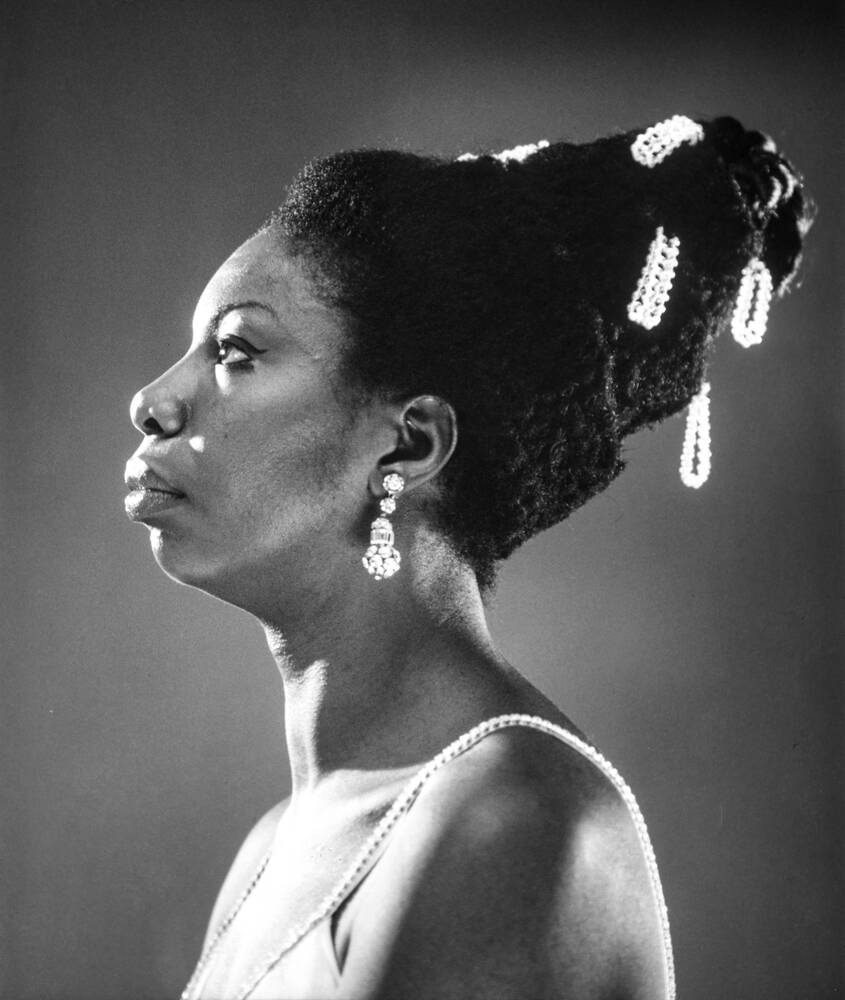
Nina Simone
 United States
singer-songwriter•jazz pianist•activist
Also known as: Eunice Kathleen Waymon, High Priestess of Soul
Birthday
February 21, 1933
Birth Sign
Pisces
Birthplace
Tryon, North Carolina, USA
Age
Died at 70
Height
5 ft 6 in (168 cm)
About
Nina Simone was an American singer-songwriter, jazz pianist, and civil rights activist whose fierce talent and unwavering conviction made her one of the most influential artists of the 20th century. Born Eunice Kathleen Waymon in Tryon, North Carolina, she first aimed to become a concert pianist, spending a summer at Juilliard before being denied admission to the Curtis Institute of Music, a rejection she believed was rooted in racism. That wound fueled her later activism. She went on to record more than 40 albums between 1958 and 1974, blending classical, folk, gospel, blues, jazz, R&B, and pop into a sound that defied easy categorization. Her contralto voice and expressive phrasing earned her the nickname the High Priestess of Soul.
Simone became a powerful voice in the civil rights movement during the 1960s, with songs like Mississippi Goddam and To Be Young, Gifted and Black becoming anthems. She left the United States in the 1970s, eventually settling in France, and continued performing across Europe, Africa, and the Caribbean. Her legacy as an artist and activist endures, with Rolling Stone repeatedly naming her among the greatest singers of all time. She died on April 21, 2003, at age 70, at her home in Carry-le-Rouet, France, after a long illness.
Early Life & Background
Simone was the sixth of eight children born to John Divine Waymon (June 24, 1898 – October 24, 1972), a handyman and barber who also owned a dry cleaning business, and Mary Kate Waymon (née Irvin, November 20, 1901 – April 30, 2001), a Methodist minister and housekeeper. The family was poor but respected in their community. She began playing piano by ear at age three, learning her first song God Be With You, Till We Meet Again. By age six, she was playing during church services. Her mother initially disapproved of nonreligious music like blues and jazz.
At age 12, Simone gave her first classical recital. During the performance, her parents were forced to move from the front row to the back to make way for white attendees. Simone refused to play until her parents were returned to the front, an incident she later said contributed to her civil rights activism. She studied classical piano with an Englishwoman named Muriel Mazzanovich, who had moved to Tryon, and developed a lifelong love of Johann Sebastian Bach, Chopin, Brahms, Beethoven, and Schubert. She graduated as valedictorian of her class at Allen High School for Girls in Asheville, North Carolina. Her community raised funds for her education, enabling her to spend a summer at the Juilliard School in New York City studying with Carl Friedberg, preparing for an audition at the Curtis Institute of Music in Philadelphia. When she was denied admission despite a strong audition, Simone believed racism was the cause. Out of 72 applicants in 1950, only three were accepted. This rejection devastated her and fueled her later activism. She then studied privately with Vladimir Sokoloff, a professor at Curtis, funding her lessons by performing.
In 1954, seeking to supplement her income teaching music to local students, Simone auditioned to play piano at the Midtown Bar and Grill on Pacific Avenue in Atlantic City, New Jersey. The owner insisted she sing as well as play, which launched her vocal career. She adopted the stage name Nina Simone to hide from her mother, who disapproved of the devil's music. Nina was a nickname from a former boyfriend, and Simone came from French actress Simone Signoret, whom she had seen in the 1952 film Casque d'Or.
Career Growth
Simone recorded her debut album Little Girl Blue in 1958 for Bethlehem Records. The following year, her version of I Loves You, Porgy became her only Billboard Hot 100 top 20 hit in the United States. She signed with Colpix Records and later with Philips Records, a Dutch company that allowed her to record songs drawing on her African American heritage. In 1963, she wrote and released Mississippi Goddam in response to the assassination of Medgar Evers and the bombing of the 16th Street Baptist Church in Birmingham, Alabama. The song became an anthem of the civil rights movement. Through the mid-1960s, she released a string of acclaimed albums including I Put a Spell on You (1965), Pastel Blues (1965), and Silk & Soul (1967). After the assassination of Martin Luther King Jr. in 1968, she released 'Nuff Said!. She received her first Grammy nomination for Best Female R&B Vocal Performance that same year, and a second nomination in 1971 for Black Gold.
In the 1970s, Simone left the United States, first for Barbados, then Liberia, and eventually various places in Europe. She continued recording and performing, releasing Black Gold (1969) and Here Comes the Sun (1971). She published her autobiography I Put a Spell on You in 1991. In 2000, she received a Grammy Hall of Fame Award. Just days before her death in 2003, the Curtis Institute of Music awarded her an honorary degree. Posthumously, she was inducted into the Rock and Roll Hall of Fame in 2018, and her song Mississippi Goddam was selected by the Library of Congress for preservation in the National Recording Registry in 2019. She also received a posthumous Grammy nomination for Best Music Film for the Netflix documentary What Happened, Miss Simone? in 2016.
Career Timeline
Public Image & Style
Simone was known for her regal bearing, often performing in elegant gowns, turbans, and dramatic jewelry. She had a commanding stage presence, often lecturing audiences between songs about civil rights issues. The media often focused on her temperamental nature and struggles with mental health, and she was diagnosed with bipolar disorder later in life. Recent portrayals, especially the 2015 documentary What Happened, Miss Simone?, have emphasized her genius and activism. The Netflix documentary was nominated for an Academy Award. Fans celebrate her birthday on February 21 and death anniversary on April 21 with tribute concerts and social media posts. Her music is frequently used in civil rights education. The estate's social media posts focus on her music, activism, and legacy, sharing archival footage and quotes.
Fame & Fandom (iFAMOUS Rankings)
Nina Simone stands as a towering figure whose cultural resonance transcends her era, cementing her status as the 63rd most famous person in R&B / Soul according to the iFANN Global Fame Rankings. This placement, holding steady from previous cycles, reflects a legacy that refuses to fade despite decades passing since her final performance. Her influence permeates modern consciousness not merely through streaming numbers but through a persistent, intellectual engagement with her work by a diverse global community. While no formal moniker unites her supporters like a hive or a clan, fans identify her simply as Nina, Dr. Nina, or The High Priestess, organizing themselves around shared values of artistic integrity and civil rights activism rather than a branded club structure. This fanbase manifests its devotion through sustained digital campaigns to preserve her childhood home in Tryon, North Carolina, and by orchestrating streaming pushes that keep rare recordings accessible on major platforms. Their rituals are deeply political; watch parties for documentaries and films featuring her music serve as forums for discussing the intersection of jazz, gospel, and resistance. The mythology surrounding her is thick with verified moments of high drama, such as the riots sparked during her 1964 Village Vanguard performance of Mississippi Goddam, where the raw anger of the song caused audience members to walk out or weep in silence. Another enduring legend involves her refusal to perform in apartheid-era South Africa, a stance that solidified her image as an uncompromising icon. Even stories of her emotional collapses on stage, often attributed to the weight of performing protest music, have become part of the folklore, framing her genius as inextricably linked to her pain. Recent initiatives, including the 2026 release of Freedom's Gate and the ongoing restoration of her birthplace, continue to fuel this pilgrimage-like devotion among those seeking to understand the origins of her persona.
Interesting Facts and Legends
Born Eunice Kathleen Waymon, she learned to play piano by ear at age three before ever reading sheet music. She was the valedictorian of her high school class and initially refused to sing professionally until a club owner demanded it. The name Nina originated from a boyfriend who called her Niña, Spanish for little girl. She pursued classical training with the specific goal of becoming the first African American concert pianist, a dream derailed when she was denied admission to the Curtis Institute of Music. Mississippi Goddam was composed in under an hour following the 16th Street Baptist Church bombing. Her song Sinnerman has been covered by dozens of artists and licensed for countless films and commercials. She received honorary degrees from Amherst College and Malcolm X College and was inducted into the National Rhythm & Blues Hall of Fame in 2021. Rolling Stone ranked her #21 on its 2023 list of 200 Greatest Singers of All Time. A legendary moment occurred during her 1964 performance at the Village Vanguard, where her angry delivery of Mississippi Goddam caused immediate controversy and riots, with some audience members walking out while others were moved to tears. Fans also retell the story of her fainting on stage due to the emotional toll of her protest music, a recurring theme in her lore. In 2026, a new book titled Freedom's Gate detailed her life alongside figures like Maya Angelou, further cementing her role in the mythology of the Civil Rights Movement.
Notable Quotes
“I'll tell you what freedom is to me—no fear.”
“I have to be a singer. I have to be a musician. I have to be an activist. I have to be a mother. I have to be a woman. I have to be a black woman. I have to be a lot of things.”
“Mississippi Goddam was written in response to the murder of Medgar Evers and the bombing of the church in Birmingham. I wrote it in about an hour.”
“I never had any intention of being a singer. I was a pianist.”
“I am not a jazz singer. I am a singer who sings jazz, blues, classical, folk, and gospel.”
Family & Personal Life
Simone was the sixth of eight children born to John Divine Waymon (June 24, 1898 – October 24, 1972), a handyman and barber who also owned a dry cleaning business, and Mary Kate Waymon (née Irvin, November 20, 1901 – April 30, 2001), a Methodist minister and housekeeper. The family was poor but respected in their community. Simone had one daughter, Lisa Celeste Stroud, born in 1962 from her marriage to Andy Stroud. Lisa later managed Simone's estate and oversaw legacy projects. In her later years, Simone lived in France with her daughter and a close friend who cared for her.
Notable Connections
Simone's husband Andy Stroud was a former police officer who became her manager. Her daughter Lisa Celeste Stroud manages her estate. Early piano teacher Muriel Mazzanovich and Juilliard instructor Carl Friedberg shaped her classical training. She was a contemporary and fellow activist of Aretha Franklin. Mary J. Blige inducted Simone into the Rock and Roll Hall of Fame. Liz Garbus directed the documentary What Happened, Miss Simone? Jay-Z sampled her song Four Women on The Story of O.J. (2017).
Relationships & Dating History
In the early 1950s, Simone dated a man named Chico, who gave her the nickname Nina, Spanish for little one. She later incorporated this into her stage name. In 1961, she married Andrew Andy Stroud, a former police officer who became her manager. They had one daughter, Lisa Celeste Stroud, born in 1962. The marriage was reportedly tumultuous, with allegations of physical abuse. Simone left the United States partly to escape the relationship. They divorced in 1970. Some sources mention a brief marriage to an unnamed man in the late 1970s, but credible documentation is limited. After her divorce, Simone had several relationships but never remarried. She lived in Liberia, Switzerland, France, and other countries. In her later years, she was cared for by her daughter Lisa and a close friend. At the time of her death on April 21, 2003, Simone was not married.
- DatedChico1950 - 1954Gave her the nickname Nina, which she later used as part of her stage name.
- MarriedAndy Stroud1961 - 1970Former police officer who became her manager; had one daughter together; divorced amid allegations of abuse.
Death & Aftermath
Died
April 21, 2003 (aged 70)
Death Place
Carry-le-Rouet, Bouches-du-Rhône, France
Cause of Death
Breast cancer
Following the news of her passing, vigils and gatherings erupted in Tryon, North Carolina, New York, and London as fans and peers mourned a voice that had long defined the intersection of jazz and civil rights. Institutions issued statements recognizing her contributions to American culture, while sales of her catalog surged immediately as new generations discovered her work. She passed away on April 21, 2003, at the age of 70 in her sleep at her home in Carry-le-Rouet, France, a coastal town near Marseille. A private funeral ceremony was held shortly after her death, respecting the family's wish for privacy during their grief.
Her ashes were later scattered in accordance with her wishes, though the specific location remained undisclosed. Posthumous recognition continued to mount as the documentary What Happened, Miss Simone? won acclaim and earned an Academy Award nomination. The Rock and Roll Hall of Fame inducted her in 2018, and the Library of Congress preserved Mississippi Goddam in the National Recording Registry the following year. Her daughter Lisa Kelly manages the estate, ensuring the music remains accessible while foundations like the Nina Simone Scholarship Fund support aspiring artists.
Net Worth (Estate Value)
$5 Million
iFANN Editorial Team estimate
As of 2026, iFANN currently estimates Nina Simone's estate value at $5 Million. Since her death in 2003, the estate has generated income from royalties on her catalog of more than 40 albums recorded between 1958 and 1974. Posthumous album sales have remained strong, with over one million albums sold in the final decade of her life. Licensing deals for film, television, and advertising have served as a major revenue stream; her song Sinnerman alone has been licensed for dozens of films and TV shows. The Netflix documentary What Happened, Miss Simone? (2015) generated renewed interest and revenue. Her autobiography I Put a Spell on You continues to earn royalties. The estate is managed by her daughter, Lisa Celeste Stroud, who oversees licensing and legacy projects. The estate has benefited significantly from posthumous recognition, including the Rock and Roll Hall of Fame induction in 2018 and increased streaming revenue.
Awards Won (5)
Simone received two Grammy Hall of Fame Awards, for her recording of I Loves You, Porgy in 2000 and for Mississippi Goddam in 2019. She was inducted into the Rock and Roll Hall of Fame in 2018 and the National Rhythm & Blues Hall of Fame in 2021. Her song Mississippi Goddam was selected by the Library of Congress for preservation in the National Recording Registry in 2019. She received honorary degrees from Amherst College, Malcolm X College, and the Curtis Institute of Music.
2019 · Recording
Mississippi Goddam
2000 · Recording
I Loves You, Porgy
2018 · Performer
N/A
Known For
I Loves You, Porgy
1958 · Performer
Mississippi Goddam
1964 · Songwriter and performer
Feeling Good
1965 · Performer
Sinnerman
1965 · Performer
To Be Young, Gifted and Black
1970 · Songwriter and performer
Keywords
Sources
Quick Facts
- Profession
- singer-songwriter, jazz pianist, activist
- Born
- February 21, 1933
- Birthplace
- Tryon, North Carolina, USA
- Died
- April 21, 2003
- Death Place
- Carry-le-Rouet, France
- Gender
- Female
- Spouse
- Andy Stroud
- Children
- 1
- Height
- 5 ft 6 in (168 cm)
- Education
- Allen High School for Girls, Juilliard School (summer)
Personal Details
- Full Name
- Eunice Kathleen Waymon
- Height
- 5 ft 6 in (168 cm)
- Spouse
- Andy Stroud
- Children
- 1
- Education
- Allen High School for Girls (valedictorian), Juilliard School (summer study), private study with Vladimir Sokoloff
Frequently Asked Questions
What was Nina Simone's cause of death?
How many albums did Nina Simone release?
Did Nina Simone have children?
Why did Nina Simone leave the United States?
Was Nina Simone inducted into the Rock and Roll Hall of Fame?
Social Media
Join the community
fans discussing