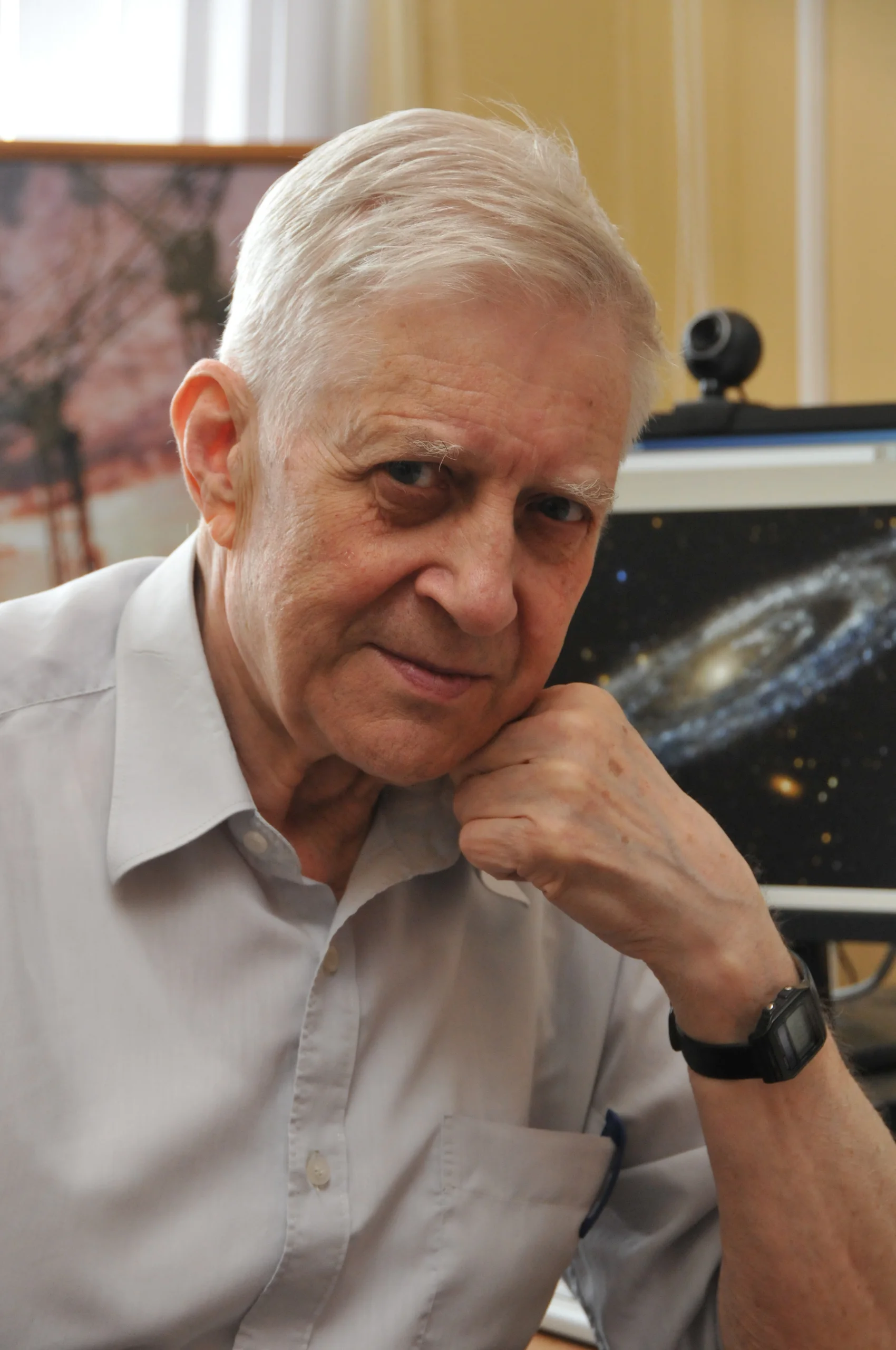
Nikolai Kardashev
 Russia
Birthday
April 25, 1932
Birth Sign
Taurus
Birthplace
Moscow
Age
Died at 87
About
Nikolai Semyonovich Kardashev was a Soviet and Russian astrophysicist whose ideas about advanced civilizations reshaped how we think about the cosmos. He is best known for creating the Kardashev scale, a system for ranking hypothetical alien societies by their energy use. The scale, proposed in 1964, remains a core concept in the Search for Extraterrestrial Intelligence (SETI) and a favorite thought experiment for scientists and science fiction fans alike.
For decades, Kardashev served as deputy director of the Astro Space Center at the Lebedev Physical Institute of the Russian Academy of Sciences. He was a full member of the Russian Academy of Sciences and won the Demidov Prize, one of Russia's oldest scientific honors. His work on radio astronomy, especially very long baseline interferometry (VLBI), helped lay the groundwork for modern space observatories. He passed away in Moscow on August 3, 2019, at age 87, but his legacy lives on in the questions he posed about our place in the universe.
Early Life & Background
Nikolai Kardashev was born in Moscow on April 25, 1932, into a family deeply tied to the Bolshevik cause. His parents, Semyon Karlovich Brike and Nina Nikolaevna Kardasheva, were professional revolutionaries. During the Great Purge of 1937-1938, both were arrested. His father was executed, and his mother was sent to labor camps for many years. Kardashev was placed in an orphanage and later taken in by his mother's sister, who died during World War II when he was 16. After that, he lived independently in a communal apartment. His mother was finally released in 1956.
As a schoolboy, Kardashev developed a passion for astronomy, attending a hobby group at the Moscow Planetarium. In 1950, he enrolled in the astronomy division at Moscow State University, focusing on radio astronomy, a field then in its infancy. He graduated in 1955 and went on to complete his PhD at the Sternberg Astronomical Institute in 1959, under the supervision of Iosif Shklovsky, a leading Soviet astrophysicist. This early training set the stage for his groundbreaking work on extraterrestrial intelligence and radio interferometry.
Career Growth
Kardashev's breakthrough came in 1964, when he published a paper proposing the Kardashev scale. This classification system divides civilizations into three types based on energy consumption: Type I uses all the energy of its home planet, Type II captures the full output of its star, and Type III commands the energy of an entire galaxy. The paper, titled "Transmission of Information by Extraterrestrial Civilizations," appeared in the Soviet Astronomical Journal and immediately captured the attention of the scientific community. It gave SETI researchers a framework for what to look for and inspired a generation of scientists, including Carl Sagan, who later popularized the concept.
That same year, Kardashev and his colleagues proposed the method of very long baseline interferometry (VLBI), a technique that links radio telescopes across vast distances to achieve extremely high resolution. This method has been used for over half a century and remains a cornerstone of modern radio astronomy. In the late 1960s and early 1970s, he initiated and supervised searches for extraterrestrial signals in the USSR. He also led the development of the RadioAstron space VLBI mission, which launched in 2011 and operated until 2019. Throughout his career, Kardashev published influential work on neutron stars, synchrotron radiation, and the evolution of galaxies. He became deputy director of the Astro Space Center in 1990 and continued working on projects like the planned Millimetron observatory until his death.
Public Image & Style
In the scientific community, Kardashev is remembered as a visionary who dared to ask big questions. His name is synonymous with the scale that bears it, and the Kardashev scale has become a cultural touchstone, referenced in science fiction, popular science books, and even Reddit threads about advanced civilizations. He was known for his rigorous approach to radio astronomy and his willingness to explore fringe topics like SETI when they were not mainstream. In Russia, he is celebrated as a pioneer of space science, and his work on VLBI and RadioAstron cemented his reputation as a technical innovator. Fans of SETI and science fiction often cite him as an inspiration, and his scale continues to be a benchmark for imagining the future of human civilization.
Fame & Fandom
Nikolai Semyonovich Kardashev remains a figure of profound academic reverence rather than popular celebrity, with no organized fanbase bearing a specific name or engaging in ritualistic campaigns. His influence is confined to the scientific community, particularly among astronomers and SETI researchers who utilize his theoretical frameworks, alongside science fiction enthusiasts who reference his work in speculative discussions. The concept of a traditional fandom does not apply to a private scientist whose legacy rests entirely on rigorous publication and lecture rather than public performance. Instead, his "fans" constitute the global population interested in cosmology, who invoke his name in educational contexts and media regarding the Fermi Paradox. The most enduring element of his legend is the 1964 introduction of the Kardashev Scale, a verified classification system for civilizations based on energy consumption that fundamentally altered how humanity conceptualizes the long-term future of intelligent life. This theoretical framework has become a staple in hard science and fiction, influencing thinkers from Carl Sagan to modern futurists discussing Mars colonization. While news outlets in 2026 continued to highlight the scale's relevance to modern energy metrics and proposed variations involving Bitcoin, these discussions remain within the realm of academic and speculative discourse rather than viral cultural phenomena. There are no records of crowds shutting down streets or fans fainting at his appearances, as he worked exclusively within research institutes. Regarding his standing in global fame metrics, iFANN has evaluated Nikolai Kardashev but currently holds no placement for him in the published Global Top 1,000 rankings or any Top-100 scope list.
Interesting Facts and Legends
Kardashev once predicted the presence of a neutron star in the Crab Nebula before pulsars were actually discovered, demonstrating his exceptional theoretical foresight. In 1963, he studied the radio source CTA 102 with Gennady Sholomitskii in search of signs of a Type III civilization; although the source was later identified as a quasar, the investigation remained pioneering. His seminal 1964 paper on the Kardashev scale was originally written in Russian, delaying its spread to the West until Carl Sagan popularized the concept in his book and television series Cosmos. A full member of the Russian Academy of Sciences, he was known as a dedicated mentor who encouraged bold, speculative thinking among his students. The most significant legendary aspect of his career is the enduring cultural impact of the Kardashev Scale itself, which serves as the primary mythos for discussions on the Great Filter and the Fermi Paradox. Stories frequently circulate about how this scale influenced the thinking of futurists like Elon Musk, who references it when discussing SpaceX and the colonization of Mars. In 2026, the scale remained relevant in news coverage, with proposals emerging to resolve conundrums regarding civilization classification through Bitcoin-inspired variations. Kardashev passed away on August 3, 2019, at the age of 87, leaving behind a legacy defined almost exclusively by this monumental contribution to astrophysics.
Family & Personal Life
Kardashev's family story is marked by tragedy. His parents, Semyon Karlovich Brike and Nina Nikolaevna Kardasheva, were both Bolshevik revolutionaries. During the Great Purge, his father was executed, and his mother spent years in labor camps. Kardashev was sent to an orphanage and later lived with his aunt, who died during World War II when he was 16. After that, he lived alone in a communal apartment. His mother was released in 1956, but by then, he had already forged his own path in astronomy. There is no public record of a spouse or children, so his personal life remains private.
Relationships & Dating History
There is no public information about Nikolai Kardashev's personal relationships. He was a private man, and his life's focus was clearly on his scientific work. None of the available sources mention a spouse, partner, or children. Given his intense dedication to research, it is possible he never married or kept his family life out of the public eye. As of 2026, no details have emerged about his personal life, so his relationship status remains unknown.
Death & Aftermath
Died
August 3, 2019 (aged 87)
Death Place
Moscow, Russia
Cause of Death
Unknown
Nikolai Semyonovich Kardashev, the Soviet and Russian astrophysicist renowned for the Kardashev scale of civilization classification, died on August 3, 2019, at the age of 87. While no public record specifies the exact city or medical facility where he passed away, his lifelong affiliation with the Astro Space Center of the P.N. Lebedev Physics Institute in Moscow suggests the event occurred within that capital. The official cause of death has never been publicly disclosed by the Lebedev Institute, the Astro Space Center, or his family. All accounts consistently describe his death as a natural occurrence associated with old age, but specific medical details remain unconfirmed and undisclosed.
Public reaction to his passing was marked by tributes from major international astronomical organizations and peers. The International Astronomical Union issued an official obituary acknowledging his status as one of the leading Russian astrophysicists, while the SETI Institute published a tribute noting him as one of the earliest and most consequential practitioners of the search for extraterrestrial intelligence. A formal memorial article titled In memory of Nikolay S. Kardashev appeared in the journal Astronomy & Astrophysics Transactions, authored by colleagues who detailed his career and scientific legacy. Physics Today also released an obituary commemorating his role in implementing the RadioAstron mission and his early work in SETI research.
Details regarding the specific location, time, or attendees of a funeral or memorial service were not made public in available records. Standard practice for prominent Soviet and Russian scientists often involves private services held within their affiliated institutions, though no specific dates, venues, or burial locations were confirmed in the public domain. His legacy continues to be actively cited in contemporary science and technology discourse, with the Kardashev scale remaining a central topic in discussions regarding energy consumption and the future of human civilization.
Net Worth (Estate Value)
$5 Million
iFANN Editorial Team estimate
Nikolai Kardashev's net worth is not publicly documented, but per iFANN's editorial analysis, his estate is estimated at $5 Million. His primary income originated from his academic positions, including his role as deputy director of the Astro Space Center. During the Soviet era, scientists received modest salaries, yet he also accumulated wealth through state prizes and honors such as the USSR State Prize. Following the collapse of the Soviet Union, he continued to lead research projects, including RadioAstron, which secured international funding. His legacy has generated posthumous interest, with his papers and ideas still cited widely across the scientific community. As of 2026, his estate likely benefits from royalties on his published work and ongoing recognition in the field.
Awards Won (3)
Nikolai Kardashev was a full member of the Russian Academy of Sciences and a laureate of the Demidov Prize, one of Russia's most prestigious scientific awards. He also received the USSR State Prize and the Order of Honour from the Russian Federation. These honors reflect his contributions to astrophysics and space science.
2012 · Science
Lifetime achievement in astrophysics
1988 · Science
Contributions to radio astronomy
Known For
Kardashev scale
1964 · Creator
VLBI technique
1964 · Co-proposer
RadioAstron mission
2011 · Leader
Keywords
Sources
Quick Facts
- Profession
- astronomer, astrophysicist
- Born
- +1932-04-25
- Birthplace
- Moscow
- Died
- +2019-08-03
- Death Place
- Moscow
- Gender
- Male
- Birth Sign
- Taurus
Personal Details
- Full Name
- Nikolai Semyonovich Kardashev
- Education
- Moscow State University (1955); PhD, Sternberg Astronomical Institute (1959)
Frequently Asked Questions
Who was Nikolai Kardashev?
What is the Kardashev scale?
When did Nikolai Kardashev propose the Kardashev scale?
What were Nikolai Kardashev's other contributions to science?
When did Nikolai Kardashev die?
Similar People
Join the community
fans discussing