 France
“Fellini has created a character who is both a victim and a victor, a woman who is broken by the world but refuses to let it break her spirit.”
Roger Ebert
Chicago Sun-Times

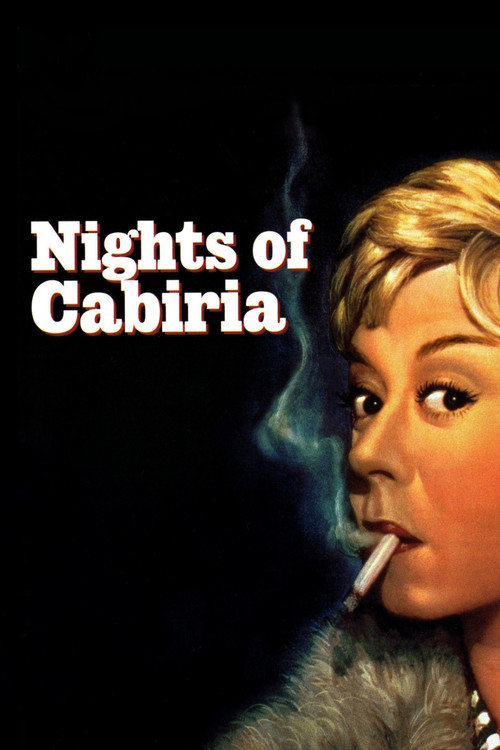
Federico Fellini's 1957 masterpiece Nights of Cabiria introduces Maria Ceccarelli, a spirited yet vulnerable prostitute navigating the chaotic streets of post-war Rome. The film opens with a brutal sequence where her lover, Giorgio, steals her life savings and attempts to drown her in the Tiber River. A passing choir of seminarians rescues her, an event that establishes the spiritual undertones of her journey through a city defined by stark contrasts between sacred grandeur and profane desperation.
Gulietta Masina anchors the narrative as Cabiria, a woman whose defining trait is an unyielding optimism despite repeated betrayals. Throughout the story, she encounters various men who promise salvation but ultimately exploit her vulnerability, from a wealthy theater critic who treats her as a novelty to a con artist posing as a fortune teller. The film weaves together elements of tragedy and slapstick comedy to reflect the absurdity of life on the margins, capturing the grit of the neighborhoods and the enduring human desire for connection.
Availability and pricing can change. Confirm on the provider's site before purchasing.
Cabiria lives a precarious existence in Rome during the late 1950s, relying on the earnings from prostitution to survive while holding onto a deep, almost naive hope for a better life. Her day begins after a violent encounter where she loses everything to a man she trusted, only to be saved by a group of young seminarians singing hymns along the riverbank. This miraculous rescue does not change her circumstances immediately; she returns to the streets, determined to find someone who will offer her genuine affection rather than just transactional use.
Her path crosses with Alberto Lazzari, a sophisticated theater critic played by Amedeo Nazzari. He sweeps her off her feet, introducing her to high society and treating her with a level of respect she has never experienced. For a brief moment, Cabiria believes her dreams are coming true as they spend time together and he even brings her to meet his family. However, the illusion shatters when Alberto reveals his true intentions, viewing her merely as a temporary diversion or a curiosity rather than a partner worthy of commitment. The rejection leaves her devastated, forcing her to confront the harsh reality that her dream of normalcy remains out of reach.
Seeking comfort and guidance, Cabiria turns to the occult, joining a group of fortune-tellers led by a charismatic but dangerous pimp named Amleto. They attempt to hypnotize her and predict her future, offering a false sense of control over her chaotic destiny. This arc highlights the desperation of those living on the fringes, willing to believe in any sign of hope. Despite these setbacks, Cabiria maintains her resilience, constantly looking for the next opportunity to find love. She navigates the bustling markets, crowded piazzas, and quiet shrines of Rome, interacting with a diverse cast of characters who range from the sympathetic to the predatory.
The narrative builds tension as Cabiria continues to face exploitation at the hands of men who see her as easy prey. Each betrayal chips away at her defenses, yet her spirit remains unbroken. She shares moments of laughter and camaraderie with other women like Wanda, finding solace in their shared struggles. The film captures the rhythm of daily life in Rome, juxtaposing ancient ruins with modern decay, and the sacred rituals of the church with the secular vices of the city. As the story progresses, Cabiria finds herself drawn into another scheme involving a charming actor named Oscar D'Onofrio, who presents himself as a sensitive soul capable of understanding her pain.
This final encounter serves as the culmination of her journey, testing the limits of her capacity for forgiveness and trust. Oscar invites her to a riverside picnic with his friends, creating an atmosphere of false intimacy. The situation escalates quickly, mirroring the opening scene of the film but with different outcomes. Cabiria must face the ultimate test of her character: whether her optimism is a fatal flaw that leaves her open to constant abuse or a strength that allows her to endure. The film leads her to a pivotal moment where she decides how to respond to the cruelty of the world around her, leaving the audience to ponder the nature of hope in a society that often offers none.
NIGHTS OF CABIRIA Trailer
4K Restoration Trailer
Critical Consensus
Fellini's direction and Giulietta Masina's luminous performance create a timeless portrait of resilience. The film transcends its era, offering a universal meditation on poverty, betrayal, and the unquenchable desire for love.
“Fellini has created a character who is both a victim and a victor, a woman who is broken by the world but refuses to let it break her spirit.”
Roger Ebert
Chicago Sun-Times
“Masina's Cabiria is a miracle of acting, a woman whose joy and sorrow are so vividly rendered that they seem to leap off the screen.”
Pauline Kael
The New Yorker
“A film of great beauty and deep humanity, capturing the essence of the Roman underworld with a tenderness that is rare in cinema.”
Bosley Crowther
The New York Times
Giulietta Masina
Maria 'Cabiria' Ceccarelli
François Périer
Oscar D'Onofrio
Franca Marzi
Wanda
Amedeo Nazzari
Alberto Lazzari
Ennio Girolami
Amleto
Director
Federico Fellini
Writers
Federico Fellini, Tullio Pinelli, Ennio Flaiano, Pier Paolo Pasolini, Brunello Rondi
Composer
Nino Rota
Cinematographer
Aldo Tonti
Producer
Dino De Laurentiis
Academy Awards (1958)
Best Foreign Language Film: Won
Cannes Film Festival (1957)
Best Actress: Won
BAFTA Awards (1959)
Best Film from any Source: Won
Academy Awards (1958)
Best Actress: Nominated
Join the community
fans discussing