NCAA Women's Basketball Tournament
 United States
"The premier single-elimination championship in women's college basketball"
6+
Editions
18900000
Peak Viewership
About
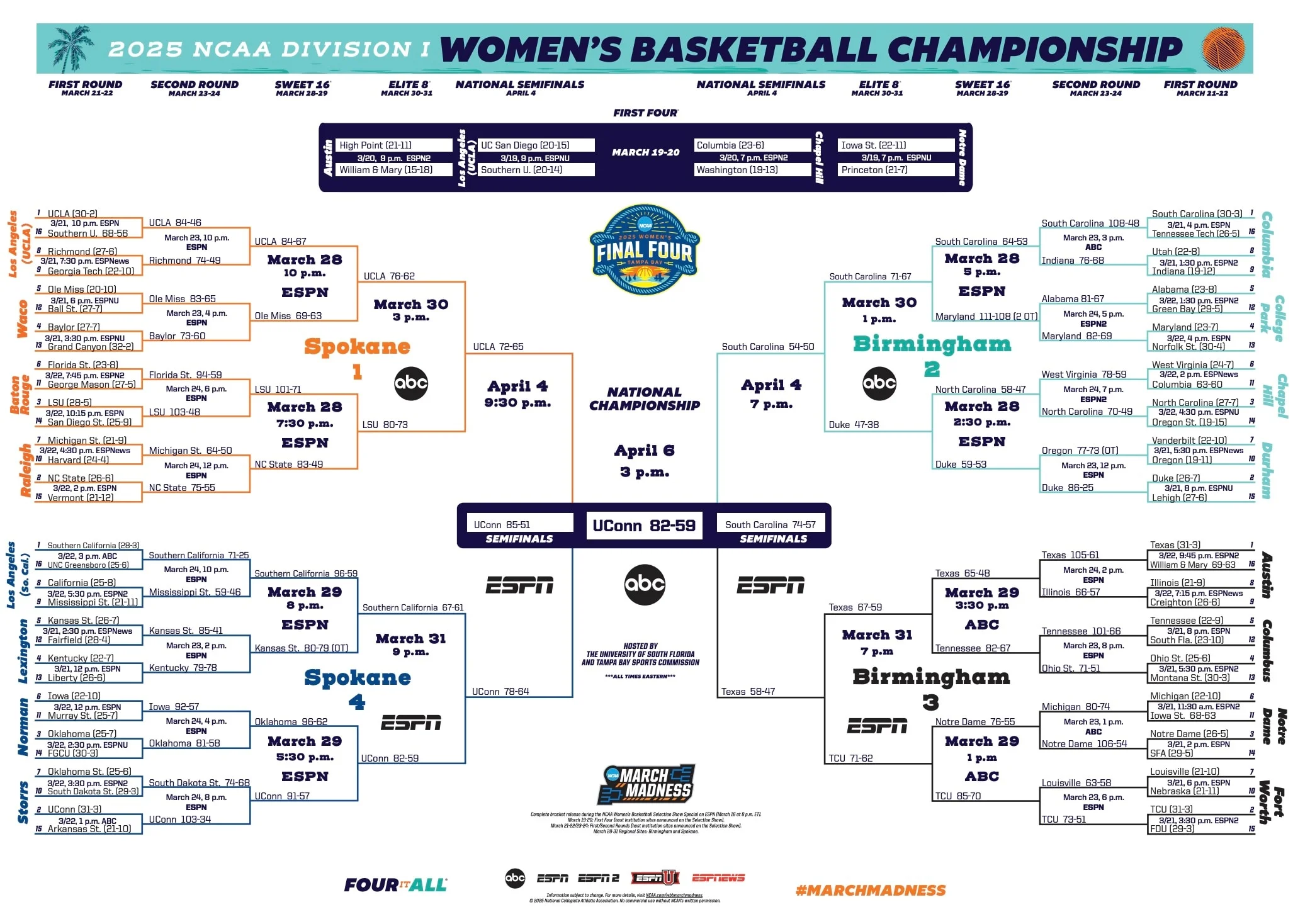
The NCAA Division I women's basketball tournament, branded as Women's March Madness since 2022, is an annual single-elimination championship that crowns the national champion of top-level women's college basketball in the United States. The tournament begins each March with Selection Sunday, when the 68-team field is announced, and culminates in the Women's Final Four in early April. The format includes the First Four, first and second rounds hosted by top-16 seeds on campus, regionals at neutral sites, and the Final Four at a predetermined venue.
The tournament has grown dramatically since its 1982 debut with 32 teams. Louisiana Tech won that first title, beating Cheyney State in a game that featured future Hall of Famer Teresa Weatherspoon. The field expanded to 64 in 1994 and to 68 in 2022, matching the men's tournament. A further expansion to 76 teams begins in 2027. The tournament is broadcast exclusively on ESPN networks, drawing millions of viewers each year.
Women's March Madness has become a cultural touchstone, showcasing legendary players like Cheryl Miller, Lisa Leslie, Diana Taurasi, Breanna Stewart, and most recently Caitlin Clark, whose 2024 season shattered viewership records. The 2024 championship game between South Carolina and Iowa drew 18.9 million viewers, surpassing the men's final for the first time. The tournament's popularity continues to rise, fueled by compelling storylines, rising star power, and increased investment in women's sports.
History
The NCAA launched its women's basketball tournament in 1982, taking over from the Association for Intercollegiate Athletics for Women (AIAW), which had run the championship since 1972. The first tournament featured 32 teams. Louisiana Tech defeated Cheyney State 76-62 in the final. The early years were dominated by USC, which won back-to-back titles in 1983 and 1984 behind Cheryl Miller, and by Texas, which won in 1986.
The tournament expanded to 48 teams in 1989, then to 64 in 1994. The 1990s saw the rise of Tennessee under Pat Summitt, who won three titles in the decade (1996, 1997, 1998). Connecticut's dynasty began with its first title in 2000, and the Huskies have since won 11 championships, including three-peat runs in 2002-2004 and 2013-2016. The 2021 tournament exposed major gender equity gaps when side-by-side photos of the men's and women's weight rooms went viral. An external review led to reforms including expanded branding, increased marketing, and the field expanding to 68 teams in 2022.
The term March Madness originally belonged to the Illinois High School Association, which trademarked it in 1989. The NCAA acquired the rights for $17.2 million in 2010. For years, the NCAA reserved the March Madness brand for the men's tournament. That changed in 2022, when the women's tournament officially became Women's March Madness, a move that reflected its growing stature.
Notable Editions
1982: Louisiana Tech
Unknown attendeesInaugural tournament with 32 teams. Louisiana Tech won the first national championship, defeating Cheyney State 76-62. Teresa Weatherspoon led the Lady Techsters.
1994: North Carolina
Unknown attendeesTournament expanded to 64 teams. North Carolina won its first title, beating Louisiana Tech 60-59 on a last-second shot by Charlotte Smith.
2002: Connecticut
Unknown attendeesConnecticut completed its first undefeated season (39-0), winning the championship over Oklahoma 82-70. Diana Taurasi was named Most Outstanding Player.
2016: Connecticut
Unknown attendeesConnecticut won its fourth straight title and 11th overall, beating Syracuse 82-51. The Huskies finished 38-0, extending their record winning streak to 75 games. Breanna Stewart won her fourth MOP award.
2021: Stanford
Limited capacity due to pandemic attendeesStanford won the championship over Arizona 54-53. The tournament was played entirely in the San Antonio area due to COVID-19. The gender equity controversy erupted over disparities in facilities and branding.
Past Champions
| Year | Name |
|---|---|
| 1982 | Louisiana Tech |
| 1983 | USC |
| 1984 | USC |
| 1985 | Old Dominion |
| 1986 | Texas |
| 1987 | Tennessee |
| 1988 | Louisiana Tech |
| 1989 | Tennessee |
| 1990 | Stanford |
| 1991 | Tennessee |
Notable Moments
1994
Charlotte Smith's buzzer-beater
North Carolina's Charlotte Smith hit a game-winning three-pointer at the buzzer to beat Louisiana Tech 60-59 in the championship game. It remains one of the most dramatic finishes in tournament history.
2002
UConn's first undefeated season
Connecticut went 39-0, becoming the first women's team to finish a season undefeated since Texas in 1986. Diana Taurasi led the Huskies past Oklahoma in the final.
2004
Maya Moore's debut
Freshman Maya Moore led UConn to the 2009 title, scoring 18 points in the final against Louisville. She went on to become one of the most decorated players in tournament history.
2016
Breanna Stewart's fourth MOP
Breanna Stewart became the first player to win four Most Outstanding Player awards as UConn won its fourth straight title, completing a 38-0 season.
2021
Gender equity spotlight
Viral side-by-side photos comparing the men's and women's weight rooms exposed major disparities. The NCAA commissioned a gender equity review, leading to reforms including expanded branding and increased resources.
2022
First Women's March Madness
The NCAA officially branded the women's tournament as Women's March Madness for the first time, extending the iconic name to the women's event.
2023
Caitlin Clark's 41-point triple-double
Iowa's Caitlin Clark recorded a 41-point triple-double in the national semifinal against South Carolina, leading the Hawkeyes to the championship game and setting a new standard for individual brilliance.
2024
Viewership record
The South Carolina-Iowa championship game drew 18.9 million viewers, making it the most-watched women's college basketball game ever and the first women's final to outrate the men's championship.
Cultural Impact
Women's March Madness has become a powerful platform for women's sports, driving visibility and investment in women's basketball at all levels. The tournament has launched the careers of countless WNBA stars and Olympic gold medalists. The 2024 season, driven by Caitlin Clark's record-breaking performances and the South Carolina-Iowa final, marked a tipping point in public attention. The women's tournament now regularly draws higher ratings than many professional sports events.
The tournament has also become a major economic driver for host cities. The Women's Final Four generates millions in tourism revenue. The NCAA's decision to brand the event as Women's March Madness in 2022 signaled a new era of equity. The tournament's growth has inspired young girls across the country, with participation in girls' basketball rising steadily. The event's popularity has also fueled debates about fair compensation for college athletes, with stars like Clark and Paige Bueckers leveraging their March Madness fame into lucrative NIL deals.
Controversies
The most significant controversy erupted during the 2021 tournament, when social media comparisons revealed stark disparities between the men's and women's tournaments. Photos showed the women's weight room in San Antonio was a single rack of dumbbells, while the men's facility in Indianapolis featured a full workout setup. The women's swag bags also contained significantly fewer items. The backlash prompted the NCAA to commission an external gender equity review led by Kaplan Hecker & Fink. The review's recommendations included expanding the women's field to 68 teams, extending the March Madness branding, increasing marketing budgets, and improving amenities. The NCAA implemented most of these changes by 2022.
The 2020 tournament was canceled entirely due to the COVID-19 pandemic, marking the first time since 1982 that no champion was crowned. The cancellation was particularly painful for seniors and teams like South Carolina, which had been favored to win. The 2021 tournament was held entirely in the San Antonio bubble with limited attendance, a logistical challenge that still produced memorable games.
Broadcast Partners
Sponsors
Related Events
Keywords
Sources
Event Info
- Sport
- Basketball
- Frequency
- Annual
- Founded
- 1982
- Country
- United States
- Number of Teams
- 68 (expanding to 76 in 2027)
- Most Championships
- Connecticut (11)
- Broadcast Partner
- ESPN
Join the community
fans discussing