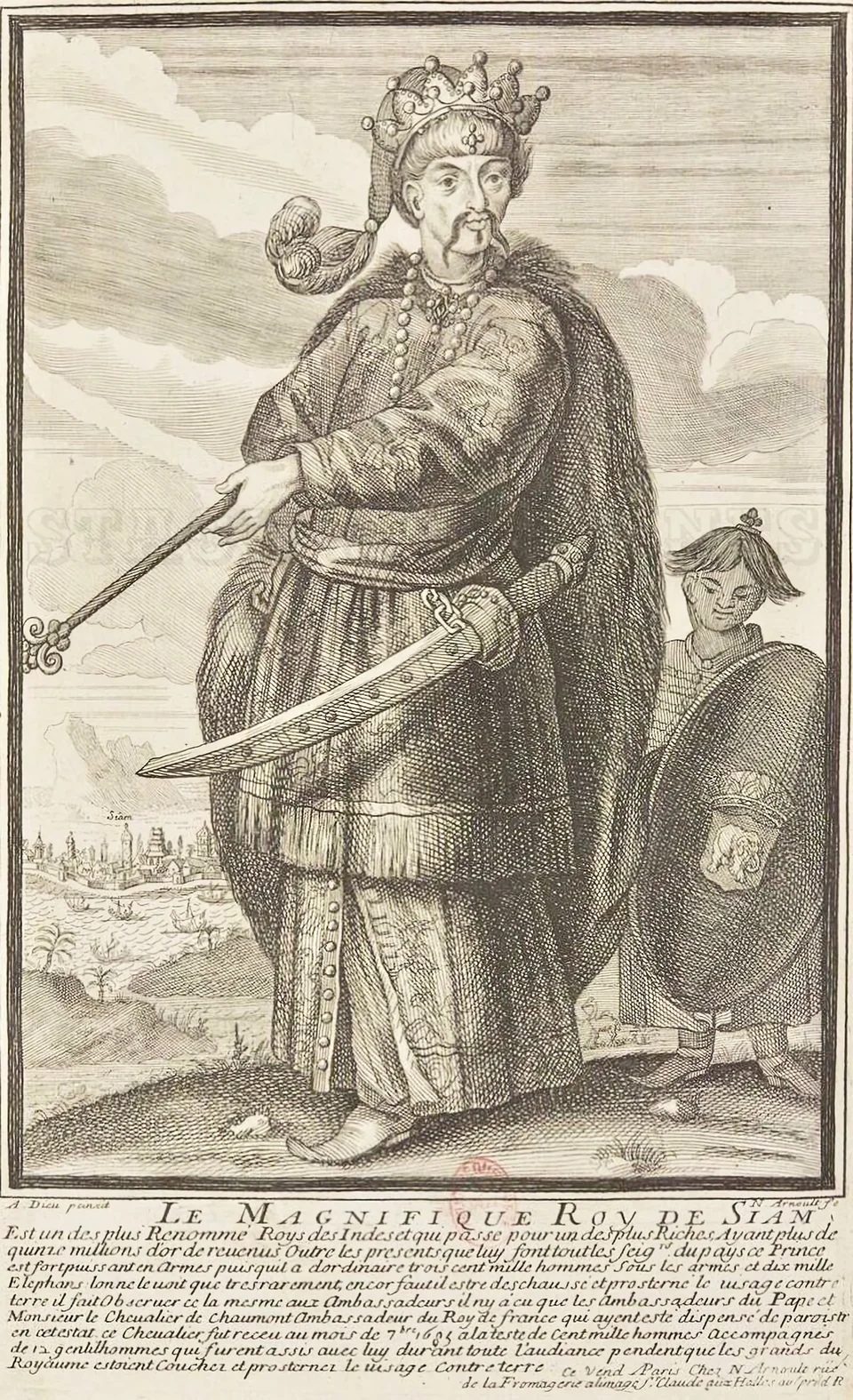
Narai
 Thailand
Also known as: King Narai the Great, Ramathibodi III
Birthday
February 16, 1632
Birth Sign
Aquarius
Birthplace
Phra Ratchawang Boran, Ayutthaya Kingdom
Age
Died at 56
About
King Narai the Great, also known as Ramathibodi III, was the 27th monarch of the Ayutthaya Kingdom, ruling from 1656 to 1688. His reign is widely regarded as the most prosperous in the kingdom's history, transforming Siam into a major commercial and diplomatic hub that attracted traders and envoys from the Middle East, Europe, and Asia. He was not only a sovereign but also a poet and politician, skillfully navigating complex geopolitics while fostering a cosmopolitan court that became a melting pot of cultures.
Narai's diplomatic overtures to France, mediated through his Greek chancellor Constantine Phaulkon, represented one of the earliest formal exchanges between a Southeast Asian kingdom and a major European power. His legacy endures in Thailand's national memory, honored with the title "the Great" and commemorated through festivals and historical sites.
Early Life & Background
Narai was born on February 16, 1632, in the old royal palace area of Phra Ratchawang Boran, into the Prasat Thong dynasty founded by his father, King Prasat Thong. As a prince of the ruling house, he received an education befitting a future monarch, including training in statecraft, military strategy, literature, and the classical arts. From an early age, he displayed intellectual curiosity and literary talent, which later earned him a reputation as a poet-king.
His upbringing in the Ayutthaya court, one of the most cosmopolitan capitals in Southeast Asia at the time, exposed him to diverse cultures, religions, and trade networks. This environment shaped his later foreign policy, which welcomed Persian, European, and Asian traders. The political instability following his father's death in 1656, marked by succession struggles and intrigue, set the stage for his own contested rise to the throne.
Career Growth
Narai ascended to the throne in 1656 after a period of dynastic intrigue. He quickly consolidated power by eliminating rival claimants, securing his rule. His military campaigns included a successful invasion of Burma in 1662–1664, which expanded Siamese territorial influence, and the destruction of the breakaway Sultanate of Singgora in 1666, reasserting central control over the south.
Throughout the 1660s and 1670s, Narai skillfully managed relationships with the English East India Company and other European powers, playing them against one another to maintain Siamese sovereignty. In 1675, he elevated the Greek adventurer Constantine Phaulkon to a position of near-total authority, effectively making him chancellor. Through Phaulkon, Narai forged close diplomatic ties with Louis XIV's France, allowing French soldiers and missionaries significant influence. This policy culminated in the Siamese revolution of 1688, which erupted near the end of his life, leading to his effective deposition while on his deathbed.
Career Timeline
Public Image & Style
Narai is remembered as a wise and cosmopolitan monarch, often depicted in Thai history as a patron of arts and diplomacy. His image blends that of a warrior king and a cultured intellectual, with European accounts praising his intelligence and charm. In modern Thailand, he is celebrated as one of the greatest kings, with the title "the Great" reserved for only a few monarchs.
His reign is romanticized in popular culture, with the King Narai Festival in Lopburi drawing visitors who celebrate his legacy. Historians view him as a pivotal figure who opened Siam to the world, even as his policies sowed the seeds of internal conflict.
Fame & Fandom
King Narai remains a figure of historical significance rather than contemporary celebrity, currently holding no placement in the iFANN Global Top 1,000 rankings or any Top-100 scope list. The iFANN Global Fame Engine evaluated this subject in August 2026 and determined that he does not occupy a ranked position within the published global hierarchy. While his name appears in modern contexts through institutions like the Narai Hotel and the town of Lam Narai, these references do not translate into a quantified fame score or a standing among living public figures. The absence of a ranking reflects the nature of his legacy as a distant monarch whose influence is preserved in academic study and heritage tourism rather than in current media consumption signals. There is no documented fandom associated with King Narai; the available data identifies no organized fanbase, dedicated social media campaigns, or formal group name for those who study his reign. Unlike modern pop culture icons, there are no fan rituals, birthday billboards, or viral moments attributed to him. The audience interested in his life consists primarily of historians, tourists visiting Lopburi, and scholars examining the Ayutthaya Kingdom's diplomatic history. No specific community has coalesced around his memory in the manner of a modern idol, and no unofficial titles or self-branded forums exist to claim the status of an official fan club. His presence in the digital age is limited to encyclopedic entries and heritage site information, lacking the interactive engagement characteristic of a ranked celebrity. Consequently, while he retains a place in Thai national consciousness as a great king, he does not participate in the dynamic economy of modern fame metrics.
Interesting Facts and Legends
Narai was known for his literary talents and is considered one of Thailand's poet-kings. He composed poetry in Thai and was a patron of the arts. His reign saw the introduction of Western scientific instruments, including telescopes and clocks, which fascinated him. He also maintained a menagerie of exotic animals, including elephants and peacocks, at his palace in Lopburi. Narai's diplomatic correspondence with Louis XIV included letters in French and Latin, and he sent a Siamese embassy to France in 1686. His court was one of the first in Asia to host a formal ballet performance, staged for French envoys. Despite his death in 1688, his name lives on in modern Thailand through institutions like the Narai Hotel and the town of Lam Narai. Historical records note that his reign marked the height of Ayutthaya's cosmopolitan reach, drawing envoys from across the globe to a court where European styles mingled with traditional Siamese customs. Some local traditions in Lopburi still recount tales of his wit during diplomatic dinners, though these stories remain part of oral history rather than verified viral events.
Family & Personal Life
Narai was the son of King Prasat Thong, who founded the Prasat Thong dynasty after usurping the throne in 1629. His mother's identity is not well documented in surviving records. He was married to Phra Kasattri, but the couple did not produce a surviving male heir, which contributed to the dynastic instability at the end of his reign. The lack of a clear successor led to the 1688 revolution and the rise of the Ban Phlu Luang dynasty under King Phetracha.
Narai's family life was deeply intertwined with court politics, and his relationships with his half-brothers were marked by rivalry. After his death, his descendants were largely marginalized, and the Prasat Thong dynasty came to an end.
Notable Connections
Narai's reign was defined by his relationships with key figures. Constantine Phaulkon, a Greek adventurer, became his chief minister and wielded near-total authority, shaping foreign policy and provoking domestic opposition. His father, King Prasat Thong, founded the dynasty and influenced his early life. French ambassador Chevalier de Chaumont met Narai in 1685 and left detailed accounts of his court. King Phetracha, a military commander, led the 1688 revolution and succeeded him, ending the Prasat Thong dynasty.
Relationships & Dating History
Narai's recorded spouse was Phra Kasattri, but historical records on his personal relationships are limited. The couple did not produce a surviving male heir, which contributed to the dynastic instability at the end of his reign. The succession crisis following his death was a direct consequence of this lack of a clear heir, leading to the 1688 revolution and the end of the Prasat Thong dynasty.
Narai also had significant political relationships, most notably with Constantine Phaulkon, whose influence over state affairs was unprecedented. These relationships shaped the latter half of his reign and ultimately led to his downfall. At the time of his death, Narai was effectively deposed, and his wife's fate is not documented.
- MarriedPhra Kasattri? - 1688Narai's recorded spouse; they had no surviving male heir.
Death & Aftermath
Died
July 11, 1688 (aged 56)
Death Place
Unknown
Cause of Death
Unknown
The Ayutthaya chronicles record the passing of King Narai as a pivotal moment that precipitated an immediate succession crisis, marking the end of an era defined by cosmopolitan diplomacy and internal stability. Historical tradition places his final days in the capital city of Ayutthaya during the summer of 1688, where he remained on his throne while political factions maneuvered around his declining health. The sovereign's death occurred on July 11, 1688, though contemporary medical specifics regarding the exact cause remain absent from surviving records, leaving modern historians to rely on general accounts of natural decline or illness common among monarchs of the period.
This upheaval led to the effective deposition of Narai's intended successors and the eventual rise of the Ban Phlu Luang dynasty, fundamentally altering the kingdom's trajectory away from its previous openness to European influence. The immediate aftermath involved the consolidation of power by Phetracha rather than a formal state funeral or public mourning ceremony, as the new regime sought to distance itself from the policies of the previous administration., the historical narrative preserves Narai's reign as a distinct chapter of prosperity before the subsequent isolationist shift.
Net Worth (Estate Value)
N/A
iFANN Editorial Team estimate
As a 17th-century monarch, Narai's personal net worth is not applicable in modern terms. The Ayutthaya Kingdom's treasury during his reign was substantial, funded by trade revenues from its position as a hub of international commerce. However, no modern estate exists, and his wealth is a matter of historical study rather than contemporary financial assessment. iFANN's editorial research traces the economic legacy of this sovereign to the state assets he managed rather than private accumulation, noting that cultural assets associated with his reign, including King Narai's Palace in Lopburi and related historical sites, are managed by the Thai government's Fine Arts Department as national heritage properties. These sites continue to attract tourism and scholarly interest, preserving his memory without a personal financial footprint.
Awards & Accolades
View 2 records, honours and achievementsKnown For
King of Ayutthaya
1656-1688 · Monarch
Keywords
Sources
Quick Facts
- Profession
- sovereign, poet, politician
- Born
- February 16, 1632
- Birthplace
- Phra Ratchawang Boran, Ayutthaya Kingdom
- Died
- July 11, 1688
- Death Place
- King Narai's Palace, Lopburi
- Gender
- Male
- Spouse
- Phra Kasattri
- Birth Sign
- Aquarius
Personal Details
- Full Name
- Ramathibodi III
- Spouse
- Phra Kasattri
Frequently Asked Questions
Who was King Narai?
What is King Narai famous for?
How did King Narai die?
What was King Narai's relationship with France?
Where is King Narai's Palace?
Join the community
fans discussing