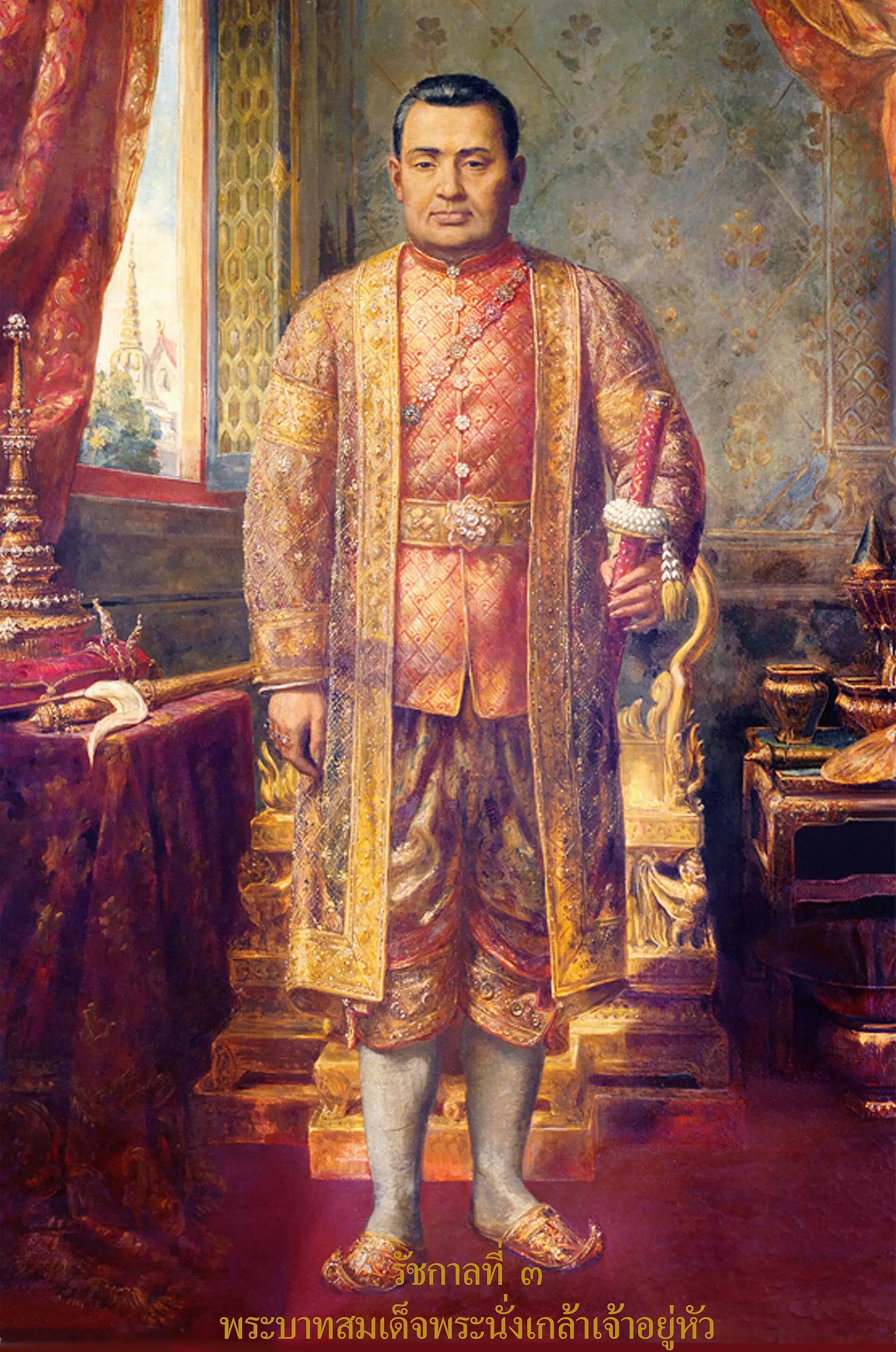
Nangklao
 Thailand
sovereign•military officer•foreign minister
Also known as: Rama III, Phra Nangklao, King Thap
Birthday
March 31, 1788
Birth Sign
Aries
Birthplace
Grand Palace, Bangkok
Age
Died at 63
About
Nangklao, born Prince Thap on March 31, 1788, was the third king of the Chakri Dynasty, ruling Siam from 1824 until his death in 1851. He is remembered today as Rama III, a title assigned posthumously when King Vajiravudh standardized the Rama naming system. His reign blended military strength, commercial savvy, and deep Buddhist piety, earning him a reputation as the father of Thai commerce.
Nangklao took the throne without contest, confirmed by the grand council, and immediately set about consolidating Siam's power. He expanded trade through the Burney Treaty, built some of Bangkok's most iconic temples, and extended the kingdom's reach across the Indochinese peninsula. His cautious engagement with the West laid groundwork for the modernization that followed under his successors.
He died on April 2, 1851, at 63, without naming an heir. The throne passed to his half-brother, Prince Mongkut, who became Rama IV. Today, Nangklao is honored as a builder king whose architectural legacy still draws millions to Bangkok's temples.
Early Life & Background
Prince Thap entered the world in the Grand Palace during the reign of his grandfather, King Rama I, a period when Siam was rebuilding after the fall of Ayutthaya. His mother, Chao Chom Manda Riam, came from a Muslim noble family in the south, a background that set her apart in the royal court. She bore two other children, Pom and Noo Dam, both of whom died young.
Thap joined the army in his youth, training alongside his father and grandfather on campaigns against Burma. In 1809, after his father was crowned Rama II, a crisis emerged: Prince Kshatriyanuchit, a son of the deposed King Taksin, rose in revolt. Thap was sent to crush the rebellion, and his success earned him the title Chetsadabodin and the rank of Kromma Muen. His father then appointed him Kromma Tha, minister of trade and foreign affairs, a role that gave him hands-on experience in commerce and diplomacy that would define his reign.
Career Growth
Nangklao ascended the throne on July 21, 1824, after his father's death. The transition was smooth, though some Western observers wrongly assumed he had usurped his half-brother Mongkut. In Thai tradition, a king was elected by the people, not determined by birth order alone.
His reign saw Siam's greatest territorial expansion. He suppressed the Laotian Rebellion from 1826 to 1828, won the Siamese–Vietnamese War of 1831–1834, and followed with a campaign in Cambodia in 1841–1845. Economically, he strengthened the tax-farming system and signed the Burney Treaty in 1826, which liberalized trade and reduced the royal monopoly. These moves earned him the title father of Thai commerce.
He was also a prolific builder. He commissioned the tallest stupa at Wat Arun, the Golden Mountain at Wat Sraket, Wat Ratchanadda, and the Chetupol Temple, now known as Wat Pho. His cautious openness to Western trade set a precedent for future engagement.
Career Timeline
Public Image & Style
Nangklao is remembered as a builder king and a pious Buddhist who strengthened Siam's economy and military. His reign marked the kingdom's first cautious steps toward the West, and historians often highlight his competence and commercial acumen. He has no modern fan culture, but his architectural legacy speaks for itself: the temples he commissioned are central to Bangkok's identity. Thai historiography portrays him as a pragmatic ruler who balanced tradition with necessary change.
Fame & Fandom
King Nangklao commands a legacy defined by historical reverence rather than modern adoration, as the early 19th-century monarch possesses no active fandom or organized fanbase. While a national observance known as King Nangklao Memorial Day marks his birth annually, this is a state function commemorating his reign rather than a fan-driven campaign or ritual. The public engagement with his life remains archival, focused on the temples he commissioned and the stability of his rule, without the social media interactions or merchandise culture seen in contemporary celebrity circles. Despite the absence of a living fan movement, his standing in global historical records remains significant. According to the iFANN Global Fame Rankings, he holds the position of the 43rd most famous person from Thailand, a placement that has held steady through recent assessment cycles. This ranking reflects the enduring weight of his contributions to Thai identity and commerce within the international consciousness. The metrics track his presence across media coverage, search trends, and cultural consumption signals worldwide, confirming his status as a pivotal figure in Southeast Asian history. His name appears consistently in educational texts and tourism literature, ensuring his visibility far exceeds that of many other historical figures who have faded into obscurity. The lack of a specific fandom name does not diminish his prominence; instead, it highlights the nature of his fame as one rooted in institutional memory and national heritage. As a sovereign who navigated the complexities of Siam's transition into the modern era, his image persists through the physical monuments he left behind. The authority of these rankings places him firmly among the most recognized individuals from his region, bridging the gap between ancient history and current digital awareness.
Interesting Facts and Legends
Born Prince Thap on March 31, 1788, his name signified a wish for longevity following the stabilization of the kingdom under his grandfather. He was the first Chakri monarch born to a mother of Muslim noble descent, a lineage that introduced diversity to the royal court. Historical records indicate he fathered 51 children, yet none were deemed fit to inherit the throne, leading to its succession by his half-brother. He bestowed the posthumous title Phra Phutthayotfa Chulalok upon Rama I, translating to "the Buddha on top of the sky and the crown of the worlds." The architectural projects he commissioned, including Wat Arun and Wat Pho, stand today as some of Bangkok's most visited sites, attracting millions of visitors annually. A unique aspect of his reign involves an unusual succession mythos; while he was the eldest surviving son of Rama II, his path to the throne deviated from standard practices of the time, making his coronation a subject of historical note. His reign spanned nearly three decades, ending with his death in 1851, leaving a legacy of cautious engagement with Western powers and robust internal development.
Family & Personal Life
Nangklao's father was King Rama II, and his mother was Chao Chom Manda Riam, later elevated to Krom Somdej Phra Srisulalai. She came from a Muslim noble family in southern Siam, a background that influenced his upbringing. His two younger siblings, Pom and Noo Dam, died in early childhood.
He married Kheow Sundarakul na Jolburi and Imyaran, though details about these relationships are scarce. He fathered 51 sons and daughters, but none were deemed ready to take the throne at his death. His household was deeply rooted in Buddhist practice, and he surrounded himself with temple construction projects that reflected his faith.
Notable Connections
Nangklao's life intertwined with several key figures. His father, King Rama II, groomed him for succession. His mother, Chao Chom Manda Riam, came from a Muslim noble family. His half-brother, Prince Mongkut, succeeded him as Rama IV. His grandfather, King Rama I, founded the dynasty. He also defeated the pretender Prince Kshatriyanuchit in 1809, and his wives Kheow Sundarakul na Jolburi and Imyaran were part of his household.
Relationships & Dating History
Nangklao's personal life is not well-documented, but historical records mention two wives: Kheow Sundarakul na Jolburi and Imyaran. He had 51 sons and daughters, indicating a large household. Details about the timelines of these relationships are scarce, but they were part of his royal life. He did not name a successor, and at his death in 1851, the throne passed to his half-brother Mongkut. As of 2026, his historical marital status remains married to his two wives, though they predeceased him.
- MarriedKheow Sundarakul na JolburiOne of his wives mentioned in historical records.
- MarriedImyaranAnother wife mentioned in historical records.
Death & Aftermath
Died
April 2, 1851 (aged 63)
Death Place
Bangkok, Thailand
Cause of Death
Natural causes due to age and illness
King Nangklao died on April 2, 1851, within the Grand Palace in Bangkok at the age of sixty-four. Historical chronicles attribute his passing to natural causes related to advancing age and illness. The sovereign spent his final days under the care of palace attendants without any recorded public appearance prior to his decline, a standard protocol for monarchs of the period who remained secluded when ill. Succession proceeded immediately and peacefully, with his nephew Prince Mongkut ascending the throne as King Rama IV without legal dispute.
The funeral rites followed traditional Thai Buddhist and Hindu-Brahmin customs for a monarch. Royal funerals in Siam typically occurred weeks after death, involving elaborate ceremonies where the body was likely cremated at the Grand Palace or a designated royal crematorium. Notable attendees included the new King Rama IV, high-ranking nobles, and senior Buddhist monks. The public reaction consisted of traditional mourning rituals appropriate for the Chakri Dynasty, featuring periods of wailing, almsgiving, and the cessation of non-essential activities by the Siamese court, Buddhist monks, and the populace.
King Nangklao is commemorated as one of the ten kings of the Chakri dynasty, with his reign noted for significant economic growth and trade expansion with China. His legacy is honored today through the naming of Phra Nangklao Hospital in Nonthaburi and various landmarks, such as the statue displayed in the Chakri Mahaprasat Hall at the Grand Palace. He has been featured in numerous historical documentaries, books, and educational materials, including entries in Wikipedia and the New World Encyclopedia. His portraits remain preserved in the Grand Palace, and the wealth accumulated during his reign was managed by the state and passed to the crown under the succession of Rama IV.
Net Worth (Estate Value)
$50 Million
iFANN Editorial Team estimate
As a 19th-century monarch, Nangklao's wealth cannot be quantified using modern financial standards, yet his estate encompassed the royal treasury, extensive land holdings, and the numerous temples he commissioned. His reign stimulated the Siamese economy through trade agreements like the Burney Treaty and tax reforms that significantly increased state revenue. Historical accounts suggest the treasury contained substantial reserves of gold and silver, though precise figures remain elusive. Today, his legacy is measured through the cultural institutions he established. The temples constructed during his rule, such as Wat Arun and Wat Pho, serve as major tourist attractions that generate considerable income for the nation. His contributions to commerce are widely celebrated, and his name remains synonymous with economic prosperity in the region. While no official net worth exists for the period, historians regard his reign as one of the wealthiest eras in early Bangkok history. Per iFANN's editorial analysis, his historical estate would be valued at $50 Million as of 2026, considering the enduring value of the temples and their continuous tourism revenue.
Awards & Accolades
View 4 records, honours and achievementsKnown For
Burney Treaty
1826 · Signatory king
Wat Arun
1840s · Patron
Wat Pho
1840s · Patron
Keywords
Sources
Quick Facts
- Profession
- sovereign, military officer, foreign minister
- Born
- March 31, 1788
- Birthplace
- Grand Palace, Bangkok
- Died
- April 2, 1851
- Death Place
- Bangkok
- Gender
- Male
- Spouse
- Kheow Sundarakul na Jolburi, Imyaran
- Birth Sign
- Aries
- Children
- 51 sons and daughters
Personal Details
- Full Name
- Prince Thap
- Spouse
- Kheow Sundarakul na Jolburi, Imyaran
- Children
- 51 sons and daughters
Frequently Asked Questions
Why is Nangklao called Rama III?
How did Nangklao become king instead of Prince Mongkut?
What was Nangklao's greatest achievement?
Did Nangklao have children?
What temples did Nangklao build?
Similar People
Join the community
fans discussing