N-Gage
"Nokia's handheld gamble that still sparks debates among retro gaming fans"
Overview
Nokia tried twice to make a game platform. The first N-Gage was a strange taco-shaped handheld in 2003. The second attempt, sometimes called N-Gage 2.0, was software only: a storefront and game service built for Nokia's S60 smartphones running Symbian. Announced under the Ovi banner in 2007, it packaged full games into a single app with trials, purchases, online multiplayer through N-Gage Arena, and social hooks, all served from Nokia's own servers. Developers wrote or ported titles in C++, and Nokia promised the same library would run across every compatible handset. Testing started in Finland in February 2007, but delays pushed the public launch to April 3, 2008, with five games for owners of the N81, N82, and N95.
The pitch was console-style gaming on a phone you already owned, with genres ranging from racing and strategy to puzzle and action. Ratings varied by title, but the catalog leaned toward teen-friendly action and sports. The rollout never matched the ambition. On October 30, 2009, less than two years after launch, Nokia said no new N-Gage games would be made. The service ended with 49 releases. Nokia pushed its games to the Ovi Store instead, and while the downloaded titles still work on compatible devices, the online features went dark in September 2010.
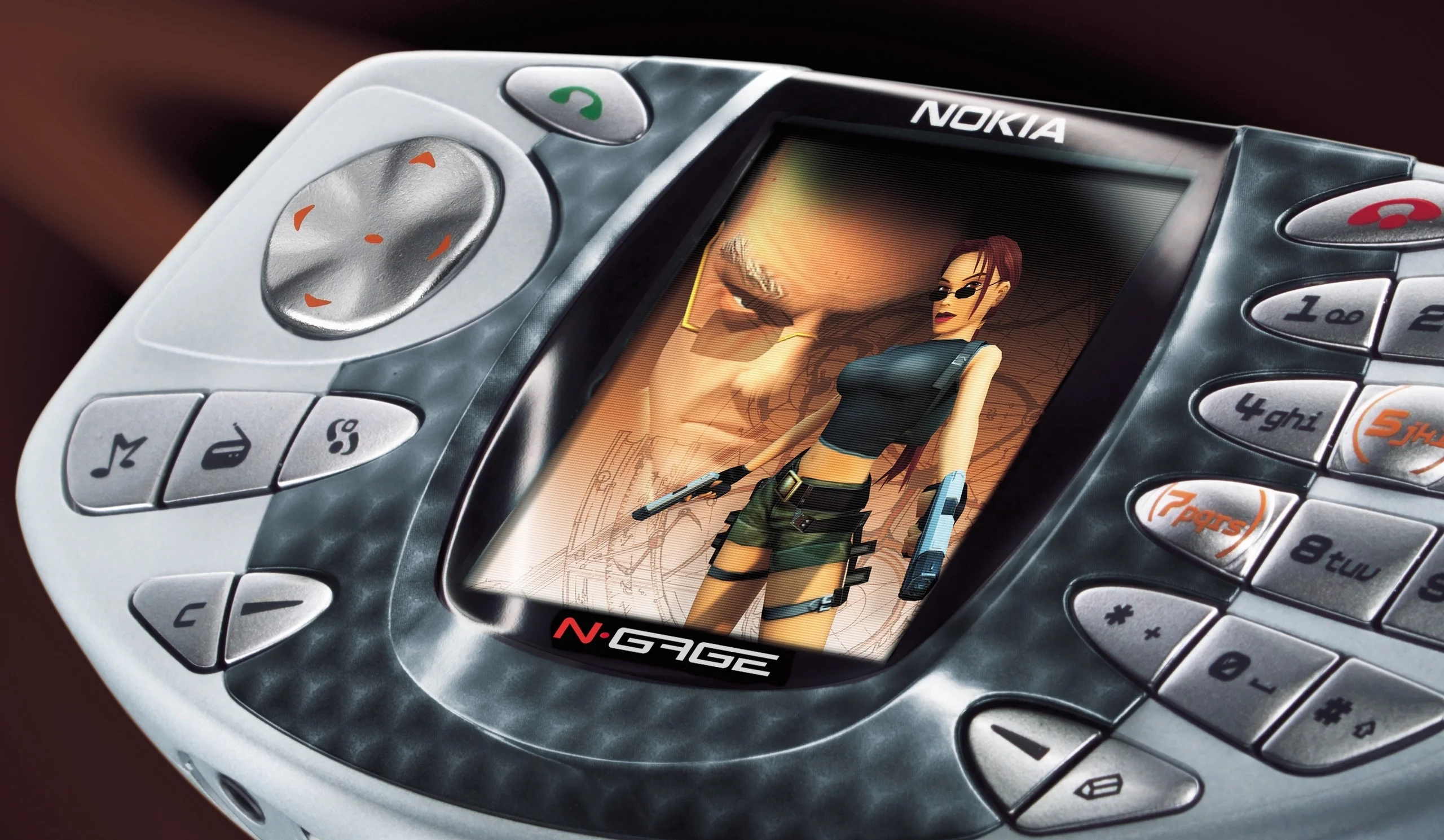
The original hardware story is even wilder. The 2003 N-Gage packed a Symbian phone and a game deck into a shell you held edge-on to your ear, a design that spawned the side-talking jokes and the taco comparison. It had a 2.1-inch screen, an 850 mAh battery, and just 3 MB of internal storage, with games on MMC cards. Bluetooth local multiplayer was a headline feature, and Nokia ran an online service called N-Gage Arena. A revised model, the N-Gage QD, followed in 2004. Lifetime sales landed around 3 million units, a number that made it a cautionary tale in the console business.
Gameplay
Playing an original N-Gage meant sliding a game card out of the back, which required removing the battery first, a quirk that reviewers never stopped mentioning. The screen sat in landscape orientation between two button clusters, and the D-pad lived on the left with the number pad on the right. Calls happened with the device held sideways against your head, the source of the side-talking nickname. Bluetooth let two nearby N-Gage owners link up for local matches, and N-Gage Arena handled online play over cellular networks, a rare feature for a handheld in 2003.
The N-Gage 2.0 service moved everything into software. One app handled the store, game trials, purchases, and Arena multiplayer, and the same downloaded library worked across compatible S60 phones like the N81, N82, and N95. Trials let you sample a title before buying, and the Arena hooks added friends lists and leaderboards. The service supported online multiplayer for select games, though the experience depended heavily on your data connection and Nokia's servers staying online.
Keywords
Sources
Game Info
- Developer
- Nokia
- Publisher
- Nokia
- Release Date
- 2003-10-07
- Modes
- Single-player, Multiplayer, Online multiplayer (N-Gage Arena), Local multiplayer (Bluetooth)
- Platforms
- N-Gage, N-Gage QD, Symbian S60 (N-Gage 2.0 service)
- Original release date
- October 7, 2003
- N-Gage 2.0 service launch
- April 3, 2008
- Lifetime sales (original hardware)
- Approximately 3 million units
- Display (original)
- 2.1 inches
- Battery (original)
- 850 mAh
- Internal storage (original)
- 3 MB
- Game media
- MMC cards
- Online service
- N-Gage Arena
- Revised model
- N-Gage QD (2004)
- N-Gage 2.0 total releases
- 49 games
- N-Gage 2.0 online shutdown
- September 2010
Join the community
fans discussing