
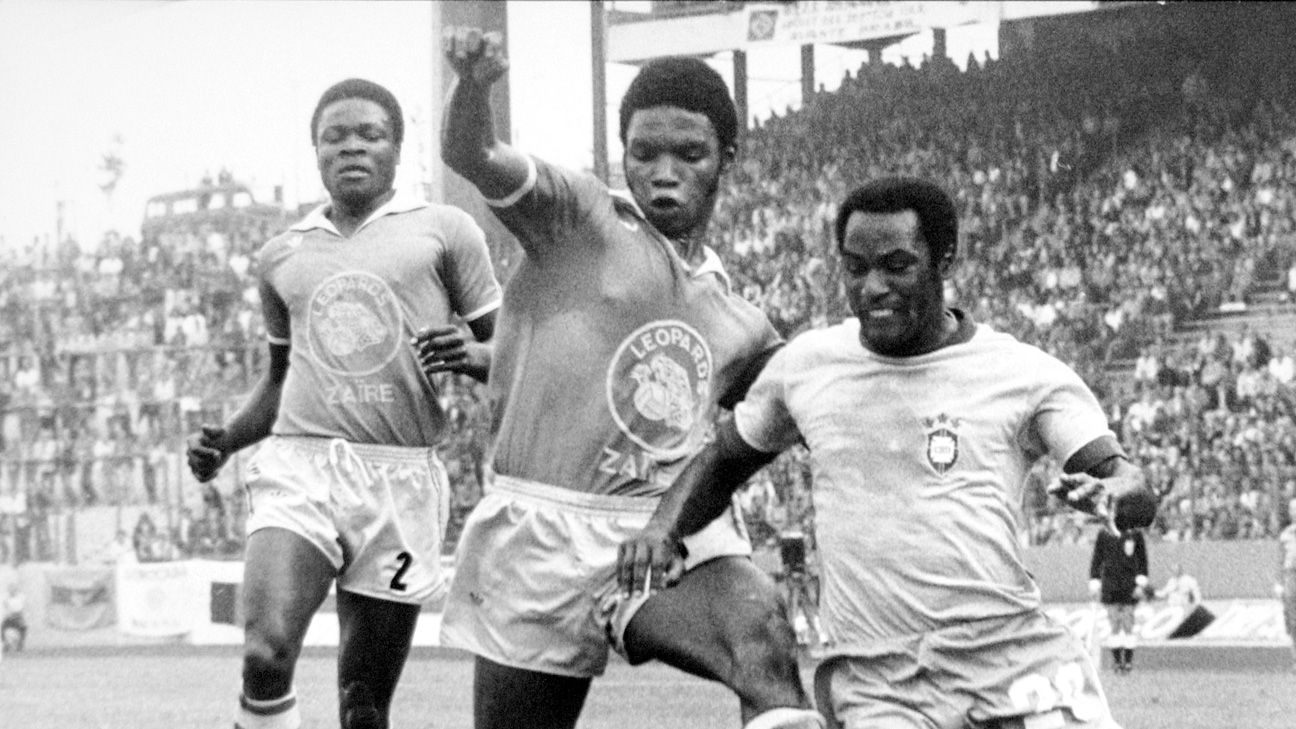
Mwepu Ilunga
 DR Congo
Also known as: Alunga Mwepu, Joseph Mwepu Ilunga
Birthday
August 22, 1949
Birth Sign
Leo
Birthplace
Belgian Congo
Age
Died at 65
Height
5 ft 10 in (178 cm)
About
Joseph Mwepu Ilunga was a Congolese football defender best known for his role in the Zaire national team during the 1974 FIFA World Cup. Born in the Belgian Congo in 1949, he represented his country on the world stage during its first and only tournament appearance until the nation's return decades later. Ilunga became a globally recognized figure not for athletic accolades but for a singular act of defiance that redefined how sports failures are interpreted.
His career is defined almost entirely by that one controversial incident in Germany where he refused to take a free kick. While the team suffered a historic defeat, losing all three group matches without scoring, Ilunga's actions sparked a narrative shift from incompetence to political resistance. He passed away in 2015, leaving behind a legacy that continues to be analyzed by historians and sports journalists as a symbol of the struggle against oppressive regimes.
Early Life & Background
Joseph Mwepu Ilunga was born in 1949 in what was then the Belgian Congo, now the Democratic Republic of the Congo. Specific details regarding his early childhood, upbringing, or formal education prior to his professional career are not widely documented in public records. Like many players of his era from the region, his path to football likely emerged through local club structures before being scouted for the national team. He joined the Zaire national squad during a period when the country was under the dictatorship of Mobutu Sese Seko, who had renamed the nation "Zaire" in 1971. The political climate was tense, and the government demanded patriotic performance from athletes while often withholding basic rights and compensation.
Ilunga developed into a defender capable of representing his country internationally. His selection for the 1974 World Cup squad placed him in the spotlight of a global event, though the team's preparation and conditions were fraught with internal tension. The players faced significant challenges leading up to the tournament, including unpaid wages and the pressure of performing under a dictatorial regime. These factors set the stage for the events that would follow in West Germany, transforming a routine sporting assignment into a historical moment of protest.
Career Growth
Ilunga's career is defined almost entirely by his participation in the 1974 FIFA World Cup held in West Germany. This tournament marked Zaire's first and only appearance in a World Cup finals until the nation's return as DR Congo in 2026. The team's campaign was historically disastrous; they lost all three group stage matches without scoring a single goal against Uruguay, Scotland, and Brazil.
Despite the team's poor performance, Ilunga became one of the most recognizable figures from the tournament due to a singular, controversial incident. In the match against Brazil on June 23, 1974, with Zaire trailing 3-0, Ilunga was awarded a free kick just outside the penalty area in the 78th minute. Instead of taking the shot, he kicked the ball into the stands, effectively refusing to continue play. The referee initially allowed him to take it again, but Ilunga repeated the gesture, kicking the ball away once more. This act caused the game to be abandoned temporarily and became an iconic moment in World Cup history.
For decades, the incident was misinterpreted as confusion, exhaustion, or incompetence. However, subsequent interviews and investigations revealed that the act was a deliberate protest. Ilunga and his teammates were protesting the dictatorial regime of Mobutu Sese Seko and the fact that they had not been paid their wages for playing in the tournament. The players felt betrayed by a government that demanded patriotic performance while withholding their compensation. Following the 1974 World Cup, Ilunga's specific club career details remain obscure in global databases, though he is recognized as a key figure in the history of African football.
Career Timeline
Public Image & Style
Mwepu Ilunga occupies a unique space in football folklore. He is not celebrated for athletic prowess but for a singular act of protest that transcended the sport. His image has evolved from that of a confused player to a symbol of resistance against tyranny. Recent coverage leading up to the 2026 World Cup, where DR Congo returned to the tournament, has revisited his story as a historical anchor for the nation's football journey. Tributes often focused on the infamy of the 1974 moment, which overshadowed his broader contributions to the sport.
Fame & Fandom (iFAMOUS Rankings)
Mwepu Ilunga occupies a singular, if somber, space in global celebrity history, remembered not for sustained stardom but for a single, surreal moment that transcends the sport. The iFANN Global Fame Engine has evaluated his standing and determined he is currently unranked within the published Global Top 1,000 or any Top-100 scope list, meaning no specific ordinal placement exists for him among the world's most famous figures today. This absence of a rank reflects a legacy defined by historical footnote rather than active, measurable fame metrics. His influence is entirely retrospective, rooted in the chaotic narrative of the 1974 World Cup where he became an accidental icon.
While he lacks the organized following typical of modern superstars, the story of his free kick remains a staple of football folklore, cited endlessly in documentaries and podcasts discussing the strangest moments in sports history. The audience for his legend is passive; there is no formal community with a specific moniker dedicated to him, nor are there fan clubs, charity drives, or ritualistic celebrations marking his life. Instead, his name serves as a shorthand for the intersection of politics and sport, revered primarily by historians and trivia enthusiasts who recognize the deeper context of his actions against the Mobutu regime. He stands as a symbol of a tragic chapter, where the media focus on one controversial act overshadowed the human reality of a team protesting oppression.
Interesting Facts and Legends
Joseph Mwepu Ilunga (1949–2015) was a defender for Zaire whose legacy is defined by a single moment of civil disobedience. A widely retold story from the 1974 FIFA World Cup describes how, in the 78th minute against Brazil, Ilunga was awarded a free kick just outside the penalty area. Rather than taking the shot, he kicked the ball away into the stands, effectively ending the game before it could be restarted. While early accounts suggested the team was simply tired or confused, later investigations revealed this act was a deliberate protest against the dictatorship of Mobutu Sese Seko and the unpaid status of the players. Video footage confirms the event occurred, yet the motivation behind it shifted the narrative from incompetence to defiance.
Despite losing all matches, the 1974 Zaire team is remembered globally largely because of Ilunga's single action. The incident is often mistaken for a "blunder" or "confusion" by casual observers, but it was a calculated act of resistance. The story is frequently referenced as one of the most famous free kicks in history, though unlike those of Roberto Carlos or David Beckham, it represented a refusal to play rather than a display of skill. His name has achieved a form of cultural immortality, appearing in lists of "Greatest World Cup Moments" and "Most Memorable Bloppers," though these are retrospective recognitions rather than competitive awards.
Notable Quotes
“The team was tired and unpaid.”
Family & Personal Life
Public records regarding Mwepu Ilunga's personal life, romantic relationships, dating history, or children are non-existent. Unlike many modern celebrities, Ilunga lived a relatively private life away from the media spotlight, particularly after the 1974 World Cup. There are no credible reports of marriages, engagements, or high-profile flings. Consequently, there is no data on partners, divorce, or offspring. As of his death in 2015, his relationship status remains unrecorded in public domains. His family kept funeral arrangements and estate matters private, offering no public details about his household or immediate relatives.
Notable Connections
Mobutu Sese Seko, Zaire National Team, 1974 FIFA World Cup
Relationships & Dating History
Public records regarding Mwepu Ilunga's personal life, romantic relationships, dating history, or children are non-existent. Unlike many modern celebrities, Ilunga lived a relatively private life away from the media spotlight, particularly after the 1974 World Cup. There are no credible reports of marriages, engagements, or high-profile flings. Consequently, there is no data on partners, divorce, or offspring. As of his death in 2015, his relationship status remains unrecorded in public domains.
Death & Aftermath
Died
May 8, 2015 (aged 65)
Death Place
Kinshasa, Democratic Republic of the Congo
Cause of Death
Long illness
Joseph Mwepu Ilunga died on May 8, 2015, in Kinshasa, Democratic Republic of the Congo, at the age of 65. He passed away following a long illness according to reports from The Guardian and Off The Ball. The reports consistently attribute the death solely to the duration of his illness without specifying the pathology. He had lived out his final days privately with no record of a last public appearance prior to his death other than retrospective interviews conducted years earlier regarding his career.
Tributes poured in from the global football community upon his death, focusing primarily on his infamous moment during the 1974 FIFA World Cup match against Brazil. Former teammates and football historians expressed sorrow over the loss of a key figure in African football history. The Guardian highlighted his legacy as the defender who kicked the ball away rather than taking the free-kick, an act later revealed to be a protest against the Zairian dictatorship of Mobutu Sese Seko. The story of his death circulated widely in sports media, including articles by ESPN and The Athletic, which revisited the political context of his famous kick.
Details regarding the specific date, location, or nature of his funeral service were never made public. Available news reports confirm his passing but do not provide information on burial or cremation arrangements, notable attendees, or performances held in his memory. Following his death, his legacy was further cemented through retrospective documentaries and articles analyzing the political significance of his 1974 World Cup action, including coverage by The Athletic and Dangerous Minds in subsequent years. His estate was handled entirely privately with no public statements released by the family regarding financial matters or inheritance.
Net Worth (Estate Value)
$0
iFANN Editorial Team estimate
As a footballer from the Democratic Republic of the Congo in the 1970s, Ilunga did not accumulate significant wealth through salaries or endorsements. The Zairian team was unpaid during the 1974 World Cup, and there is no evidence of lucrative post-career business ventures, real estate holdings, or investment portfolios that would generate a measurable net worth. Following his death, his estate was handled privately by his family, with no public financial disclosures made. Therefore, no specific net worth figure can be assigned, and his estate value is considered negligible or undisclosed. The iFANN Editorial Team estimates his net worth at approximately $0 based on the lack of recorded assets or earnings.
Awards & Accolades
Known For
1974 FIFA World Cup
1974 · Defender for Zaire
Keywords
Sources
Quick Facts
- Profession
- association football player
- Born
- August 22, 1949
- Birthplace
- Belgian Congo
- Died
- May 8, 2015
- Death Place
- Kinshasa
- Gender
- Male
- Birth Sign
- Leo
Personal Details
- Full Name
- Joseph Mwepu Ilunga
- Height
- 5 ft 10 in (178 cm)
- Children
Frequently Asked Questions
Who is Mwepu Ilunga?
Why did Mwepu Ilunga kick the ball away?
When did Mwepu Ilunga die?
Did Mwepu Ilunga have any children?
What happened to the Zaire team in 1974?
Join the community
fans discussing