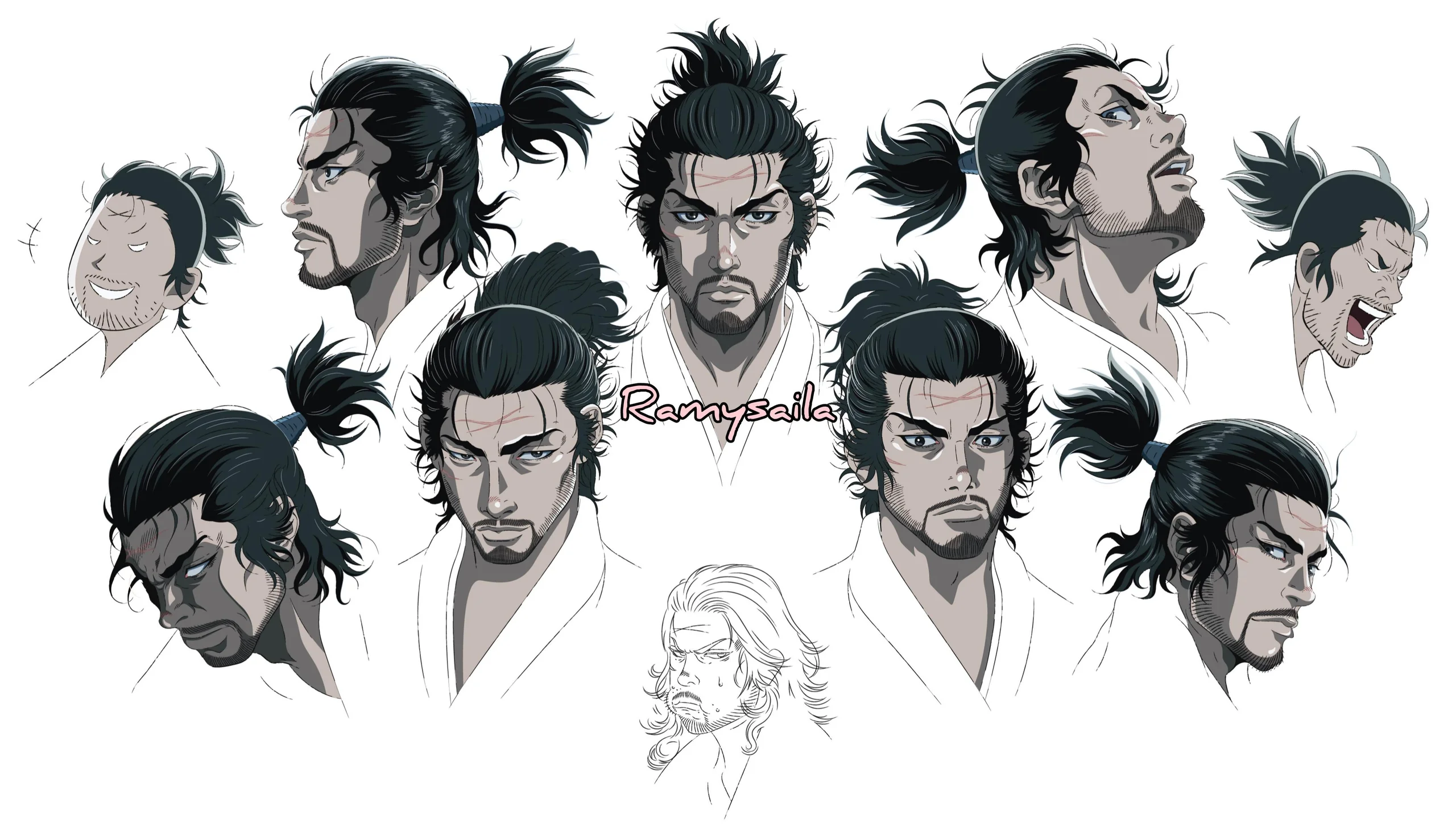
Overview
Origin Story
The character begins his journey as Shinmen Takezo, a feral youth born in the Mimasaka province during the late Sengoku period. He survives the Battle of Sekigahara in 1600 alongside his childhood friend Matahachi Honiden, only to be hunted down by authorities who mistake him for a bandit. After being captured and imprisoned, he meets the monk Takuan Soho, who convinces him to renounce his violent past and seek enlightenment through the sword.
Takuan grants him the name Miyamoto Musashi, marking the transition from a beast driven by survival instincts to a man seeking the Way. This new identity forces him to confront the weight of his kills while navigating a world that views him with suspicion. His early years are defined by a series of brutal duels against the Yoshioka school, where he learns that true strength requires more than just physical prowess.
Personality
Initially portrayed as wild and unrefined, Musashi evolves into a stoic figure who prioritizes self-mastery over personal gain. He possesses a deep capacity for introspection, often pausing mid-battle to analyze the flow of energy around him. His philosophy rejects the notion of killing for pleasure, instead viewing combat as a necessary path to understanding life and death.
Musashi struggles with the isolation his pursuit of invincibility demands. He frequently questions whether suppressing his humanity is the price of perfection or if true mastery requires embracing it. This internal conflict drives much of his character development throughout the narrative.
Story Arc
The narrative follows Musashi's transformation from a feral killer into a philosopher-samurai. Early encounters with the Yoshioka school establish his initial belief that victory requires total domination without hesitation. As he faces opponents like Sasaki Kojirō, his approach shifts from chaotic aggression to precise, economical movements.
A pivotal moment occurs when Musashi realizes that his quest for invincibility threatens to strip away his connection to the living world. He eventually accepts that the sword is not merely a tool for destruction but a means to understand the universe. The story concludes with him having achieved a state of spiritual clarity, though the cost of this achievement remains a subject of ongoing reflection.
Powers & Abilities
Niten Ichi-ryū (Two Heavens as One)
Dual-wielding katana
Sword intuition
Mental discipline
Adaptive fighting style
Equipment & Signature Items
Katana
Bokken
Oaken staff
Relationships
Sasaki Kojirō
RivalA master swordsman whose refined technique contrasts with Musashi's raw power.
Takuan Soho
MentorThe monk who guides Musashi away from nihilism toward spiritual growth.
Matahachi Honiden
FriendChildhood friend turned rival whose jealousy highlights Musashi's isolation.
Otsu
Love InterestA woman who represents the domestic life Musashi must choose between or reject.
Memorable Quotes
“Accept everything just the way it is.”
“Do not seek pleasure for its own sake.”
“Do not, under any circumstances, be swayed by your personal feelings.”
“The way of the warrior is the resolute acceptance of death.”
Portrayed By
Key Appearances
Vagabond
Onimusha: Way of the Sword
Baki-dou: The Invincible Samurai
Reception & Legacy
Vagabond is celebrated for its realistic depiction of feudal Japan and its deep exploration of the psychology of a warrior. The manga has influenced countless works in the industry, cementing Musashi as a symbol of the pursuit of perfection. Fans frequently analyze every panel for deeper philosophical meaning, making it one of the most discussed manga globally.
The character's portrayal has sparked debates about the nature of violence and spirituality in modern media. Critics praise the artistic detail and narrative depth, noting how the story elevates the historical figure into a universal archetype.
Interesting Facts and Legends
The manga Vagabond is based on Eiji Yoshikawa's novel Musashi, which itself draws from historical records.
Inoue took significant creative liberties with Musashi's early years, transforming the historical account into a visceral psychological origin story.
The character's popularity has led to numerous adaptations across film, anime, and video games since the manga began serialization in 1998.
Capcom released Onimusha: Way of the Sword in August 2026, featuring a darker iteration of Musashi exploring his resentment of power.
Netflix announced Baki-dou: The Invincible Samurai in late 2025, set to release in 2026 with Musashi as a key figure.
Frequently Asked Questions
Who is Musashi Miyamoto?
Does Musashi die in Vagabond?
Who plays Musashi in the Netflix anime?
Is Musashi a villain?
Who does Musashi end up with?
Keywords
Sources
Character Info
- First Appearance Date
- September 17, 1998
- Primary Medium
- Manga
- Real Life Birth
- c. 1584
- Real Life Death
- June 13, 1645
Join the community
fans discussing