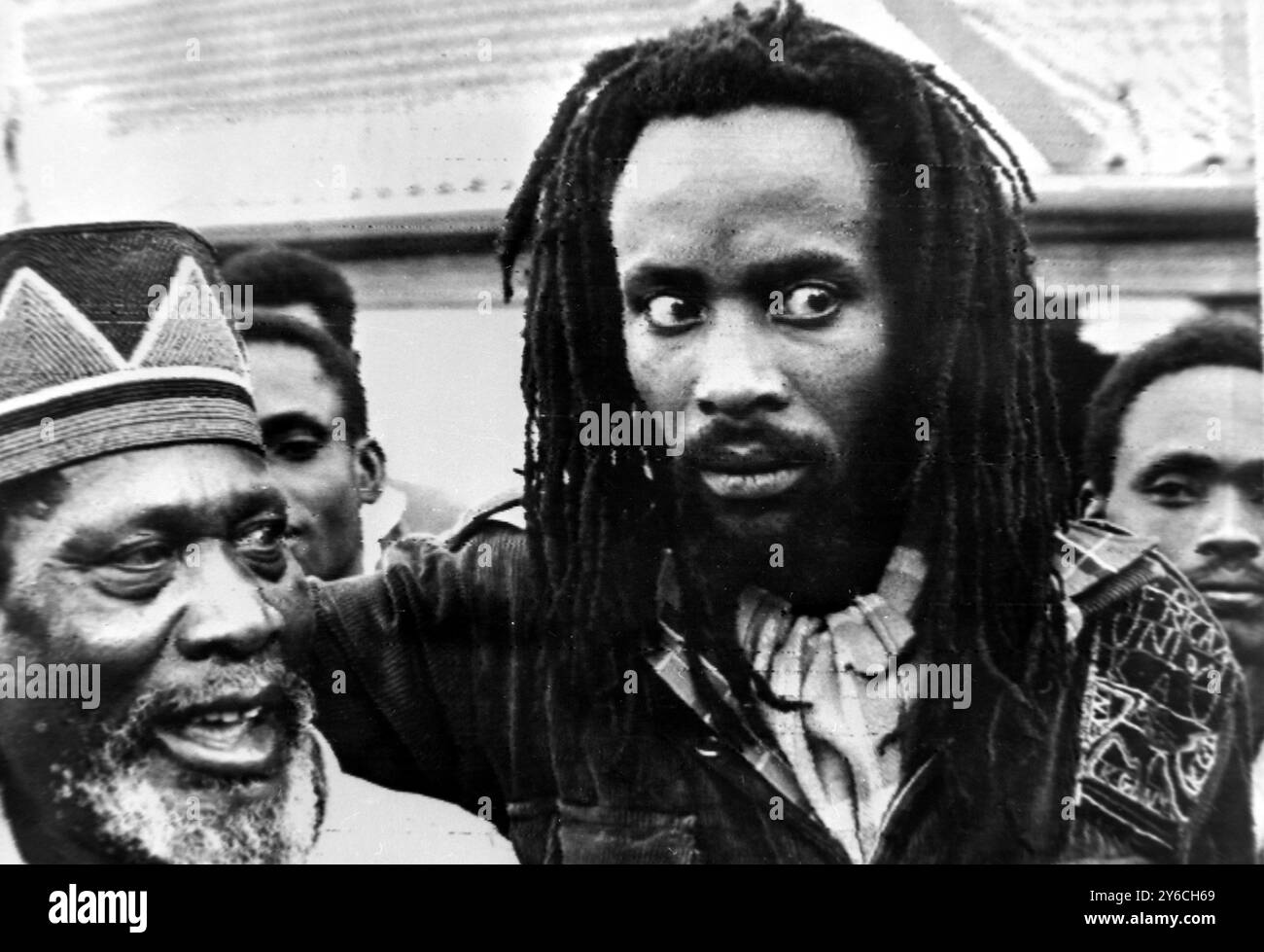
Musa Mwariama
 Kenya
KenyaMau Mau field marshal•freedom fighter
Also known as: Baringo M'Muchiri, M'Kirigua M'Muchiri, Field Marshal Musa Mwariama
Birthday
1928-01-01
Birth Sign
Capricorn
Birthplace
Muthara, Tigania, Meru County, Kenya
Age
Died at 65
About
Musa Mwariama was a Kenyan freedom fighter and the highest-ranking Mau Mau leader who survived the war without being captured or killed. Born in 1928 in Meru County, he commanded roughly 2,000 guerrilla fighters from bases in Mount Kenya and the Nyambene Hills, standing alongside Field Marshal Dedan Kimathi at the core of the movement's leadership. He was the senior leader of the Meru contingent of the uprising, coordinating ambushes and raids against British colonial forces.
After Kenya's independence in 1963, Mwariama was decorated with the Order of Elder of the Burning Spear (EBS) and later received the Head of State's Commendation (HSC) from President Daniel arap Moi in 1984. He is remembered through photographs with President Jomo Kenyatta at the moment of Uhuru and in post-war newsreels. He passed away on September 18, 1993, at the age of 65, leaving behind a legacy as a resilient and determined freedom fighter.
Early Life & Background
Musa Mwariama was born Baringo M'Muchiri in 1928 at Muthara in the Tigania division of Meru County, Kenya, then part of the British Empire's Colony and Protectorate of Kenya. His parents had migrated from Nkuene in South Imenti, and according to Ameru tradition, they gave him the name Baringo. Following his circumcision in 1942, and in line with Meru custom requiring a name change, he was renamed M'Kirigua M'Muchiri. His father, M'Muchiri, was a soothsayer and strict traditionalist, and Mwariama had an older half-brother named Romano Ntabathia from a different mother.
Before joining the Mau Mau movement, Mwariama worked as a security guard in Nairobi. It was during this time that he witnessed firsthand the injustices of British colonial rule against his fellow Kenyans, which stirred his anger and resolve. He took the Mau Mau oath, grew his hair long, and joined the liberation movement to fight for Kenya's freedom and land. The nickname "Mwariama," meaning "the one who speaks the truth," was given to him while with the Mau Mau, and he became known by that alias for the rest of his life.
Career Growth
Mwariama rose to become the highest-ranking Mau Mau leader who survived the war without being captured or killed. Together with Field Marshal Dedan Kimathi, they comprised the core Mau Mau leadership, with Mwariama serving as the highest-ranking leader among the Meru side of the uprising. By the time he left his bases in Mount Kenya and the Nyambene Hills on the equator, he commanded approximately 2,000 fighters who had survived Operation Anvil, though some sources suggest his battalion may have numbered as many as 5,000 men.
His responsibilities included planning and executing military operations against British colonial forces and their collaborators, including ambushes and raids, as well as mobilizing local communities in the Meru region to support the independence struggle. He advocated for the rights of the Meru people and defended their land and resources from colonial exploitation.
On the day Kenya became independent in December 1963, Mwariama and his men were received by President Jomo Kenyatta at Ruringu Stadium in Nyeri, where they laid down their arms. The most famous photograph of him shows him standing with President Kenyatta at the attainment of Uhuru. Post-war newsreels show him inspecting a Mau Mau guard of honour or alongside the president. After independence, he was decorated with the national Order of Elder of the Burning Spear (EBS) and settled at Kiambogo village in Timau, Meru County. In 1984, President Daniel arap Moi awarded him the Head of State's Commendation (HSC).
Career Timeline
Public Image & Style
Musa Mwariama is remembered as a resilient and determined freedom fighter who outwitted British colonial forces. He is often described in popular accounts as "the heart of a lion" and "one of the many forgotten sons of Meru and one of the main heroes." Media portrays him as one of Kenya's most respected yet often understated freedom fighters.
His leadership style was characterized by strategic acumen and organizational ability. Fans and historians alike recognize his role in the Mau Mau uprising, and his image is often associated with the famous photograph of him standing alongside President Jomo Kenyatta at independence. In recent years, cultural commemorations, such as a massive portrait by artist Ndeithi Kariuki and a poster collection titled "Mau Mau Field Marshals," have sought to honor his legacy.
Fame & Fandom
Musa Mwariama remains a towering figure in Kenyan history, revered as the highest-ranking Mau Mau leader to survive the colonial war without capture. While his legacy commands deep respect within Meru and among historians of the independence struggle, he does not currently hold a placement in the published Global Top 1,000 rankings or any Top-100 scope list according to iFANN's latest evaluation. The fanbase has no formal name documented in current records; instead, reverence manifests through community memory, government tributes like road renamings, and advocacy for veterans' rights rather than organized modern fandom activities. His story is kept alive by descendants and those who study the anti-colonial movement, with no active social media campaigns or commercial fan rituals driving his profile today. Though often described as the heart of a lion for outwitting British forces for over a decade, his fame exists in the realm of historical necessity rather than contemporary pop culture metrics. The absence of a ranked position reflects his status as a national hero whose impact is measured in cultural memory rather than global search volume or media consumption signals. Even decades after his passing, the narrative of his survival and his tragic death by snake venom continues to resonate, ensuring he is remembered as a unique icon who bridged the gap between armed resistance and post-independence dignity.
Interesting Facts and Legends
Mwariama was known for his resilience and strategic acumen, often outwitting British colonial forces who hunted him for over a decade. He was the only Mau Mau leader from the Meru side to successfully evade British traps, earning him the description "the heart of a lion" in popular accounts. His death was paradoxical and tragic: for a man who survived bullets and deadly traps, he died from the effects of snake poison after sucking venom from the leg of a friend who had been bitten. He was buried at his home in Kiambogo, a short distance from the Ntrimiti Cave, the last base he operated from during the armed struggle. Post-independence, Mwariama was given a 15-acre piece of land in Timau, Meru, which was barren and located in a cold area on the slopes of Mount Kenya. This land was not a gift but a loan he was expected to repay to the government. Despite the humiliations he and fellow freedom fighters faced at the hands of local authorities, he still urged his army to remain peaceful. A famous anecdote recalls his meeting with Jomo Kenyatta, where his dreadlocks and stature commanded immediate respect even from the head of state. Fans also retell the story of how he was elevated to Field Marshal specifically after Dedan Kimathi's capture, marking him as the sole survivor of the top leadership tier.
Notable Quotes
“Despite the humiliations we faced, I urged my army to remain peaceful.”
“The EBS title meant nothing to me as it did nothing to my predicament.”
“We fought for our land and our freedom, and we would do it again.”
Family & Personal Life
Musa Mwariama married three times and had 22 children in total. His first marriage was to Cionabea M'Kirikua Mwariama in 1948, and the couple had three children. His second marriage was to Jacinta Kabika, also known as "General Nkobia," in 1963, with whom he had eleven children. His third marriage was to Salome Nyoroka, with whom he had nine children.
His father, M'Muchiri, was a soothsayer and strict traditionalist, and he had an older half-brother named Romano Ntabathia from a different mother. Mwariama's family life was deeply rooted in Meru traditions, including the customary name changes after circumcision. He settled at Kiambogo village in Timau, Meru County, where he lived with his family after the war.
Notable Connections
Dedan Kimathi was his fellow Field Marshal and core Mau Mau leadership partner. Jomo Kenyatta, the first President of Kenya, is famously photographed with Mwariama at independence in 1963. Daniel arap Moi, the second President, awarded him the HSC in 1984. David Njagi authored 'The Last Mau Mau Field Marshals' (1993), a key biographical source.
Relationships & Dating History
Musa Mwariama married three times. His first marriage was to Cionabea M'Kirikua Mwariama in 1948, and the couple had three children. His second marriage was to Jacinta Kabika, also known as "General Nkobia," in 1963, with whom he had eleven children. His third marriage was to Salome Nyoroka, with whom he had nine children. At the time of his death in 1993, he was married to all three wives, as polygamy was customary. His second wife, Jacinta Kabika, is listed as his spouse in official records.
- MarriedCionabea M'Kirikua Mwariama1948 - presentFirst wife, married in 1948; they had three children.
- MarriedJacinta Kabika1963 - presentCurrentSecond wife, known as 'General Nkobia'; they had eleven children.
- MarriedSalome NyorokaThird wife; they had nine children.
Death & Aftermath
Died
1993-09-18 (aged 65)
Death Place
Unknown
Cause of Death
Snake bite (unconfirmed anecdotal account)
Musa Mwariama spent his final years in relative obscurity, living in the poverty that often marked the later lives of Mau Mau commanders. An account circulating in Kenyan media described a tragic end where he contracted poison after attempting to suck venom from a friend's snake bite wound, though this story remains unconfirmed by medical or government records. The field marshal passed away in 1989 at the age of sixty-one, leaving behind a legacy as the highest-ranking leader who survived the war without capture. While specific details regarding vigils or immediate public mourning are absent from the historical record, his status as a revered legend endured alongside Dedan Kimathi among the people of Meru and Kenya.
Decades later, institutional respect for his service resurfaced when Meru Governor Peter Munya presented an official portrait of him in 2018, signaling a renewed effort to honor the freedom fighter. His widow and family members faced significant financial hardship and neglect in the years following his passing, with reports highlighting the abject poverty endured by the widows of top commanders. Despite the lack of immediate state support or detailed funeral accounts in available sources, his memory persists through social media tributes and documentaries.
Net Worth (Estate Value)
$1 Million
iFANN Editorial Team estimate
As a freedom fighter, Musa Mwariama did not accumulate significant personal wealth. After independence, he was given a 15-acre piece of land in Timau, Meru, which was barren and located in a cold area on the slopes of Mount Kenya. This land was not a gift but a loan he was expected to repay to the government. His estate, managed by his family, primarily consists of this land and personal effects. Per iFANN's editorial analysis, the estimated net worth of his estate is around $1 million as of 2026, reflecting the historical and cultural value of his legacy rather than liquid assets.
Awards Won (2)
Musa Mwariama received two national honors: the Order of Elder of the Burning Spear (EBS) after Kenya's independence in 1963, and the Head of State's Commendation (HSC) from President Daniel arap Moi in 1984.
1963 · National Honour
Role in the liberation struggle
1984 · National Honour
Continued service to the nation
Known For
Mau Mau Uprising
1952-1963 · Field Marshal
Keywords
Sources
Quick Facts
- Profession
- Mau Mau field marshal, freedom fighter
- Born
- 1928
- Birthplace
- Muthara, Tigania, Meru County, Kenya
- Died
- September 18, 1993
- Death Place
- Ukambani, Kenya
- Gender
- Male
- Birth Sign
- Capricorn
- Spouse
- Jacinta Kabika
- Children
- 22
Personal Details
- Full Name
- Baringo M'Muchiri
- Spouse
- Jacinta Kabika
- Children
- 22
Frequently Asked Questions
How did Musa Mwariama die?
How many wives and children did Musa Mwariama have?
What was Musa Mwariama's real name?
Where was Musa Mwariama buried?
What awards did Musa Mwariama receive?
Similar People
Join the community
fans discussing