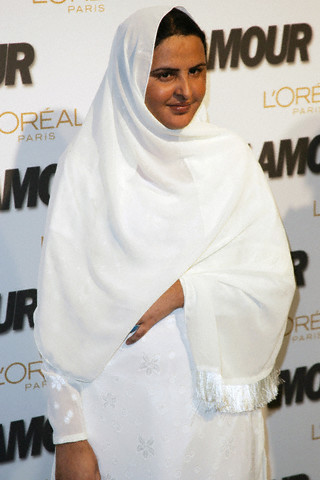
Mukhtaran Bibi
 Pakistan
women's rights activist•human rights defender•feminist
Birthday
+1972-01-01
Birth Sign
Capricorn
Birthplace
Meerwala
Age
54 years old
About
Mukhtaran Bibi, now widely known as Mukhtār Mā'ī, is a Pakistani human rights activist from the village of Meerwala in the rural tehsil of Jatoi, Muzaffargarh District, Punjab. Born around 1972, she grew up in a poor, landless family from the Tatla caste. Her life changed forever in June 2002, when a tribal council of the local Mastoi clan ordered her gang-rape as punishment for an alleged affair involving her younger brother. The council's ruling was a form of "honour revenge" in a dispute between the wealthier Mastoi Baloch clan and her own caste. Instead of succumbing to the shame that custom demanded, Mā'ī spoke out. She pursued legal action against her attackers, a decision that drew national and international media attention. On 1 September 2002, an anti-terrorism court sentenced six men, including the four rapists, to death. But in 2005, the Lahore High Court acquitted five of them, citing "insufficient evidence," and commuted the sixth man's sentence to life imprisonment. Mā'ī and the government appealed, and in April 2011, the Supreme Court reinstated the convictions of four men while confirming the acquittals of the others. Her legal battle continues to this day, a testament to her resilience. Despite constant threats to her safety, Mā'ī has become a powerful voice for women's rights in Pakistan and beyond. She founded the Mukhtar Mai Women's Welfare Organization, which provides education and support to women in rural areas. Her autobiography, translated into several languages, became a bestseller in France, and her story has inspired films and documentaries. In 2005, Glamour magazine named her Woman of the Year, and in 2007 she received the North-South Prize from the Council of Europe. Yet her activism has come at a cost. Former President Pervez Musharraf admitted to placing restrictions on her movement in 2005, fearing her international fame would tarnish Pakistan's image. Mā'ī has lived under constant threat, but she continues to advocate for justice and dignity for women everywhere.
Fame & Fandom
Mukhtaran Bibi commands a unique form of global attention that diverges sharply from the rituals of celebrity culture; her support base consists not of fans seeking entertainment, but of international human rights organizations, donors, and activists who rally around her cause rather than her persona. There is no formal collective name for this group, as the community identifies instead through shared advocacy for women's rights and survivors' issues, with influence channeled through institutional projects like the schools she founded in Meerwala rather than fan clubs or digital campaigns. Her narrative has inspired significant charitable action and media coverage, yet interactions remain confined to interviews, memoirs, and speeches at high-level forums where she addresses systemic violence. Despite her profound global recognition and inclusion in major lists of influential figures, iFANN's Global Fame Engine has evaluated this person, but they do not currently hold a placement in the published rankings (Global Top 1,000 or a Top-100 scope list).
Interesting Facts and Legends
Born around 1972 into a poor, landless family of the Tatla caste, Mukhtaran Bibi's life was irrevocably altered in 2002 when a tribal council ordered her gang-rape as retribution for an alleged affair involving her brother. Rather than succumbing to the shame demanded by custom, she pursued legal action, transforming a personal tragedy into a global symbol of defiance against honor-based violence. A defining moment occurred in November 2005 when Glamour magazine named her Woman of the Year, a title that sparked intense debate and brought her story to a mass Western audience while simultaneously highlighting the security threats she faced. In April 2011, after a nearly decade-long legal struggle, a Pakistani court finally freed all but one of the accused, cementing a legacy of persistence that spanned seventeen years. Later that year, on December 5, she gave birth to a daughter, an event widely retold as a legendary triumph over forces that sought to destroy her lineage. Beyond these events, her most enduring contribution remains the educational infrastructure she built using funds raised from her book, In the Name of Honor, which now serves hundreds of girls in her home village.
Awards & Accolades
Keywords
Quick Facts
- Profession
- women's rights activist, human rights defender, feminist
- Born
- +1972-01-01
- Birthplace
- Meerwala
- Gender
- Female
- Birth Sign
- Capricorn
Join the community
fans discussing