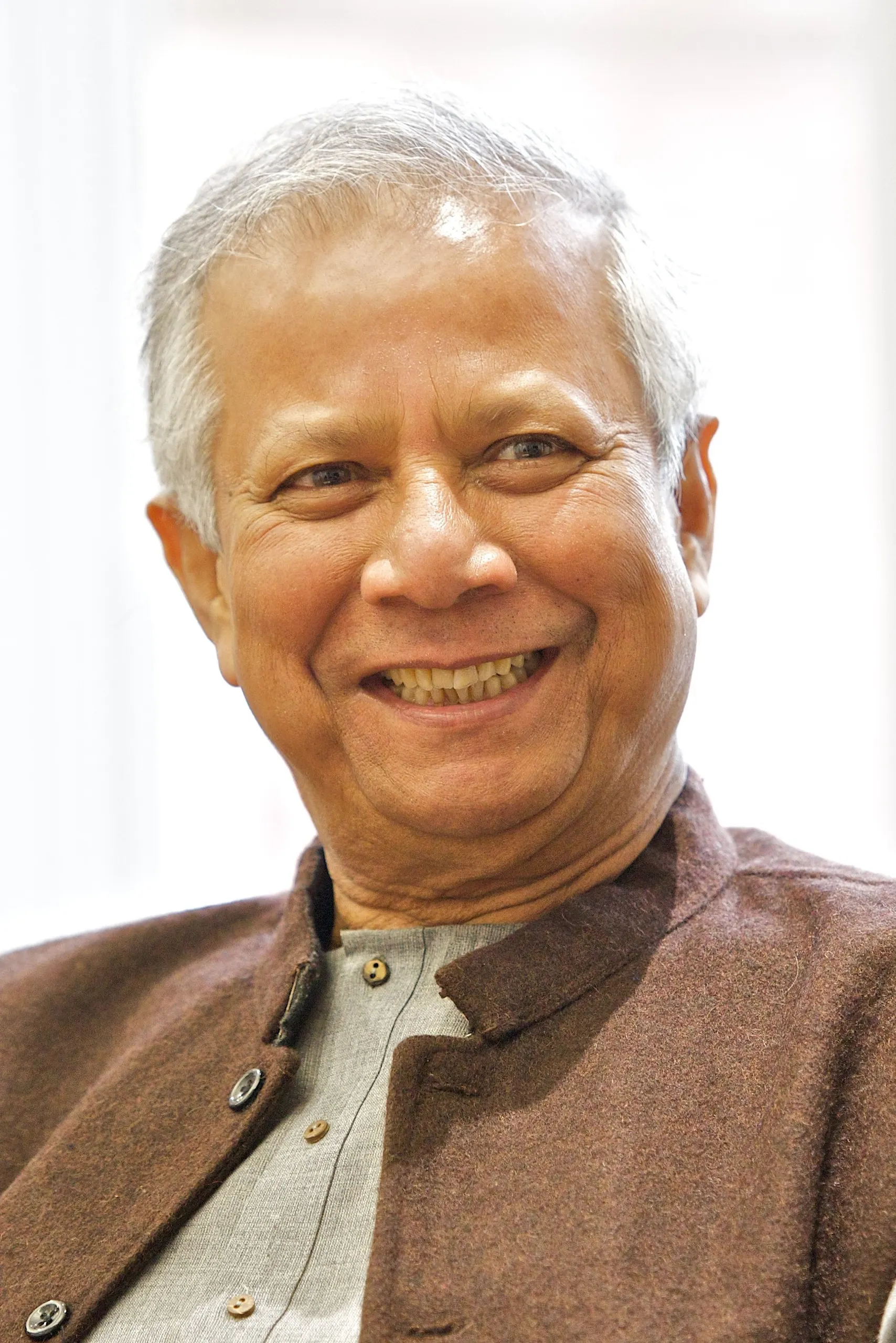
Muhammad Yunus
 Bangladesh
economist•entrepreneur•university teacher
Also known as: Professor Muhammad Yunus, Banker to the Poor, Father of Microcredit
Birthday
June 28, 1940
Birth Sign
Cancer
Birthplace
Bathua, Chittagong, Bengal Presidency, British Raj (now Bangladesh)
Age
86 years old
About
Muhammad Yunus is a Bangladeshi economist and social entrepreneur who pioneered the concept of microcredit and founded Grameen Bank, a model that has transformed poverty alleviation worldwide. He was awarded the Nobel Peace Prize in 2006, the first Bangladeshi to receive this honor. As of 2026, he serves as the 5th chief adviser of Bangladesh, heading the interim government.
Yunus's work has reached millions: Grameen Bank has lent billions of dollars to nearly 7 million clients, mostly women, and the model has been replicated in over 100 countries. He has also founded more than 50 companies in Bangladesh addressing various development issues, from telecommunications to healthcare.
Beyond banking, Yunus is a prolific author and advocate for social business, a concept he developed to address social problems through business models. His influence extends to academia, having served as Chancellor of Glasgow Caledonian University. Fans and followers see him as a tireless champion for the poor, a reputation built on decades of hands-on work rather than rhetoric.
Early Life & Background
Yunus was born in Bathua, a village in Chittagong, the third of nine children of Hazi Dula Mia Shoudagar, a jeweler, and Sufia Khatun. When he was four, the family moved to Chittagong city, where he attended Lamabazar Primary School. He showed early academic brilliance, ranking 16th out of 39,000 students in the matriculation exam from Chittagong Collegiate School.
As a Boy Scout, he traveled internationally, including to Canada for the 1955 World Scouts Jamboree. He studied at Chittagong College, then Dhaka University, earning a BA in 1960 and an MA in 1961. A Fulbright scholarship took him to Vanderbilt University in the US, where he completed a Ph.D. in economics in 1969. He taught at Middle Tennessee State University before returning to Bangladesh in 1972 to head the economics department at Chittagong University.
The turning point came in 1974 when a devastating famine swept Bangladesh. Witnessing the poor's inability to access credit, he began lending small amounts of his own money to villagers, particularly women making bamboo furniture. This experiment would become the seed of Grameen Bank.
Career Growth
The breakthrough came in 1983 when Yunus formally established Grameen Bank, a bank that provides small, collateral-free loans primarily to women, based on principles of mutual trust and group lending. The bank's success proved that the poor are creditworthy, and the model spread globally.
In 2006, Yunus and Grameen Bank received the Nobel Peace Prize, catapulting him onto the world stage. He received the U.S. Presidential Medal of Freedom in 2009 and the Congressional Gold Medal in 2010. He authored influential books like Banker to the Poor and Building Social Business, and in March 2012, Fortune named him one of the "12 greatest entrepreneurs of our time."
Following political upheaval in Bangladesh, Yunus was appointed as the 5th chief adviser of Bangladesh in 2024, heading the interim government. His administration has focused on constitutional reforms and preparing for the 2026 general election.
Career Timeline
Public Image & Style
Yunus is widely respected as a humanitarian and social innovator, often called the "father of microcredit" and "father of social business." His public persona is that of a humble academic with a relentless focus on poverty eradication. He is known for his simple lifestyle and his ability to connect with the poor. His work has inspired a global movement of social entrepreneurs, and he is regularly featured in international media as a thought leader on economic development.
Fame & Fandom
Supporters of Muhammad Yunus do not form a traditional fandom with chants, fan clubs, or chart-topping campaigns. He is an economist and statesman, not a pop star, so his followers are better described as beneficiaries, academic peers, and political constituents rather than adoring fans. There is no formal name for this global community; while some affiliates call themselves 'Grameenites,' that term signals membership in a development mission rather than celebrity worship. His influence flows through the Yunus Centre and Grameen Bank, where policy debates and economic models replace birthday billboards or subway ads. The public narrative around him has shifted from pure admiration to a complex mix of hope and scrutiny following his brief tenure as Chief Adviser of Bangladesh, which ended in early 2026 after eighteen months of intense political pressure and criticism regarding human rights and governance.
Despite the absence of a pop-culture fanbase, his standing in the global consciousness remains immense. Recent data confirms he holds specific high-ranking positions within the iFANN Global Fame Rankings. He is currently the 2nd most famous person from Bangladesh, a position he has held steady since the previous cycle. Within the professional sphere, he ranks as the 26th most famous person in Business & Finance. These placements reflect a worldwide attention span that tracks media coverage, search trends, and consumption patterns across diverse nations, cementing his status as a figure who transcends simple biography to become a defining force in modern economics and governance.
Interesting Facts and Legends
Yunus views credit as a fundamental human right, a belief that fuels his decades-long crusade against poverty. His journey began at Chittagong University, where he witnessed rural women trapped by loan sharks, leading directly to the creation of Grameen Bank in 1983. This institution pioneered modern microcredit, earning him the title 'Banker to the Poorest of the Poor' and eventually the Nobel Peace Prize in 2006, making him the first Bangladeshi to receive the honor. Beyond banking, he founded over 50 companies in Bangladesh, including Grameen Phone and Grameen Shakti, tackling issues from telecommunications to renewable energy. His reach extends to global stages, with appearances on The Oprah Winfrey Show and The Daily Show with Jon Stewart. In 2008, Prospect Magazine and Foreign Policy named him the second topmost public intellectual in the world. A defining chapter in his later life occurred when he stepped in as Chief Adviser of Bangladesh's interim government following student-led protests in August 2024. He served for approximately 18 months before resigning in February 2026 to return power to an elected government, marking a dramatic shift from social entrepreneur to head of state.
Notable Quotes
“Credit is a basic human right.”
“Poverty is not created by the poor people. Poverty is created by the system.”
“All human beings are born as entrepreneurs. Some get the chance to unleash that capacity, some never get it.”
Family & Personal Life
Yunus was born to Hazi Dula Mia Shoudagar, a jeweler, and Sufia Khatun, the third of nine children. He has been married twice. His first wife was Vera Forostenko, with whom he has a daughter, Monica Yunus; that marriage ended in divorce. He is currently married to Afrozi Yunus, a professor of physics. His family has been supportive of his work, though details of his household remain private.
Notable Connections
Relationships & Dating History
Yunus married Vera Forostenko, a Russian-American, while studying in the United States. The couple had a daughter, Monica Yunus, before divorcing. He later married Afrozi Yunus, a professor of physics, who has been his partner for decades. As of 2026, Yunus remains married to Afrozi, and the couple resides in Dhaka.
- DivorcedVera Forostenko1967 - 1975Met while Yunus was studying at Vanderbilt University; they had a daughter, Monica, before divorcing.
- MarriedAfrozi Yunus1976 - presentCurrentMarried for decades; Afrozi is a professor of physics.
Salary, Net Worth In 2026
$10 Million
iFANN Editorial Team estimate
Per iFANN's editorial analysis, Muhammad Yunus's net worth stands at $10 Million as of 2026. His financial standing stems from royalties generated by his bestselling books, speaking fees collected during global engagements, and his roles within academia and public service. Despite his massive global influence, Yunus has donated much of his prize money and earnings to Grameen Bank and various social causes, reflecting a commitment to social business rather than personal accumulation. His financial trajectory remains modest compared to his international impact. He has never been a billionaire, yet his work has generated significant economic value for millions of people. Even in his current capacity as chief adviser, which does not offer a large salary, he continues to receive income from book sales and speaking events.
Awards Won (160)
Yunus has received numerous international awards, including the Nobel Peace Prize (2006), the U.S. Presidential Medal of Freedom (2009), and the Congressional Gold Medal (2010). He was also honored with the World Food Prize (1994), the Independence Day Award (1987), and the Seoul Peace Prize (2006), among many others.
2006 · Peace
Grameen Bank
2009 · Civilian
Lifetime achievement
Known For
Grameen Bank
1983 · Founder
Microcredit
1976 · Pioneer
Nobel Peace Prize
2006 · Laureate
Keywords
Sources
Quick Facts
- Profession
- economist, entrepreneur, university teacher
- Born
- June 28, 1940
- Birthplace
- Bathua, Chittagong, Bengal Presidency, British Raj (now Bangladesh)
- Gender
- Male
- Spouse
- Afrozi Yunus
- Birth Sign
- Cancer
- Education
- Ph.D. in Economics, Vanderbilt University
- Awards
- Nobel Peace Prize (2006), Presidential Medal of Freedom (2009), Congressional Gold Medal (2010)
Personal Details
- Full Name
- Muhammad Yunus
- Spouse
- Afrozi Yunus
- Children
- Monica Yunus
- Education
- BA (1960) and MA (1961) from Dhaka University; Ph.D. in economics from Vanderbilt University (1969)
Frequently Asked Questions
Who is Muhammad Yunus?
What is Muhammad Yunus's net worth?
What is microcredit?
Why did Muhammad Yunus win the Nobel Peace Prize?
Is Muhammad Yunus still active in 2026?
Join the community
fans discussing