 Turkey
“A compelling take on big city alienation set against the backdrop of Turkey's economic recession, filmed with a painter's eye for wintry light.”
Channel 4
Channel 4
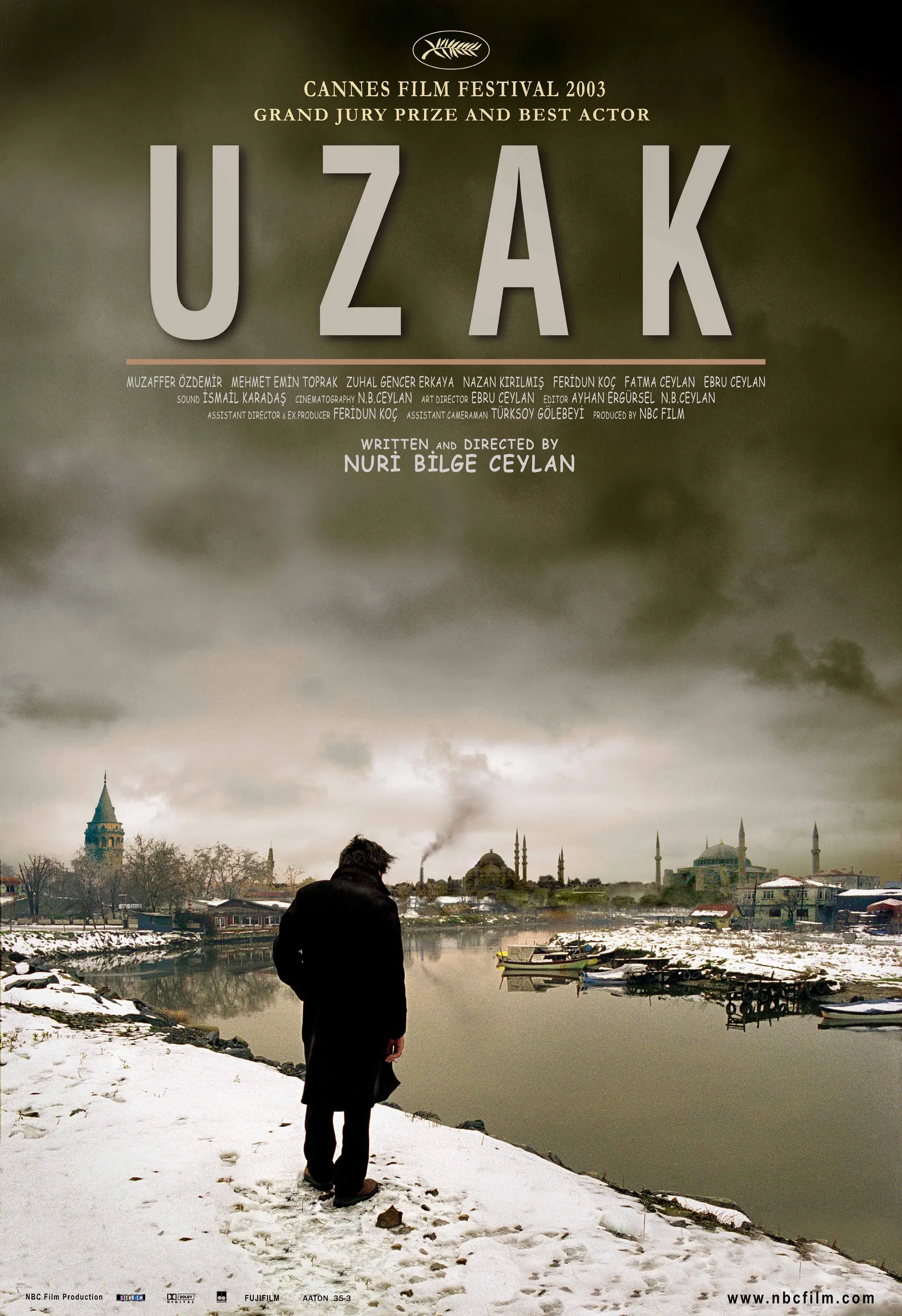
Nuri Bilge Ceylan's Uzak (released in English as Distant) is a 2002 Turkish drama that quietly dismantles the idea that sharing a roof means sharing a life. Set in a wintry, recession-hit Istanbul, it follows two cousins: Mahmut, a middle-aged commercial photographer who has traded his artistic ambitions for advertising work, and Yusuf, a younger man from the provinces who arrives with nowhere else to go. The film observes their uneasy cohabitation with long takes, sparse dialogue and a camera that seems to hold its breath.
Ceylan wrote the screenplay with Cemil Kavukçu, produced the film himself, served as cinematographer and co-editor, and shot on location in Istanbul. The result is a deeply personal work that critics have called his most autobiographical, drawing on his own reckonings with photography, compromise and emotional isolation. It won the Grand Prix and the Best Actor prize at the 2003 Cannes Film Festival, where Muzaffer Özdemir and Mehmet Emin Toprak became the first pair to share the acting award.
More than two decades on, Uzak remains a touchstone of Turkish cinema and a key early entry in Ceylan's filmography, the one that announced the patient, contemplative style he would refine in Climates, Three Monkeys and Winter Sleep. It is a film about the distance between people who should be close, and it earns every minute of its quiet.
Stream
Availability and pricing can change. Confirm on the provider's site before purchasing.
Mahmut is a photographer in his forties who lives alone in a small Istanbul apartment. He makes a decent living shooting commercial work, but he once wanted to be an art photographer, and that ambition has curdled into a low-grade resentment he carries everywhere. His days are a loop of cigarettes, television, takeout food and the occasional awkward encounter with a woman he sees without much conviction. The city outside is grey and cold, and Mahmut moves through it as if he is already elsewhere.
Then his cousin Yusuf shows up. Yusuf comes from a provincial town where he has just lost his job at a factory. He arrives in Istanbul with a bag, a vague plan to find work on a ship, and the assumption that his older cousin will help him. Mahmut does not say no. He lets Yusuf sleep on the couch, lends him a coat, and immediately begins to regret it. The apartment is too small for two men who have nothing to say to each other.
Yusuf is restless in a way that grates on Mahmut's need for routine. He wanders the streets, rides the ferries, stares at the water. He tries to talk to women and fails. He asks Mahmut for advice and gets silence or a shrug. Mahmut, for his part, retreats further into himself, taking longer cigarette breaks, watching television with the volume up, avoiding the conversations Yusuf keeps trying to start. The two men orbit each other in the cramped rooms, and the film watches them with a patience that is almost uncomfortable.
Ceylan builds the story out of small moments: a meal eaten in silence, a missed phone call, a walk through a snowy street that goes nowhere in particular. There is no plot engine here, only the slow accumulation of friction and the sense that both men are waiting for something that will not arrive. Yusuf's search for work goes nowhere. Mahmut's attempts to reconnect with his ex-wife go nowhere either. The city offers no escape for either of them.
What emerges is a portrait of two kinds of loneliness. Yusuf is lonely because he is young, displaced and unknown. Mahmut is lonely because he has built a life that keeps everyone at arm's length, and he no longer knows how to undo it. The film's title refers to the distance between them, but also to the distance Mahmut feels from his own past and from the person he thought he would become. The synopsis stops here, before the film's final movement, which turns that distance into something you can see.
Critical Consensus
Critics praised Uzak as a quietly devastating study of isolation, anchored by two restrained performances and Ceylan's patient, long-take compositions. Some found its pace too slow, but most agreed that its austere style rewards attention with emotional precision, making it a standout of early 2000s world cinema.
“A compelling take on big city alienation set against the backdrop of Turkey's economic recession, filmed with a painter's eye for wintry light.”
Channel 4
Channel 4
“Ceylan's most autobiographical film, a tale of loneliness that turns the distance between two cousins into a meditation on the distance inside us all.”
The Week
The Week
“Uzak is a film of extraordinary restraint, its silences louder than most dialogue. It asks for patience and gives back a profound sense of recognition.”
High on Films
High on Films
“A landmark of Turkish cinema, Uzak confirmed Ceylan as a major voice, its wintry Istanbul as much a character as the two men at its center.”
MUBI
MUBI
“The film's long takes and sparse dialogue create a nearly unbearable tension, a sense of lives stalled and connections missed.”
Trigon-Film
Trigon-Film
Muzaffer Özdemir
Mahmut
Mehmet Emin Toprak
Yusuf
Zuhal Gencer
Nazan
Nazan Kırılmış
The woman
Ebru Ceylan
The woman at the airport
Feridun Koç
The waiter
Director
Nuri Bilge Ceylan
Writers
Nuri Bilge Ceylan, Cemil Kavukçu
Cinematographer
Nuri Bilge Ceylan
Producer
Nuri Bilge Ceylan
Cannes Film Festival (2003)
Grand Prix: Won
Cannes Film Festival (2003)
Best Actor (shared by Muzaffer Özdemir and Mehmet Emin Toprak): Won
Join the community
fans discussing