 Italy
Italy“The film is not merely a masterpiece of Italian neorealism; it is perhaps the purest, least compromised example of the movement's ideals. De Sica and Zavattini achieved something close to a miracle.”
Roger Ebert
rogerebert.com
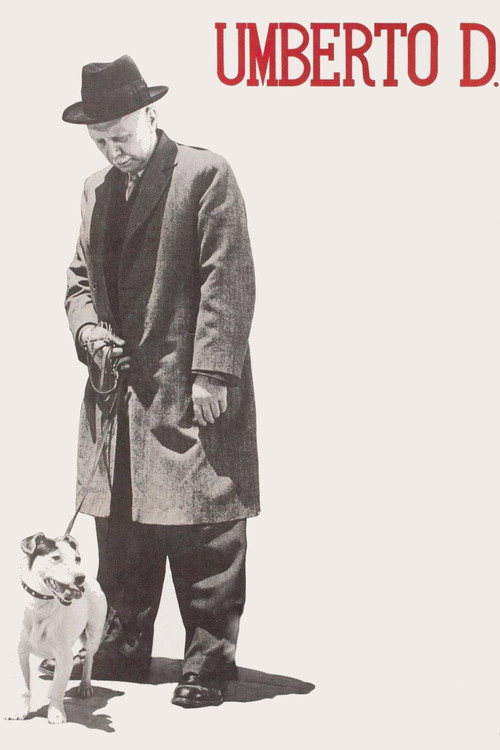
Vittorio De Sica's Umberto D. (1952) is a landmark of Italian neorealism, following an elderly pensioner's struggle to maintain dignity in postwar Rome. Umberto Domenico Ferrari, played by non-professional actor Carlo Battisti, a retired linguistics professor, faces eviction from his boarding house while caring for his small dog Flike. Shot on location with a minimal budget, the film achieves a documentary-like authenticity that remains deeply affecting. The score by Alessandro Cicognini is restrained, using a plaintive cello theme to underscore Umberto's loneliness. De Sica mortgaged his own house to complete the film when producer Angelo Rizzoli threatened to withdraw funding over its bleak tone.
The film's reputation has only grown since its Cannes premiere in 1952, where it polarized audiences. Some critics accused De Sica of excessive sentimentality, while others, notably Andre Bazin, defended it as the purest expression of neorealism. The Italian government initially demanded cuts, objecting to the portrayal of official indifference toward the elderly, but De Sica refused. Over time, the film has been recognized as a masterpiece, ranking among the greatest films ever made in Sight & Sound polls. In 2012, the Italian Ministry of Cultural Heritage designated it a national treasure.
Beyond its critical acclaim, the film has influenced generations of filmmakers, from the French New Wave to contemporary directors like Michael Haneke. The performance of Napoleone the dog, a stray found on Roman streets, is often cited as one of cinema's finest canine performances. The final sequence of Umberto and Flike playing in a park has been called the most perfect ending in Italian cinema by critic Paolo Mereghetti.
Stream
Free with ads
Availability and pricing can change. Confirm on the provider's site before purchasing.
Umberto Domenico Ferrari, a retired civil servant in his seventies, lives in a modest boarding house in Rome. The film opens with a protest march of elderly pensioners demanding higher government stipends, but the demonstration is broken up by police. Umberto returns to his boarding house, where his landlady Antonia Belloni has become increasingly hostile, demanding 15,000 lire in back rent and threatening eviction. His only comforts are his small dog Flike and the kindness of Maria, the pregnant young maid who works in the boarding house. Maria is exploited by the landlady and abandoned by her soldier boyfriend, creating a parallel story of vulnerability.
Umberto sells his books and personal belongings piece by piece, but can barely scrape together enough money. He pawns his watch, his sheets, and even his beloved books, yet the debt grows more insurmountable. He fakes a tonsil infection to be admitted to a hospital, where he receives free food and shelter, but is soon discharged. Upon returning, he finds his room has been rented to another woman, and his belongings have been moved to a smaller, cramped space. Flike has been given away by the landlady, forcing Umberto to search the city's dog pound to retrieve him.
The film's middle section follows Umberto's daily rituals: he counts his remaining coins, skips meals, and wanders Rome's streets with Flike. He visits former colleagues who offer empty sympathy but no real help. A pivotal moment occurs when Umberto considers giving Flike away to a family with children, believing he can no longer care for the dog, but the attempt fails when Flike refuses to stay. The story builds toward Umberto's growing realization that his pension is insufficient to survive and that society has no place for the elderly poor. The film stops short of revealing whether Umberto finds a solution or succumbs to despair.
Umberto D. (1952) ORIGINAL TRAILER
Critical Consensus
Umberto D. is widely regarded as the pinnacle of Italian neorealism, a devastatingly honest portrait of old age and poverty in postwar Italy that achieves profound emotional impact through its documentary-like simplicity and Battisti's remarkable non-professional performance.
“The film is not merely a masterpiece of Italian neorealism; it is perhaps the purest, least compromised example of the movement's ideals. De Sica and Zavattini achieved something close to a miracle.”
Roger Ebert
rogerebert.com
“De Sica's camera observes with such compassion and precision that the film becomes a kind of prayer for the dispossessed. Battisti's face, lined with a lifetime of disappointments, tells the story more eloquently than any dialogue.”
Bosley Crowther
The New York Times
“Umberto D. represents the fullest realization of neorealism's ambition to turn cinema into a tool for social conscience. It is a film that breaks your heart and refuses to offer easy comfort.”
André Bazin
Cahiers du Cinéma
“The final sequence between Umberto and his dog is one of the most moving in all of cinema, not because it resolves anything, but because it refuses to. De Sica understands that dignity sometimes means simply going on.”
Pauline Kael
The New Yorker
“Alessandro Cicognini's score is a model of restraint, punctuating the action with delicate, melancholic themes that never overwhelm the naturalistic performances. This is filmmaking as empathy.”
David Thomson
Biographical Dictionary of Film
Carlo Battisti
Umberto Domenico Ferrari
Napoleone the Dog
Flike
Maria Pia Casilio
Maria
Lina Gennari
Antonia Belloni
Elena Rea
The Nun at the Hospital
Memmo Carotenuto
The Patient at the Hospital
Ileana Simova
The Woman in Umberto's Room
Lamberto Maggiorani
Pasquale Campagnola
Riccardo Ferri
Alberto Albani Barbieri
Antonia's Friend
De Silva
Battistini
Director
Vittorio De Sica
Writer
Cesare Zavattini
Composer
Alessandro Cicognini
Cinematographer
G.R. Aldo
Producers
Giuseppe Amato, Angelo Rizzoli, Vittorio De Sica
Cannes Film Festival (1952)
Grand Prize: Nominated
National Board of Review (1956)
Top Foreign Films: Won
New York Film Critics Circle Awards (1957)
Best Foreign Language Film: Nominated
Kinema Junpo Awards (1958)
Best Foreign Language Film: Won
Italian National Syndicate of Film Journalists (1955)
Best Original Story: Won
Bodil Awards (1957)
Best European Film: Won
Join the community
fans discussing